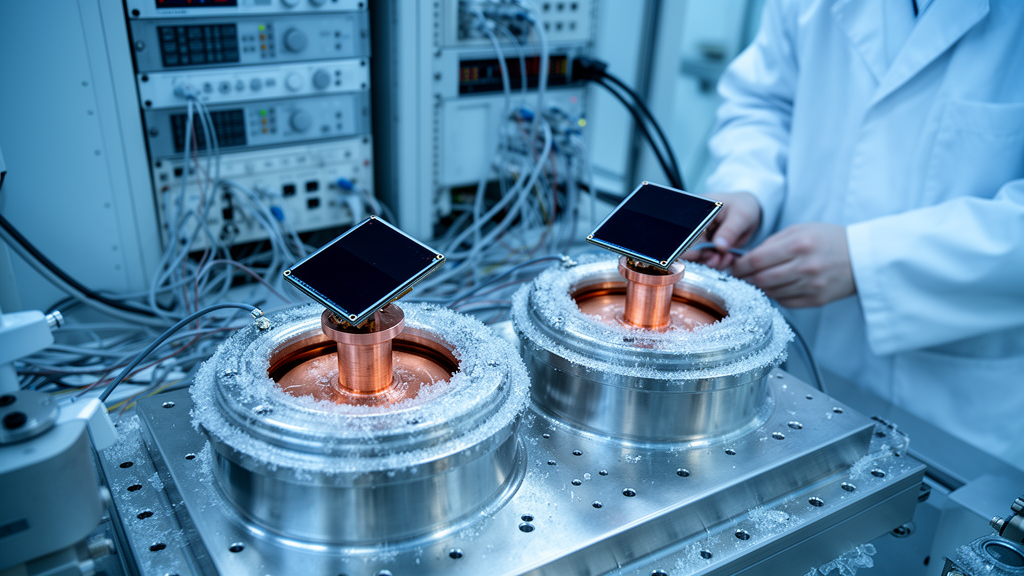
Deep inside every infrared camera, telescope, and missile seeker sits a detector that must count individual photons against a tide of its own internal noise. That tide is the dark current — the electrical leakage that flows through a photodetector even when no light strikes it at all. It is the single most important figure of merit for an infrared focal plane array, because it sets the signal-to-noise ratio and the faintest radiant power the instrument can detect. Now a team of Chinese researchers has shown that the two standard ways of measuring this critical quantity can disagree by enormous margins, and that the disagreement depends dramatically on how cold the detector is. The findings, published in Frontiers in Materials, could change how engineers screen and certify infrared detector chips worldwide.
The study, led by Sanjie Liu and colleagues at the Hunan Institute of Science and Technology in Yueyang, focused on mid-wave infrared focal plane arrays built from an InAs/GaSb type-II superlattice — a material system prized for third-generation detectors that can operate at relatively high temperatures. Each chip carried 640 by 512 pixels on a 15-micrometer pitch, sensitive across roughly 3.7 to 4.9 micrometers of the infrared spectrum. The researchers paired measurements of 24 detector chips at two cryogenic temperatures, 120 kelvin and 150 kelvin, using two fundamentally different measurement philosophies: the blind cold shield method and the theoretical coefficient method. A third temperature, 140 kelvin, was measured on a subset of chips for descriptive comparison only.
The blind cold shield, or BCS, method is the hardware purist’s approach. Engineers physically replace the detector’s standard cold shield with a blind one held at the same temperature as the detector itself, creating an approximately zero-field-of-view condition. With almost no background radiation reaching the pixels, whatever signal remains is attributed to dark current. The team used a fixed 4-degree field of view configuration, allowed the detector to reach thermal equilibrium, waited an additional ten minutes for stabilization, and then calculated dark current by measuring output voltage at different integration times. It is direct, physical, and conceptually simple — but it requires opening up the cryogenic hardware.
The theoretical coefficient, or TC, method takes the opposite route. Instead of reconfiguring hardware, it extracts dark current indirectly from ordinary variable-temperature blackbody response measurements. The detector views a blackbody source at two temperatures — 20 and 35 degrees Celsius in this experiment, with emissivity of 99.8 percent — and the change in output signal between the two illumination conditions is separated from the dark-current-related component using a coefficient derived from Planck’s radiation law. The method rests on three approximations: that the effective quantum efficiency stays roughly constant between the two blackbody conditions, that the detector and readout circuit remain within their linear operating regime, and that the intrinsic dark current itself does not change during the paired measurements. Because it needs no hardware replacement, the TC method promises rapid, non-invasive characterization — a tempting advantage for production lines.
What the paired comparison revealed was striking. At 120 kelvin, 17 of the 24 chips — 70.8 percent — showed TC dark-current values more than 20 percent below the BCS baseline, while only a single chip fell within the ±20 percent engineering consistency window. The mean absolute relative deviation between the two methods stood at a staggering 74.9 percent. But at 150 kelvin the picture transformed: the proportion of chips with TC underestimation exceeding 20 percent collapsed to 29.2 percent, half of all chips landed inside the ±20 percent window, and the mean absolute relative deviation fell to 42.1 percent. A two-sided Wilcoxon signed-rank test on the paired data confirmed the reduction was statistically significant, with p = 3.22 × 10⁻⁴.
Perhaps the most vivid way to see the temperature effect is through the geometric mean ratio of TC to BCS values. At 120 kelvin, that ratio was approximately 0.40 — meaning the TC method, on average, returned less than half the dark current the BCS method did. At 150 kelvin, the ratio climbed to approximately 0.92, close to unity. For a representative chip, the discrepancy was even more dramatic: at 120 kelvin the BCS method yielded 4.30 × 10⁻⁶ amperes per square centimeter while the TC method gave 3.05 × 10⁻⁷ — a relative deviation of 92.9 percent. Even at 150 kelvin, that chip still showed a 64.6 percent relative deviation, a reminder that individual chips can behave very differently from the statistical trend.
Bland–Altman analysis, a statistical technique borrowed from medical research for assessing agreement between two measurement methods, added a crucial layer of nuance. The mean TC–BCS difference remained negative at both temperatures — the TC method systematically returned lower values — but the 95 percent limits of agreement were broad and actually grew wider at 150 kelvin, spanning roughly −1.48 × 10⁻⁵ to 1.17 × 10⁻⁵ amperes per square centimeter. In other words, while the proportional relationship between the two methods improved with temperature, the absolute chip-to-chip variability persisted and did not shrink. The authors emphasize that the two methods therefore cannot be regarded as fully interchangeable on an absolute-value basis, even where their relative consistency improves.
Why does the discrepancy balloon at the coldest temperatures? The answer plausibly lies in the physics of dark current itself, which is not a single phenomenon but a family of leakage mechanisms: diffusion current, generation-recombination current, direct tunneling, trap-assisted tunneling, and surface leakage. Their relative contributions depend on temperature, electric field, doping profile, junction structure, and defects — and the temperature at which any one mechanism becomes dominant is detector-specific rather than governed by a universal threshold. At 120 kelvin, thermally activated contributions are strongly suppressed, so weakly temperature-dependent tunneling mechanisms may claim a larger fraction of the total dark current. That, in turn, undermines the simplified temperature-dependent assumptions underlying the TC method’s theoretical coefficient.
At the same time, the BCS method carries its own vulnerabilities in the cryogenic regime. Residual thermal radiation from the cold shield, Dewar window, and other optical components may contaminate the measured signal precisely when the intrinsic dark-current signal becomes small — introducing a positive bias into the BCS-derived value. These two error sources may act in opposite directions, jointly inflating the inter-method discrepancy at low temperature. The authors are careful to note that their experiment did not independently quantify each dark-current component or the absolute error of either method, so the relative contribution of each error source cannot be uniquely determined from the current dataset. The BCS result is treated as a reference baseline, not an error-free ground truth.
The practical implications reach across the infrared detector industry, where dark current governs detector screening, process assessment, and operating-condition optimization. The TC method’s speed and non-invasiveness make it attractive for rapid engineering characterization, but this study shows its reliability is temperature- and configuration-dependent — the conclusions apply strictly to the investigated 120 to 150 kelvin range and cannot be extrapolated to 77 kelvin or room temperature without further measurements. The authors stress that their results support no universal rule such as
Subject of Research: Temperature dependence and consistency of dark current measurement methods for infrared focal plane arrays
Article Title: Temperature dependence and consistency of dark current measurement methods for infrared focal plane arrays
Article References: Feng, R., Long, J., Li, X., Cao, Y., Zeng, Z., Deng, Z., Liang, Z., Liu, Y., Li, B., & Liu, S. (2026). Temperature dependence and consistency of dark current measurement methods for infrared focal plane arrays. Frontiers in Materials, 13, Article 1950579. https://doi.org/10.3389/fmats.2026.1950579
Image Credits: AI Generated
DOI: 10.3389/fmats.2026.1950579
Keywords: infrared detectors, dark current, focal plane arrays, measurement methods, cryogenics, type-II superlattice, detector characterization, Temperature, dependence, consistency, dark, current
Cite Scienmag News
Denise Maddox. (October 17, 2026). Two Ways to Measure Dark Current Diverge Sharply in Cryogenic Infrared Detectors. Scienmag. https://scienmag.com/two-ways-to-measure-dark-current-diverge-sharply-in-cryogenic-infrared-detectors/
Denise Maddox. "Two Ways to Measure Dark Current Diverge Sharply in Cryogenic Infrared Detectors." Scienmag, 17 October 2026, https://scienmag.com/two-ways-to-measure-dark-current-diverge-sharply-in-cryogenic-infrared-detectors/. Accessed 17 October 2026.
Denise Maddox. "Two Ways to Measure Dark Current Diverge Sharply in Cryogenic Infrared Detectors." Scienmag. October 17, 2026. https://scienmag.com/two-ways-to-measure-dark-current-diverge-sharply-in-cryogenic-infrared-detectors/