


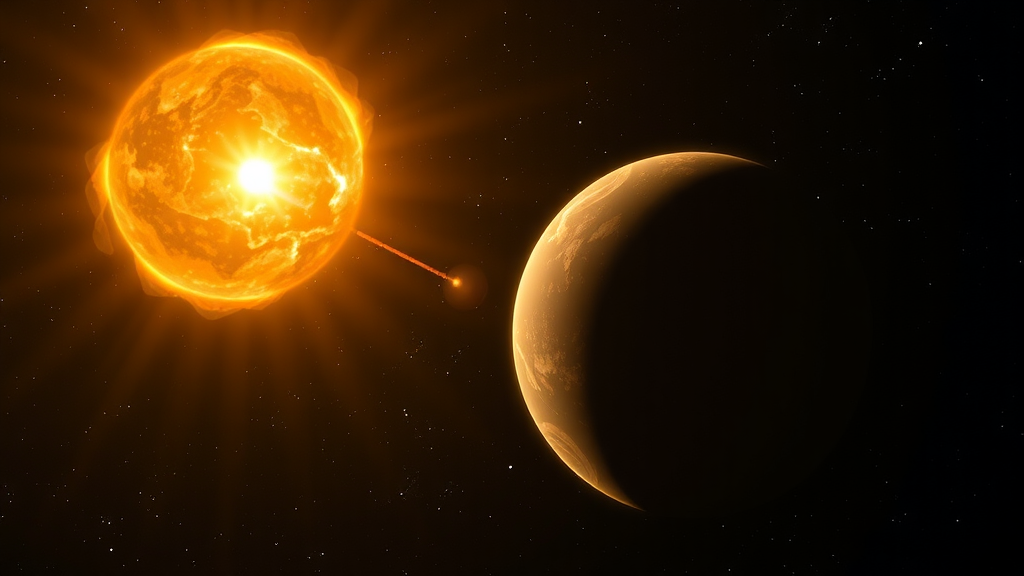
Astronomers have captured, for the first time in such detail, the orbital motion of a pair of infant massive stars locked in a surprisingly lopsided embrace. The protobinary system, known as IRAS 07299−1651, sits some 3,500 light-years away in a giant star-forming region, and a new study published in Nature Astronomy reveals that its two young stellar components are tracing an orbit so elongated that it is nearly parabolic — a trajectory more reminiscent of a passing comet than a settled stellar couple. The finding challenges long-standing assumptions about how massive binary stars are assembled in their earliest phases and points instead to a dramatic ‘core-merger’ scenario in which two independently forming stars recently collided, gravitationally speaking, for the very first time.
Most massive stars in the universe are not loners. Decades of surveys of massive main-sequence stars have shown that the overwhelming majority are found in binary or higher-order multiple systems, and that these partnerships profoundly shape how the stars live and die. Binaries strip each other’s outer layers, exchange mass, spin each other up and, in the most violent cases, merge — producing some of the most energetic events in astronomy, including gravitational-wave sources detected by observatories such as LIGO and Virgo. Yet despite their ubiquity, the question of how massive binaries form in the first place has remained one of the most stubborn puzzles in star formation research.
Three main pathways have been proposed. In the disk fragmentation scenario, a single massive protostar surrounded by a massive accretion disk becomes gravitationally unstable, and the disk breaks apart to form a companion. In core fragmentation, a single dense cloud core splits early on into two separate condensations that each collapse into a star while still bound together. The third possibility, stellar capture, involves two stars formed independently in the same crowded region that happen to pass close enough for their mutual gravity to bind them. Each scenario leaves a distinct fingerprint in the geometry and dynamics of the resulting binary, particularly in the eccentricity of the orbit and the alignment between the orbital plane and the disks of gas feeding the young stars.
The trouble has always been observation. Measuring the three-dimensional orbit of a binary system requires detecting the tiny apparent shift of one component relative to the other across multiple observing epochs — the orbital proper motion. For massive protostars, which are deeply embedded in dusty cocoons that block visible light and which orbit slowly because of their large masses and wide separations, this measurement demands exquisite angular resolution, sensitivity and patience. As a result, direct orbital reconstructions of massive binaries in their infancy have been essentially nonexistent, leaving theorists to argue over plausible scenarios without decisive observational constraints.
The team behind the new work, led by Yao Wang and Yichen Zhang of Shanghai Jiao Tong University together with an international collaboration, overcame this obstacle by combining years of high-resolution observations from several of the world’s most powerful telescopes. They used the Atacama Large Millimeter/submillimeter Array (ALMA) and the Jansky Very Large Array (JVLA) to image the system at wavelengths ranging from submillimetre to centimetre across multiple epochs, allowing them to track the relative positions of the two protostellar components with extraordinary precision. Complementary infrared imaging from the James Webb Space Telescope and the European Southern Observatory’s Very Large Telescope provided an additional view of the embedded pair and its surroundings, piercing the dust that hides the nursery.
The multi-epoch data revealed the unmistakable signature of orbital motion: the two components, separated by roughly 200 astronomical units — about 200 times the Earth–Sun distance — are visibly moving around each other. That detection opened the door to a full three-dimensional orbital reconstruction. But the team did not stop at astrometry. They also modeled the multi-wavelength continuum emission from each component to estimate the masses and the properties of the circumstellar disks, analyzed the kinematics of hydrogen recombination lines — spectral lines emitted by ionized gas close to each protostar that trace Keplerian motion — and examined radio jet observations that helped pin down the orientation of the disks relative to the orbit.
When all of these pieces were fitted together using Bayesian orbital modeling, a striking picture emerged. The preferred orbital solutions are highly eccentric, with the pair’s current trajectory lying close to a parabola — the razor’s edge between a bound elliptical orbit and an unbound hyperbolic escape. In other words, the two protostars appear to have been caught at the delicate moment when their first gravitational encounter is only barely holding them together. Even more tellingly, the circumstellar disks around both components are strongly misaligned with the orbital plane, tilted far from the flat configuration expected if the two stars had formed together from a single rotating structure.
Both properties — the near-parabolic eccentricity and the severe disk–orbit misalignment — are difficult to produce in the standard disk-fragmentation or core-fragmentation pictures, which tend to yield binaries on more circular orbits with disks broadly aligned with the orbital plane. Instead, they fall out naturally from the core-merger scenario. In this picture, the two protostars began their lives in separate, initially unbound cloud cores within the same star-forming region. As the cores drifted through the dense cluster environment, they converged on a near-parabolic encounter. During this close passage, dynamical friction and gravitational torques from their gas envelopes dissipated enough orbital energy to leave them barely bound, while the encounter itself scrambled the orientations of their disks, tilting them out of any common plane.
The idea that stellar encounters in young clusters can sculpt binary architectures is not new — astronomers have long studied how flybys perturb protoplanetary disks and how dynamics in cluster cores can harden or soften binaries. What makes this result remarkable is that it offers direct, quantitative evidence that such a process has operated on a massive protobinary caught in the act. IRAS 07299−1651, with its pair of massive twin disks and its razor-thin orbital binding, looks less like a binary that was born together and more like one that was assembled after the fact, stitched together by gravity during a single fateful pass. It is a snapshot of binary assembly in real time, preserved in the geometry of the system for observers to decode.
The implications ripple outward across stellar astrophysics. If core-merger encounters represent an important channel for forming eccentric massive binaries, then the population of massive binaries on eccentric orbits — including many of those that will eventually interact, exchange mass or merge — may owe their existence not to shared birth but to later dynamical matchmaking. This affects predictions for the rates of massive binary interactions, the formation of gravitational-wave progenitors and the statistics of stripped stars and X-ray binaries. More broadly, the study demonstrates that with multi-epoch, multi-wavelength observations and modern orbital fitting techniques, astronomers can now reconstruct the three-dimensional choreography of forming massive star systems, turning what was once pure theory into a measurable, evolving picture. The team has also released the reduced ALMA and JVLA continuum images and hydrogen recombination line data cubes through the Zenodo repository, ensuring that other researchers can scrutinize and build upon this rare glimpse of two young giants caught mid-encounter, their futures still hanging on a gravitational knife’s edge.
Subject of Research: The three-dimensional orbital architecture and core-merger formation pathway of the massive protobinary IRAS 07299−1651.
Article Title: An eccentric massive protobinary assembled via a core-merger parabolic encounter
Article References: Wang, Y., Zhang, Y., Fedriani, R., Tanaka, K. E. I., Rosero, V., Yang, K., Andersen, M., Beltrán, M. T., Bonfand, M., Cheng, Y., De Buizer, J. M., Di, Y., Garay, G., Gorai, P., Li, Z.-Y., Yang, Y.-L., & Tan, J. C. (2026). An eccentric massive protobinary assembled via a core-merger parabolic encounter. Nature Astronomy. https://doi.org/10.1038/s41550-026-02953-z
Image Credits: AI Generated
DOI: 10.1038/s41550-026-02953-z
Keywords: massive star formation, protobinary, orbital eccentricity, IRAS 07299−1651, ALMA, JVLA, core merger, disk misalignment, hydrogen recombination lines, protostellar disks, stellar dynamics, Nature Astronomy
Cite Scienmag News
Grant Pearson. (September 21, 2026). Two Baby Giant Stars Caught in a Cosmic Near Miss Reshape Ideas of How Massive Binaries Form. Scienmag. https://scienmag.com/two-baby-giant-stars-caught-in-a-cosmic-near-miss-reshape-ideas-of-how-massive-binaries-form/
Grant Pearson. "Two Baby Giant Stars Caught in a Cosmic Near Miss Reshape Ideas of How Massive Binaries Form." Scienmag, 21 September 2026, https://scienmag.com/two-baby-giant-stars-caught-in-a-cosmic-near-miss-reshape-ideas-of-how-massive-binaries-form/. Accessed 5 October 2026.
Grant Pearson. "Two Baby Giant Stars Caught in a Cosmic Near Miss Reshape Ideas of How Massive Binaries Form." Scienmag. September 21, 2026. https://scienmag.com/two-baby-giant-stars-caught-in-a-cosmic-near-miss-reshape-ideas-of-how-massive-binaries-form/


