


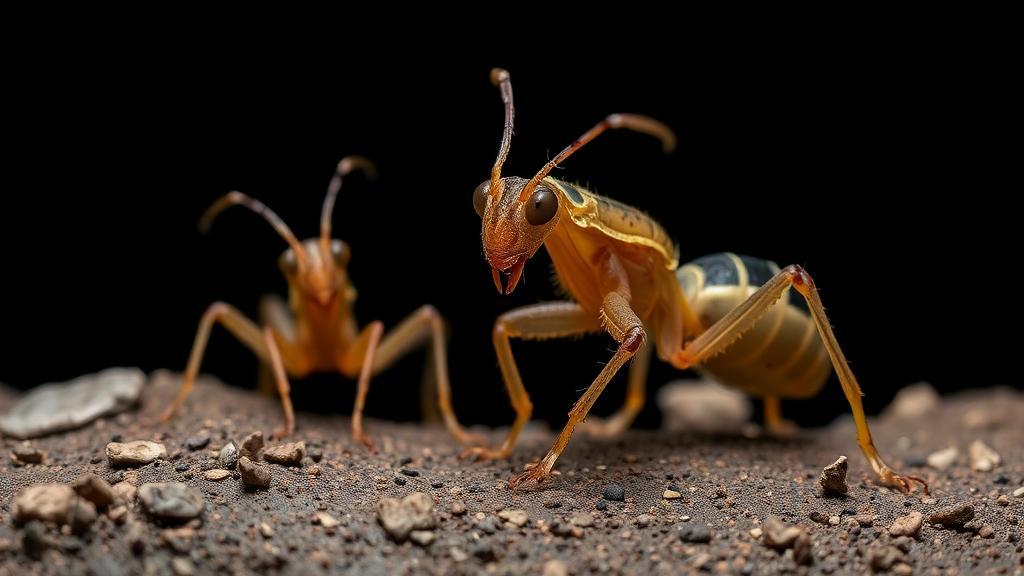
Deep in the coastal forests and rocky hills of Bigeumdo Island, off the southwestern coast of South Korea, two species of antlion have been quietly flying under the radar of science. A new study published in the Biodiversity Data Journal reports Pseudoformicaleo nubecula (Gerstaecker, 1885) and Paraglenurus okinawensis (Okamoto, 1910) from the Korean Peninsula for the first time, expanding the country’s known antlion fauna and prompting a full update to the identification key used to tell these insects apart.
Antlions, members of the family Myrmeleontidae, are the largest family in the order Neuroptera, a group of insects that also includes lacewings and owlflies. Roughly 2,100 antlion species are known worldwide, organized into four subfamilies: Ascalaphinae, Dendroleontinae, Myrmeleontinae, and Nemoleontinae. The subfamily Nemoleontinae is cosmopolitan, containing 66 genera and more than 670 species distributed across four tribes: Glenurini, Megistopini, Nemoleontini, and Protoplectrini. Despite this global diversity, the Korean Peninsula had previously yielded only six recorded Nemoleontinae species, a number that now rises to eight with the two new records.
The genus Pseudoformicaleo, established by van der Weele in 1909, belongs to the tribe Nemoleontini and comprises eight species spread widely across the Old World, from Africa and the Middle East through Asia to Australia. Before this study, no member of the genus had ever been documented on the Korean Peninsula. The newly reported species, Pseudoformicaleo nubecula, was originally described as Creagris nubecula by Gerstaecker in 1885 from a type locality in Rockhampton, Australia, and has since accumulated a long list of synonyms reflecting its broad distribution and morphological variability, including names such as Pseudoformicaleo jacobsoni, Creagris matsuokae, Protoplectron costatus, Tahulus caligatus, Creagris horikawae, and Exiliunguleon nanus.
The second new record, Paraglenurus okinawensis, belongs to the tribe Megistopini, a placement refined by Zheng and colleagues in 2025 after the genus was originally classified under Nemoleontini. The genus Paraglenurus contains 13 species distributed across Asia, including China, Indonesia, Japan, North Korea, South Korea, and the Russian Far East, as well as the African islands of Madagascar and the Seychelles. Three Paraglenurus species had already been recorded in Korea: Paraglenurus albiventris, Paraglenurus japonicus, and Paraglenurus melanostictus, the latter two newly documented as recently as 2025 by Kim and colleagues. Paraglenurus okinawensis, originally described as Glenuroides okinawensis by Okamoto in 1910 from Okinawa, Japan, was previously known only from Japan.
The specimens were collected on Bigeumdo Island in Shinan-gun, Jeollanam-do, through direct collections of adults using insect nets and light traps. All material is preserved dry and deposited at Jeonbuk National University in Jeonju, South Korea. The researchers documented the insects with a Canon EOS 6D camera and a Canon Macro Lens EF 100mm, while dissected genitalia were examined under a Leica S8AP0 stereomicroscope fitted with a Tucsen Dhyana 400 DC digital camera. Stacked photographs were produced with Helicon Focus software and processed in Adobe Photoshop, allowing detailed illustration of adult morphology and genital structures.
For genital preparation, the apex of each abdomen was treated with 10 percent potassium hydroxide at 70 degrees Celsius for 20 minutes, then rinsed with distilled water and transferred to glycerin for examination. This standard technique clears soft tissue and reveals the sclerotized genital structures that are critical for species-level identification in antlions. Morphological terminology followed established conventions from prior antlion studies, and wing venation was described using standard abbreviations for the anal veins, cubitus anterior and posterior, media anterior and posterior, and radius anterior and posterior.
The diagnosis and supplementary description of Pseudoformicaleo nubecula reveal a striking insect. The antenna is as long as the head plus thorax, the eye is large and wider than the frons, and the legs are thick, with the first tarsomere very long and a tooth-like projection on the medial tarsal claw. The forewing carries dark brown markings with six or seven crossveins in the presectoral area, and the pterostigma is white with a proximal dark brown spot. Measured males ranged from 29.1 to 30.5 millimeters in body length with forewing lengths of 22.1 to 24.1 millimeters, while a single female measured 26.3 millimeters in body length. Notably, Pseudoformicaleo nubecula is the smallest myrmeleontid species recorded in Korea, and the male abdomen is shorter than the hindwing. The species was observed resting on plant stems at night on a rocky hill, consistent with the ambush-hunting lifestyle known for antlion larvae, though larvae were not examined during this study.
Paraglenurus okinawensis presents a different profile. The antenna is longer than the head plus thoracic length, the eye is nearly as wide as the frons, and the legs are slender, with the hind femur plus tibia nearly as long as the combined head and thorax. The pretarsal claw is opposable, a distinctive feature of the genus. The forewing displays white and dark brown markings with 9 to 11 crossveins in the presectoral area, and the hindwing is as long as the forewing. Males measured 20.3 to 20.9 millimeters in body length with forewing lengths of 21.4 to 22.2 millimeters, while females ranged from 20.6 to 22.1 millimeters in body length with forewing lengths of 24.1 to 26.3 millimeters. The male forewing length does not exceed 24 millimeters, making this a small species compared to its congeners, and the preapical dark marking on the hindwing is linear and parallel to the posterior margin, a key diagnostic trait. Unlike other Paraglenurus species that show relatively broad distributions across Korea, Paraglenurus okinawensis has so far been collected only near the coast of Bigeumdo, in a coastal forest behind the natural dune.
To facilitate future identification work, the researchers provided an updated taxonomic key to the species of Korean Nemoleontinae, now covering eight species across the genera Deutoleon, Distoleon, Pseudoformicaleo, and Paraglenurus. The key separates the tribes Nemoleontini and Megistopini by antenna length, eye size, leg thickness, and male genital structure, then distinguishes species by hindwing crossvein number, forewing length, abdominal coloration, and markings in the hindwing rhegma area. For Pseudoformicaleo nubecula, the combination of a hindwing presectoral area with only one crossvein, a forewing length of roughly 22 to 24 millimeters, and a male abdomen longer than the hindwing separates it from the larger Distoleon species. For Paraglenurus okinawensis, the linear preapical dark marking parallel to the hind margin distinguishes it from Paraglenurus albiventris, Paraglenurus melanostictus, and Paraglenurus japonicus, which show distally expanded markings and different abdominal patterns.
The broad distribution of Pseudoformicaleo nubecula, stretching from Asia to Australia and including Korea, Australia, China, Indonesia, Japan, Malaysia, Palau, Papua New Guinea, Sri Lanka, Vietnam, India, and Thailand, is accompanied by considerable morphological variation, and the authors note that additional molecular research is required to resolve species limits across this range. The suggested vernacular Korean names reflect the insects’ distinctive features: Kko-ri-myeong-ju-jam-ja-ri for Pseudoformicaleo nubecula, referring to the long abdomen of the male, and Kko-ma-byeol-bak-i-myeong-ju-jam-ja-ri for Paraglenurus okinawensis, recognizing it as the smallest species of its genus recorded on the Korean Peninsula. As surveys continue on Korea’s islands and coastal habitats, entomologists anticipate that further undocumented antlion diversity may yet come to light in these underexplored corners of East Asia.
Subject of Research: Biodiversity and Taxonomy
Article Title: New report of two Nemoleontinae species from the Korean Peninsula ( Neuroptera , Myrmeleontiformia , Myrmeleontidae )
Article References: Kim, J., Yang, J., & Kim, S. (2026). New report of two Nemoleontinae species from the Korean Peninsula (Neuroptera, Myrmeleontiformia, Myrmeleontidae). Biodiversity Data Journal, 14, Article e203903. https://doi.org/10.3897/bdj.14.e203903
Image Credits: AI Generated
Keywords: antlions, Neuroptera, Korean Peninsula, new species records, Nemoleontinae, Biodiversity Data Journal, entomology, report, species, Korean, Peninsula, Myrmeleontiformia
Cite Scienmag News
Gavin Prescott. (October 19, 2026). Two Antlion Species Recorded in Korea for the First Time. Scienmag. https://scienmag.com/two-antlion-species-recorded-in-korea-for-the-first-time/
Gavin Prescott. "Two Antlion Species Recorded in Korea for the First Time." Scienmag, 19 October 2026, https://scienmag.com/two-antlion-species-recorded-in-korea-for-the-first-time/. Accessed 19 October 2026.
Gavin Prescott. "Two Antlion Species Recorded in Korea for the First Time." Scienmag. October 19, 2026. https://scienmag.com/two-antlion-species-recorded-in-korea-for-the-first-time/


