


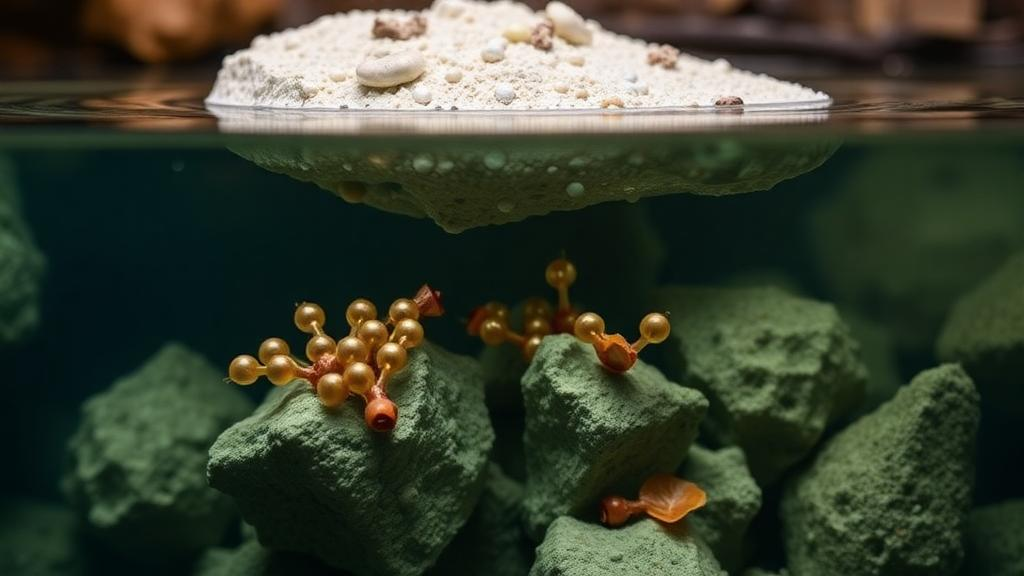
Researchers in Brazil have grown carbon nanotubes directly on a common green rock and used the resulting material to pull a stubborn agricultural herbicide out of water. The study, published in Frontiers in Carbon, describes how serpentinite—a cheap, abundant ultrabasic rock composed of hydrated magnesium silicates—was impregnated with cobalt and then subjected to chemical vapour deposition at 900 °C, producing multiwalled carbon nanostructures anchored to a mineral support. The team, led by Emilay Baessa Teixeira Diogo and Ana Paula de Carvalho Teixeira at the Federal University of Minas Gerais, together with collaborators at CEFET-MG, the State University of Minas Gerais and the Federal University of Viçosa, reports that these magnetic, amphiphilic composites removed the herbicide sulfentrazone from aqueous solution through two complementary mechanisms: adsorption on the carbon surfaces and chemical reduction by metallic cobalt nanoparticles.
Serpentinite is an appealing starting point for sustainable materials science. It is essentially a silicon oxide tetrahedral sheet bonded to a magnesium hydroxide octahedral layer, and it occurs in large quantities in mining regions such as Minas Gerais, where the samples for this study were donated by the company Pedras Congonhas. Because natural minerals are inexpensive, widely available and easy to process, they are increasingly being explored as supports for environmental technologies. The Brazilian group has a track record in this area, having previously grown carbon nanostructures on chrysotile, vermiculite and iron mining tailings for applications ranging from dye adsorption to the removal of the hormone ethinyl estradiol from water.
The synthesis route followed a well-established logic of catalytic chemical vapour deposition, or CVD, in which a metal catalyst decomposes a carbon-bearing gas and carbon atoms reorganize into nanotubes or nanofibers on the catalyst surface. In this case, powdered serpentinite was impregnated with aqueous cobalt nitrate at 5, 10 and 20 percent metal by weight, dried, and then reduced at 800 °C in a dilute hydrogen–nitrogen stream to generate metallic cobalt nanoparticles. The reduced solids were subsequently heated to 900 °C under flowing methane, a relatively stable carbon source that demands high temperatures for activation and decomposition. The three products, named Serp5, Serp10 and Serp20 according to their cobalt loading, were then characterized by X-ray diffraction, Raman spectroscopy, thermogravimetric analysis, electron microscopy and nitrogen adsorption measurements.
A crucial preliminary finding concerned the thermal behaviour of the rock itself. Unlike inert ceramic supports such as magnesium oxide or alumina, serpentinite contains hydroxyl groups and iron ions and undergoes phase transformations on heating. X-ray diffraction showed that the raw rock contained the hydrated magnesium silicates lizardite, antigorite and talc—interestingly, no chrysotile was detected, despite that mineral being common in serpentinites. After calcination at 800 °C in air, the hydrated phases gave way to forsterite (Mg2SiO4), olivine and enstatite, and the same non-hydrated assemblage persisted under the reducing atmosphere used before carbon growth. Understanding which phases actually survive the CVD process was essential, because these dehydroxylated silicates, not the original hydrated minerals, serve as the true support during nanotube synthesis.
Microscopy confirmed that every catalytic system produced multiwalled carbon nanostructures growing over cobalt cores. Statistical analysis of twelve images per sample gave average diameters of 43 ± 12 nanometres for Serp5, 46 ± 23 nanometres for Serp10 and 82 ± 38 nanometres for Serp20, with the larger cobalt loadings yielding thicker structures and broader size distributions—a heterogeneity the authors attribute to the variable particle sizes of the natural support. The cobalt particles encapsulated within the nanotube cavities measured between roughly 10 and 100 nanometres, which points to a tip-growth mechanism, the mode typical of large catalyst particles, rather than the base-growth seen with smaller nanoparticles. Raman spectroscopy revealed the characteristic D and G bands of graphitic carbon near 1320 and 1580 cm−1, with ID/IG ratios of 1.2, 1.1 and 1.0 for Serp5, Serp10 and Serp20 respectively—values close to unity, as expected for carbons grown on a natural, structurally variable mineral.
The cobalt loading had little effect on the structure of the carbon but a strong effect on how much of it was produced. Thermogravimetric analysis showed oxidation of the carbonaceous material between 470 and 600 °C, with maximum oxidation temperatures of 548, 536 and 514 °C for Serp5, Serp10 and Serp20. The authors propose two explanations for this downward shift: higher cobalt content may favour less organized, less thermally stable carbon, and abundant metal particles can themselves catalyse carbon oxidation. By weight, the carbon yields rose from about 14 percent for Serp5 to 23 percent for Serp10 and 37 percent for Serp20, figures confirmed by elemental analysis. Surface areas, however, remained modest—7, 9 and 14 square metres per gram—little changed from pure serpentinite at roughly 10 square metres per gram, likely because the mineral matrix dominates the composite.
The target contaminant, sulfentrazone, is a pre-emergent herbicide with high persistence and moderate mobility in soil, meaning it can accumulate in agricultural land and migrate into surface and groundwater. Exposure to agrochemicals of this class is associated with gastrointestinal and respiratory damage, cancer risk and fetal development problems, making efficient removal technologies a global priority. When the untreated serpentinite was tested, it removed only 7.6 percent of the herbicide, an effect the researchers attribute to electrostatic attraction between the amphoteric hydroxyl groups of antigorite, lizardite and talc and the positively charged herbicide at the working pH. Intriguingly, after thermal treatment alone the removal dropped to 2.8 percent, because the dehydroxylated forsterite–olivine–enstatite assemblage interacts far less strongly with the sulfentrazone molecule.
Growing carbon nanostructures on the rock reversed that decline. Removal efficiencies after CVD reached 17.3, 18.4 and 25.2 percent for Serp5, Serp10 and Serp20, tracking the carbon content of each composite. The sp2-hybridized carbon sheets can adsorb the herbicide through π–π interactions with its aromatic ring, supplemented by hydrogen bonding involving carboxyl groups on the material and electrostatic contributions. Adsorption was also remarkably fast: equilibrium with Serp5 was reached within five minutes, as available active sites filled rapidly before the process decelerated. Because Serp20 performed best, it was selected for deeper study of pH and concentration effects, with a fixed reaction time of 25 minutes chosen to guarantee equilibrium across all conditions.
The pH experiments revealed the second removal mechanism. Removal by Serp20 peaked under acidic conditions, falling from 41.7 percent at pH 2 to 12.7 percent at pH 10. Chromatographic analysis of the treated solutions showed that at pH 2 and 4 a new peak appeared alongside the parent herbicide, corresponding to the dechlorinated sulfentrazone molecule—a degradation product previously reported by co-author Mayra Aparecida Nascimento and colleagues in work on iron–nickel bimetallic nanoparticles. The picture that emerges is that metallic cobalt corrodes in acid, transferring electrons directly to the herbicide or to protons that generate reactive atomic hydrogen capable of cleaving the molecule, while at higher pH the cobalt surface passivates as cobalt oxide and electrostatic repulsion between the negatively charged composite and the anionic herbicide suppresses adsorption.
Isotherm analysis of adsorption on Serp20 showed that the Freundlich model, with a coefficient of determination of 0.969, described the data better than the Langmuir model at 0.904, indicating heterogeneous surface binding sites rather than uniform monolayer coverage. The experimentally determined removal capacity at an initial sulfentrazone concentration of 50 milligrams per litre was 14.9 milligrams per gram, with a fitted maximum capacity of 16.0 milligrams per gram. Those figures sit within the range reported for other carbon-based pesticide adsorbents, which span from a few milligrams per gram for magnetic graphene oxide capturing neonicotinoids to more than 100 milligrams per gram for biochars removing phenoxyacid herbicides. What distinguishes the Brazilian composite is its dual function—carbon adsorption plus cobalt-driven reductive degradation—combined with a magnetic character inherited from the iron-bearing rock that should allow simple magnetic separation after treatment, and a raw material that costs essentially nothing. The authors suggest this combination of low-cost geology, straightforward CVD synthesis and coupled adsorption–degradation chemistry offers a promising template for remediating persistent agrochemicals in contaminated water.
Subject of Research: Synthesis of carbon nanostructures on cobalt-impregnated serpentinite for sulfentrazone herbicide removal from water
Article Title: Carbon nanostructures supported on Co/serpentinite for sulfentrazone removal
Article References: Diogo, E. B. T., Vieira, A. F. P., Nascimento, M. A., Pinto, P. S., de Paula, F. G. F., Moreira, R. P. L., & Teixeira, A. P. D. C. (2024). Carbon nanostructures supported on Co/serpentinite for sulfentrazone removal. Frontiers in Carbon, 3, Article 1402105. https://doi.org/10.3389/frcrb.2024.1402105
Image Credits: AI Generated
DOI: 10.3389/frcrb.2024.1402105
Keywords: carbon nanostructures, serpentinite, chemical vapour deposition, cobalt catalyst, sulfentrazone, herbicide removal, water treatment, adsorption, multiwalled carbon nanotubes, magnetic composites, dechlorination, environmental remediation
Cite Scienmag News
Bethany Barker. (October 16, 2026). Turning Serpentine Rock Into Carbon Nanotube Filters That Strip Herbicide From Water. Scienmag. https://scienmag.com/turning-serpentine-rock-into-carbon-nanotube-filters-that-strip-herbicide-from-water/
Bethany Barker. "Turning Serpentine Rock Into Carbon Nanotube Filters That Strip Herbicide From Water." Scienmag, 16 October 2026, https://scienmag.com/turning-serpentine-rock-into-carbon-nanotube-filters-that-strip-herbicide-from-water/. Accessed 16 October 2026.
Bethany Barker. "Turning Serpentine Rock Into Carbon Nanotube Filters That Strip Herbicide From Water." Scienmag. October 16, 2026. https://scienmag.com/turning-serpentine-rock-into-carbon-nanotube-filters-that-strip-herbicide-from-water/


