
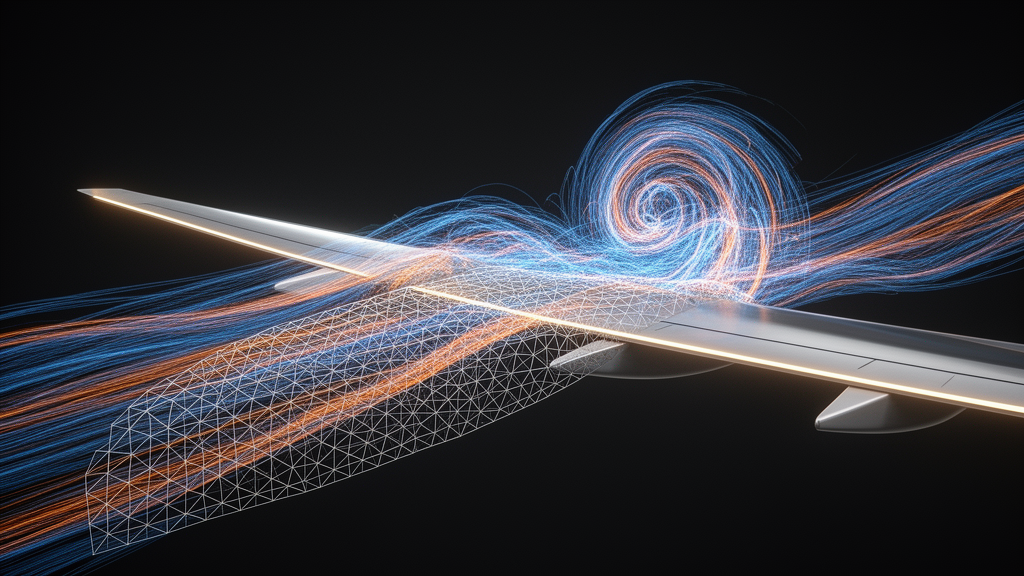
Turbulence is one of the hardest problems in computational physics, and a new study published in the journal Advances in Aerodynamics offers a way to tame its enormous appetite for computing power. Researchers Chang Xu, Jinsheng Cai and Shucheng Pan have developed an adaptive large-eddy simulation (LES) framework that lets the computational mesh rearrange itself as the flow evolves, concentrating resolution only where the turbulence actually lives. Their method, described in a paper published on 17 July 2026, pairs a dynamic adaptive mesh refinement algorithm with a new class of adaptive subgrid models, and the authors report both improved accuracy and substantial savings in computational cost across three benchmark turbulent-flow problems.
The core challenge the team set out to address is well known in the simulation community. Direct numerical simulation, or DNS, resolves every scale of a turbulent flow down to the smallest dissipative eddies, and it delivers the most complete picture possible. Large-eddy simulation relaxes this burden by filtering out structures smaller than the grid and representing their influence through a subgrid model, typically an eddy-viscosity closure such as the classic Smagorinsky model. The catch is that the grid must still be fine enough everywhere that matters, and conventional LES runs on static meshes that are uniformly fine, wasting effort in calm regions of the domain.
The new approach attacks this inefficiency with a simple but effective diagnostic. The authors define a quantity they call the Intensity in Block, or I_IB, which measures the normalized root-mean-square of velocity fluctuations within each mesh block relative to the block-averaged flow. A high value signals a region packed with small-scale, rapidly varying motions that demand fine resolution; a low value indicates smooth flow that can be handled with coarse cells. By comparing each block’s intensity against thresholds derived from the average, minimum and maximum values across all blocks, the algorithm decides dynamically whether to refine, coarsen or leave each block unchanged as the simulation advances in time.
This means the mesh follows the flow rather than the other way around. In regions dominated by large, sluggish structures, blocks consolidate into coarser cells, while zones with fine vortex structures are subdivided into finer blocks. The refinement and coarsening operations use a high-order multi-resolution interpolation scheme, with fifth-order prediction, to transfer data between grid levels accurately. Unlike compressible-flow AMR methods that refine mainly on gradients to capture shocks, this criterion responds to the severity of turbulence itself, so it works even in flows without strong discontinuities.
The second half of the innovation concerns what happens below the finest grid. Even after refinement, some structures remain unresolved, and the subgrid model must account for their effect on the resolved flow. Existing AMR-LES schemes often rely on subgrid turbulent kinetic energy models, which require solving an additional transport equation for the subgrid kinetic energy, adding significant computational overhead. The new framework avoids that entirely. Because the adaptive mesh naturally carries velocity information at two different filter scales on every block, the authors exploit this multi-resolution data directly to compute the eddy viscosity coefficient.
The derivation rests on the energy spectrum of homogeneous isotropic turbulence. The turbulent kinetic energy contained between two truncated wave numbers, corresponding to the fine grid spacing and a coarser spacing twice as large, can be computed straight from the velocity difference between the two filter levels. A scaling relation then links that energy to the unresolved subgrid energy, yielding what the authors call the ASM-C model, where ASM stands for Adaptive Subgrid Model and C indicates a constant Kolmorogov-derived coefficient. A second variant, ASM-D, goes further: by combining the subgrid stress expressions at the two filter scales, it obtains an eddy viscosity that depends on the local dynamic velocity and position information at every grid element, with no auxiliary equations at all.
The team validated the method on three canonical problems using an in-house adaptive-mesh solver with high-order WENO-CU6 spatial discretization and second-order Runge-Kutta time marching. The first case, a two-dimensional Kelvin-Helmholtz instability with a maximum refinement level of five and an effective finest resolution of 512 by 512, showed the mesh concentrating near the shearing interfaces where velocities change dramatically, while the domain boundaries stayed coarse. The density contours matched a high-resolution uniform-mesh reference at 2048 by 2048, and the adaptive simulation ran dramatically faster per time step than a uniform 512-squared calculation.
The second and most demanding test was the three-dimensional Taylor-Green vortex at Reynolds number 1600 and Mach number 0.1, simulated on a three-level adaptive mesh with an effective resolution of 128 cubed. Here the adaptive subgrid models showed their advantage over the traditional Smagorinsky closure. The time evolution of the turbulent kinetic energy dissipation rate from both ASM-C and ASM-D tracked direct numerical simulation data closely before the dissipation peak, whereas the Smagorinsky model distinctly overestimated it. At the peak, near nine eddy-turnover times, the kinetic energy spectra showed that the adaptive models better captured intermediate-to-high wavenumber content, while the Smagorinsky model suffered premature spectral decay from excessive dissipation. Vorticity contours confirmed that the ASM models retained richer small-scale structure.
The third benchmark, a three-dimensional temporal mixing layer at Mach 0.3 and Reynolds number 160 based on the initial momentum thickness, tested the method on inhomogeneous turbulence. The adaptive mesh concentrated refinement along the central shear plane and expanded that refined zone as turbulent structures of disparate scales developed. Mean streamwise velocity profiles and Reynolds stress components collapsed onto similarity coordinates and agreed well with previous experimental and numerical reference data. For this case, the authors report an acceleration ratio of roughly 3.7 to 4.3 compared with uniform-mesh LES.
The study’s conclusions are carefully scoped to what the benchmarks show: significant gains in computational efficiency while maintaining acceptable accuracy in resolving multiscale flow features. The simulations were run on a 64-core AMD EPYC workstation with parallelization via Intel’s Threading Building Blocks, using 8, 32 and 64 cores for the three test cases respectively.
Subject of Research: An adaptive large-eddy simulation method that dynamically refines computational meshes based on local velocity fluctuation intensity and introduces two adaptive subgrid models for turbulent flow simulation.
Article Title: Adaptive large-eddy simulations with a dynamic subgrid model based on local velocity fluctuation intensities
Article References: Xu, C., Cai, J., & Pan, S. (2026). Adaptive large-eddy simulations with a dynamic subgrid model based on local velocity fluctuation intensities. Advances in Aerodynamics, 8(1), Article 20. https://doi.org/10.1186/s42774-025-00226-3
Image Credits: AI Generated
DOI: 10.1186/s42774-025-00226-3
Keywords: large-eddy simulation, adaptive mesh refinement, turbulence modeling, subgrid model, computational fluid dynamics, Taylor-Green vortex, Kelvin-Helmholtz instability, mixing layer, eddy viscosity, Navier-Stokes equations, computational efficiency, Adaptive
Cite Scienmag News
Audrey Campbell. (October 29, 2026). Turbulence Simulation Gets Smarter: Meshes That Follow the Flow. Scienmag. https://scienmag.com/turbulence-simulation-gets-smarter-meshes-that-follow-the-flow/
Audrey Campbell. "Turbulence Simulation Gets Smarter: Meshes That Follow the Flow." Scienmag, 29 October 2026, https://scienmag.com/turbulence-simulation-gets-smarter-meshes-that-follow-the-flow/. Accessed 29 October 2026.
Audrey Campbell. "Turbulence Simulation Gets Smarter: Meshes That Follow the Flow." Scienmag. October 29, 2026. https://scienmag.com/turbulence-simulation-gets-smarter-meshes-that-follow-the-flow/