


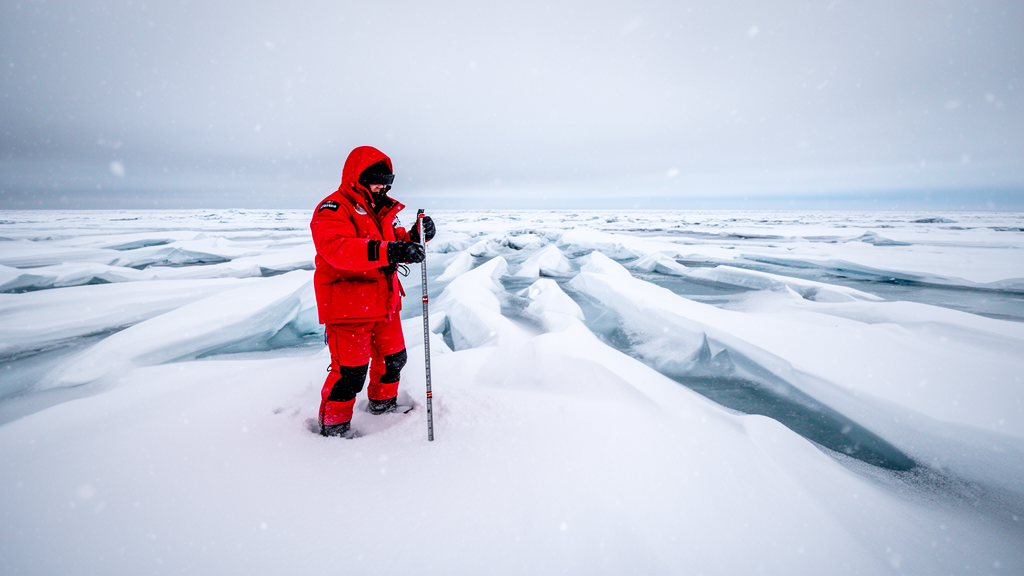
Simulating snow cover on Arctic sea ice with numerical sea ice models has long suffered from substantial overestimates of snow depth during the winter and spring seasons, but newly published evaluations utilizing field data from the year-long Multidisciplinary Drifting Observatory for the Study of Arctic Climate expedition reveal that incorporating and calibrating wind-driven snow redistribution parameterizations can reduce these modeling errors by more than half. Arctic snow acts as a critical thermal blanket that restricts the conductive loss of heat from the relatively warm ocean to the freezing polar atmosphere during the dark winter months while dramatically reflecting incoming solar radiation during the late spring and summer. When column-based sea ice models fail to account for the physical processes that blow snow across uneven ice topographies and sweep drifting particles into open leads of seawater, simulated snow accumulations swell well beyond actual environmental levels. By systematically testing both bulk redistribution and explicit blowing-snow erosion parameterizations against multi-sensor field measurements collected along the MOSAiC drift track, atmospheric and sea ice researchers demonstrated that unparameterized simulations overestimate peak snow water equivalent by approximately 80 millimeters, whereas physically tuned redistribution parameterizations reduce the mean absolute error down to approximately six millimeters.
The role of snow atop polar sea ice is multifaceted, exerting divergent and seasonally dependent influences on the surrounding climate system and the underlying ice pack. During winter, the high insulating capacity of the porous snowpack dampens the upward heat flux from the ocean, thereby suppressing the thermodynamic growth of congelation ice beneath the floes. In summer, the high surface albedo of the snow mantle reflects the bulk of shortwave radiation, delaying the onset of surface ice melt until the snowpack itself ripens and melts. Once melting is underway, percolation of snowmelt water can either refreeze as superimposed ice or accumulate on the surface to produce expansive melt ponds that absorb solar energy, accelerating ice decay. Furthermore, heavy snow loading on relatively thin floes can depress the ice surface below the sea level, initiating seawater flooding and the subsequent formation of snow-ice. Because these thermodynamic and structural transformations depend directly on the absolute mass and depth of the snow layer, accurate numerical representation of snow accumulation is vital for understanding current polar sea ice evolution and projecting its long-term response within a warming global climate.
To investigate why sea ice models traditionally struggle with snow accumulation, the study evaluated the single-column Icepack model using a comprehensive suite of atmospheric, oceanic, and sea ice observations collected between December 2019 and July 2020 within a fifteen-kilometer radius of the MOSAiC Central Observatory. Atmospheric boundary layer conditions were prescribed from continuous recordings at the Met City monitoring station and three autonomous Atmospheric Surface Flux Stations, capturing downward shortwave and longwave radiation, two-meter air temperature, humidity, and ten-meter wind speeds extrapolated from two-meter measurements using a power-law relationship with an aerodynamic surface roughness length of 0.001 meters. Oceanic forcing was supplied by combining temperature and salinity profiles within the mixed layer depth gathered across eight Conductivity, Temperature, and Depth buoys and four autonomous ocean flux buoys. Rather than relying on the default constant friction velocity in Icepack, the researchers implemented a quadratic ice-ocean drag law to calculate dynamic friction velocity from observed relative ice velocities, establishing a realistic thermodynamic and dynamic baseline for the single-column numerical framework.
Snowfall inputs represent one of the largest sources of uncertainty in polar modeling, as different observational instruments and reanalysis products frequently exhibit substantial divergence under blowing snow conditions. To minimize product-dependent biases, the researchers drove Icepack using an average of precipitation measurements recorded by a Present Weather Detector situated on the deck of the research vessel Polarstern and precipitation estimates from the ERA5 atmospheric reanalysis, resulting in a cumulative snowfall value of 91 millimeters from 31 October 2019 to 26 April 2020. Sea ice and snowpack conditions were initialized and verified using seven autonomous Snow and Ice Mass Balance Array buoys deployed across both first-year ice and second-year ice regimes. Because actual snow density observed in the field ranged from 250 to 400 kilograms per cubic meter, whereas Icepack maintains a static background snow density of 330 kilograms per cubic meter, all observed physical snow depths were converted into snow water equivalent using density relationships derived from high-resolution SnowMicroPen measurements, enabling a direct and physically consistent mass comparison.
The physical mechanisms governing snow redistribution in Icepack version 1.3.2 are divided into two distinct formulations: a bulk redistribution parameterization and a subgrid blowing-snow scheme designated as snwITDrdg. In the bulk redistribution scheme, unresolved wind transport is represented by diverting a fixed fraction of incoming snowfall on level ice directly into leads, parameterized by an excess snow mass ratio p that characterizes the relative concentration of snow gathered near ice ridges compared to level surfaces. In the snwITDrdg scheme, snow erosion is activated whenever the local wind speed exceeds a threshold of approximately 3.5 meters per second, calculated from the effective snow density of 330 kilograms per cubic meter. Suspended snow particles are then either deposited into open leads or redistributed locally across fifteen discrete ice thickness categories, with lead losses governed by open water fractions and ice surface roughness scales. Icepack assumes local mass conservation across these discrete subgrid categories within the single column, treating snow blown into open water as an immediate loss to the ocean without lateral exchanges to neighboring model grid cells.
When the Icepack model was executed without any snow redistribution mechanism, the simulated snow water equivalent began drifting substantially above observed values as early as mid-January, with discrepancies expanding rapidly during major snowfall events. The unparameterized simulation reached a peak snow water equivalent of 155 millimeters on 13 May, more than double the observed peak of 75 millimeters, before undergoing rapid summer melting that stripped away all snow by 17 June. Applying the default bulk redistribution scheme—configured with a historical parameter value of p equal to 0.3 based on 1990s SHEBA campaign data—lowered peak snow water equivalent to approximately 130 millimeters, yielding a mean absolute error of roughly 23 millimeters prior to June. The default snwITDrdg blowing-snow scheme provided stronger initial dampening, reducing peak snow water equivalent to approximately 105 millimeters and lowering the pre-June mean absolute error to approximately 13 millimeters. Nevertheless, both default schemes consistently overestimated winter and spring snow accumulation and initiated summer melt prematurely, proving that standard parameter choices fail to reflect Arctic snow dynamics.
To overcome these persistent simulation biases, the investigators conducted extensive sensitivity experiments to optimize the internal tuning parameters within both parameterization schemes. In the bulk redistribution framework, the parameter p was varied across a range from 0.3 to 4.0, informed by MOSAiC field measurements showing that large pressure ridges accumulated nearly five times more snow depth than adjacent level ice. Increasing p elevates the mathematical term p divided by one plus p from 0.23 to 0.80, channeling a substantially higher fraction of snowfall over level ice directly into leads. As more snow mass was diverted away from the level ice pack, simulated snow accumulation declined steadily across the winter. The optimal bulk configuration occurred at p equal to 4.0, which dropped the mean absolute error for simulated snow water equivalent to 6.2 millimeters, representing an impressive 73 percent reduction in error relative to the baseline bulk experiment and demonstrating the profound impact of realistic ridge-snow trapping.
Optimization of the snwITDrdg blowing-snow scheme required addressing the dynamic interplay between the empirical snow erosion coefficient gamma and satellite-observed sea ice concentration. Adjusting gamma across eleven sensitivity steps from 1.0 times 10 to the power of negative five to 3.0 times 10 to the power of negative five accelerated the parameterized erosion rate and diminished snow thickness, yet tuning gamma alone without prescribed ice concentration failed to capture realistic lead losses. However, when daily sea ice concentration from the AMSR2 satellite sensor was prescribed into the model—capturing real lead openings that lowered local concentration to 0.7 during late April and late July—the simulated snow loss into leads during a prominent storm sequence between 19 and 28 April aligned precisely with isotopic field measurements showing 7 to 11 millimeters of area-averaged snow loss. Setting gamma to 2.4 times 10 to the power of negative five under prescribed ice concentrations achieved a minimal snow mean absolute error of 6.4 millimeters, cutting baseline blowing-snow error by approximately 51 percent.
Examining the cumulative snow mass budget revealed how each parameterization alters specific mass exchange pathways, including direct snowfall, surface melt, sublimation, snow-ice transformation, and lead losses. While sublimation losses remained steady at modest levels across all simulations, the optimized schemes diverted substantial snow mass into leads, curtailing the excessive accumulation that previously fueled exaggerated summer melt volumes. Interestingly, the snwITDrdg configuration diagnostically enhanced snow-ice formation by redistributing eroded snow onto thinner ice thickness categories, thereby inducing surface flooding and freezing. However, because multi-site averaged SIMBA buoy observations showed negligible real-world snow-ice production over the study period, researchers cautioned that category-dependent redistribution in Icepack represents an internal model-diagnostic mechanism rather than an empirical confirmation. Prescribing realistic AMSR2 sea ice concentration exerted minimal influence on the bulk scheme but strongly altered snwITDrdg outcomes, underscoring that wind-driven erosion schemes are exceptionally sensitive to open-water exposure in fractured pack ice.
Despite the notable accuracy gains achieved through parameter calibration, several structural modeling limitations remain to be resolved in future sea ice code developments. Even in the best-performing configurations, simulated snow thickness peaked approximately seven days later than observed in the field and exhibited an overly rapid melt progression during late June and July. These remaining discrepancies likely stem from unresolved physical processes, such as the direct sublimation of suspended blowing snow particles, unrepresented melt-pond evolution, and the reliance on a static snow density rather than dynamic compaction physics. Furthermore, because Icepack treats snow thickness uniformly within each ice category, it does not explicitly capture the extreme micro-scale heterogeneity that characterizes drifting snow across deformed floes. Consequently, the optimized parameters p equal to 4.0 and gamma equal to 2.4 times 10 to the power of negative five serve as effective bulk tuning values that compensate for unrepresented sink mechanisms, providing sea ice modelers with indispensable guidance to improve large-scale Arctic climate simulations.
Subject of Research: Effects of calibrated snow redistribution parameterizations on simulated Arctic snow thickness using Icepack and MOSAiC observations
Article Title: Effects of snow redistribution parameterization on simulated snow thickness validated by MOSAiC observations
Article References: Gu, F., Liu, C., Han, B., Yang, Q., & Liu, J. (2026). Effects of snow redistribution parameterization on simulated snow thickness validated by MOSAiC observations. The Cryosphere, 20(11), 6521-6533. https://doi.org/10.5194/tc-20-6521-2026
Image Credits: AI Generated
Keywords: Arctic sea ice, Icepack model, snow redistribution, blowing snow, snow water equivalent, MOSAiC expedition, sea ice thermodynamics, snow thickness, lead snow loss, SIMBA buoys, parameter optimization, snow erosion, polar climate modeling, snow mass balance, AMSR2 concentration, pressure ridges
Cite Scienmag News
Sloane Callahan. (November 12, 2026). Tuning Snow Redistribution Parameterizations Halves Arctic Snow Depth Errors in Icepack. Scienmag. https://scienmag.com/tuning-snow-redistribution-parameterizations-halves-arctic-snow-depth-errors-in-icepack/
Sloane Callahan. "Tuning Snow Redistribution Parameterizations Halves Arctic Snow Depth Errors in Icepack." Scienmag, 12 November 2026, https://scienmag.com/tuning-snow-redistribution-parameterizations-halves-arctic-snow-depth-errors-in-icepack/. Accessed 12 November 2026.
Sloane Callahan. "Tuning Snow Redistribution Parameterizations Halves Arctic Snow Depth Errors in Icepack." Scienmag. November 12, 2026. https://scienmag.com/tuning-snow-redistribution-parameterizations-halves-arctic-snow-depth-errors-in-icepack/




