


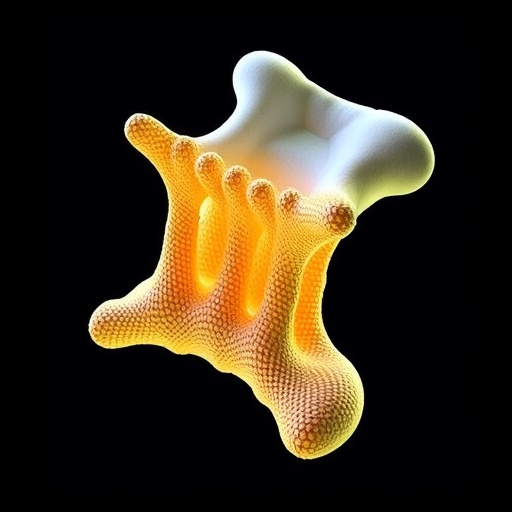
In a groundbreaking advancement that intertwines the realms of bioengineering and material science, researchers have unveiled a novel design framework for bionic bone scaffolds. This innovation harnesses the capabilities of diffusion modeling to create scaffolds with finely-tuned microstructures, offering significant promises for the field of regenerative medicine. The study signals a significant leap forward in developing biomimetic materials that can effectively support bone regeneration and integration within the human body. The presented work meticulously details the methodologies employed in scaffold design, showcasing a promising pathway for therapeutic interventions that rely on scaffold-based approaches.
The development of bionic scaffolds is not a new concept, but the incorporation of diffusion modeling brings a fresh perspective to an existing paradigm. Diffusion models have traditionally been utilized to understand processes such as heat and mass transfer. However, their application in scaffold design introduces a dynamic approach, providing the ability to control microstructural characteristics systematically. The implications of this for bone scaffolding are transformative, as these characteristics play a critical role in the biological behavior and mechanical properties of the scaffolds.
Understanding how these optimized scaffold structures interact with biological tissues is paramount. The design framework proposed by Chen, Shen, and Xu meticulously evaluates the microstructural parameters that influence the biological environment. This includes parameters like pore size, geometry, and connectivity, all of which are significant for facilitating cell attachment, migration, and proliferation. The findings suggest that the precise control over these elements not only enhances the scaffolds’ structural integrity but also promotes the desired biological responses crucial for successful bone regeneration.
Adapting to the body’s natural healing processes is the essence of bionic design. The scaffolds designed through this new framework mimic intricate bone architecture, allowing for effective nutrient and waste transport. In the context of biointegration, these microstructural features can significantly affect how host tissues respond to foreign materials. The study underlines that with the calibrated geometry achieved through diffusion modeling, the scaffolds can more readily integrate with the surrounding bone tissue, substantially increasing the success rate in clinical applications.
The research team approached scaffold design with a keen focus on tunability. The ability to adjust microstructural attributes is not just an additive feature—it’s a fundamental aspect that ensures each scaffold can be tailored for specific clinical scenarios. By methodically varying diffusion parameters in the modeling process, the researchers can create scaffolds that are optimized for distinct applications, such as load-bearing in critical bone defects or promoting faster healing in less demanding scenarios. This adaptability positions the new scaffolding technology as a versatile tool in the biomaterials toolbox.
Moreover, the implications of this research extend beyond the simply mechanical or structural. The biological interactions between cells and the scaffold’s surfaces are pivotal for successful integration and regeneration. This innovation reflects a comprehensive understanding of the physical and chemical cues that can orchestrate complex cellular behavior. With the addition of functionalized surfaces that can enhance bioactivity, the performance of these sceneries can be further improved, indicating a profound impact on future orthopedic solutions.
As the aging population continues to rise, the demand for effective solutions to combat bone-related ailments such as osteoporosis and fractures has never been greater. The innovations brought forth by this research could contribute significantly to addressing an escalating public health challenge. With the ability to engineer scaffolds that can adjust their properties based on patient-specific needs, the potential applications stretch into personalized medicine, where treatment protocols are tailored to individual patients’ unique biological circumstances.
In addition to the immediate clinical applications, the principles derived from diffusion modeling could inspire future research directions in scaffold technology. The framework laid out by the authors sets the stage for the exploration of new materials, such as biodegradable polymers and composites, further enhancing the functionality and sustainability of bionic scaffolds. Future work will likely focus on integrating these advanced materials with smart technologies, such as embedded sensors that can monitor healing progress in real-time.
Looking ahead, ecological sustainability is another essential aspect to be considered in the development of biomedical designs. Innovations in scaffold fabrication that utilize sustainable materials and environmentally friendly production methods can greatly enhance the overall impact of this research. The balance between functionality, safety, and sustainability will define the future landscape of regenerative medicine, and the diffusion model-based approach may very well lead the way in achieving this delicate equilibrium.
In essence, the study conducted by Chen et al. exemplifies how interdisciplinary collaboration can drive revolutionary changes in medical practices. By integrating principles from physics, biology, and engineering, researchers are not only addressing present challenges but also paving the way for future innovations. This work is poised to stimulate further investigation into sophisticated scaffold designs that can address both clinical needs and patient quality of life, thus ushering in a new era of personalized bone regeneration therapies.
Advancements in tissue engineering hold the promise of developing highly effective treatments for bone repair and reconstruction. As researchers continue to explore the full capabilities of diffusion modeling in scaffold design, there’s a growing optimism that these intelligent materials can aid in developing more effective therapies. In doing so, they could potentially replace traditional grafting methods, thus minimizing invasive surgeries and complications.
This pioneering study offers a glimpse into the future of biomaterials, where the lines between artificial and natural blur through intelligent design and engineering. With ongoing research and development, the vision of personalized and effective bionic bone scaffolds is not just a theoretical concept; it is inching closer to becoming a clinical reality. The authors’ contributions lay a vital foundation for further exploration, and the academic and medical communities eagerly await the next wave of innovations stemming from this work.
Chen, J., Shen, S., Xu, L. et al. Diffusion Model-Based Design of Bionic Bone Scaffolds with Tunable Microstructures.
Ann Biomed Eng (2025). https://doi.org/10.1007/s10439-025-03847-3
Cite Scienmag News
Ophelia Keating. (September 30, 2025). Tunable Microstructures in Bionic Bone Scaffold Design. Scienmag. https://scienmag.com/tunable-microstructures-in-bionic-bone-scaffold-design/
Ophelia Keating. "Tunable Microstructures in Bionic Bone Scaffold Design." Scienmag, 30 September 2025, https://scienmag.com/tunable-microstructures-in-bionic-bone-scaffold-design/. Accessed 6 September 2026.
Ophelia Keating. "Tunable Microstructures in Bionic Bone Scaffold Design." Scienmag. September 30, 2025. https://scienmag.com/tunable-microstructures-in-bionic-bone-scaffold-design/


