

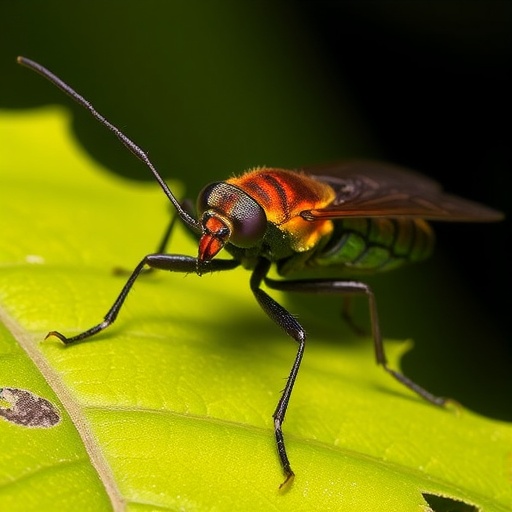
Insects dominate the animal kingdom, representing nearly 70 percent of all known species on Earth. Their vast diversity, especially in tropical regions, underscores their critical ecological roles, ranging from pollination to decomposition and predation. However, recent observations cast a troubling shadow over the future of these indispensable organisms in the face of climate change. A pioneering study led by Dr. Kim Holzmann of the University of Würzburg and Dr. Marcell Peters from the University of Bremen reveals that tropical insects possess exceedingly limited thermal tolerance, raising alarms about the resilience of biodiversity hotspots as global temperatures escalate.
This comprehensive research, published in the forthcoming issue of Nature, scrutinizes the thermal limits of over 2,000 insect species sampled across diverse altitudinal gradients in East Africa and South America. From the cool, mist-laden mountain forests to the sweltering lowland rainforests and savannas, the study evaluates insects’ physiological boundaries against rising heat stress. Intriguingly, while high-altitude species demonstrate some capacity for short-term adaptation to increased temperatures, countless lowland tropical insects show minimal ability to adjust, highlighting an uneven and alarming vulnerability within ecosystems.
The study’s findings emphasize that insects’ thermal tolerance is not merely a reflection of their immediate environment but is deeply entrenched in their evolutionary biology. The research team conducted genome analyses across various species to uncover why tolerance varies significantly among different insect orders such as moths, flies, and beetles. Their investigations pinpointed the role of protein stability and structure, which appear highly conserved throughout insect evolutionary history. These molecular constraints suggest that the capacity for rapid physiological adaptation to warming temperatures is fundamentally limited, imposing strict bounds on these species’ survival under accelerating climate stress.
Understanding these genetic and biochemical underpinnings is crucial. Proteins govern essential cellular functions and their denaturation or malfunction under thermal stress can lead to organismal failure. The study describes how evolutionary continuity in protein heat resilience explains why certain insect groups conspicuously withstand higher temperatures better than others. This deeply conserved trait underscores the challenges tropical insects face in adjusting to the unprecedented thermal regimes spurred by anthropogenic climate change, which unfolds at rates far exceeding natural evolutionary timescales.
The prognoses emerging from this research are particularly bleak for tropical lowland ecosystems, such as the Amazon basin, widely regarded as the Earth’s richest repository of biodiversity. Dr. Holzmann highlights that if global warming continues unchecked, critical heat stress conditions predicted for the Amazon would jeopardize approximately half of its insect species. The demise of such a large fraction of insect populations poses a cascading threat to ecosystem stability, given their indispensable roles in nutrient cycling, plant reproduction, and food web dynamics.
Beyond individual species losses, the functional collapse of insect communities could trigger widespread disturbances. Pollination deficits can imperil plant biodiversity and agricultural productivity, decomposition slowdowns can disrupt nutrient turnover, and loss of predatory insects may unleash imbalances by allowing pest populations to explode unchecked. These consequences ripple outward, potentially destabilizing entire ecosystems, compromising carbon sequestration, and undermining livelihoods relying on these natural services, thereby intensifying the climate crisis itself.
The research also draws attention to significant gaps in existing data, particularly regarding the heat tolerance of tropical insects. Historically, experimental and observational datasets have been biased toward temperate species, leaving tropical fauna understudied and underrepresented. This scarcity hampers accurate predictive modeling and conservation planning in some of the world’s most vulnerable and ecologically critical areas. By expanding thermal tolerance assessments across diverse taxa and altitudes, the present study addresses these deficiencies, offering crucial empirical evidence to guide future climate resilience efforts.
Methodologically, the study showcases a rigorous integration of fieldwork and molecular biology. Thermal tolerance experiments involved exposing insect specimens to controlled, incrementally increasing temperatures to identify their critical thermal maxima, beyond which physiological functions fail. Concurrently, genome sequencing and bioinformatics analyses elucidated the structure and stability of heat-sensitive proteins, enabling a holistic understanding of both phenotypic responses and their genetic determinants. This multidisciplinary approach exemplifies cutting-edge ecological genomics applied to pressing global issues.
Importantly, the findings underscore that thermal tolerance traits in insects are not highly plastic traits amenable to rapid evolution within ecological timescales. This limited plasticity contrasts starkly with some other organisms capable of acclimation or evolutionary adaptation under similar stressors. Such biological rigidity mandates urgent conservation interventions, including habitat preservation, microclimate buffering, and climate mitigation strategies, to avert precipitous losses in insect biodiversity and the vital ecosystem functions they sustain.
Ultimately, this study provides a clarion call to researchers, policymakers, and the global community. It stresses that solutions to the climate crisis must encompass a nuanced appreciation of species-specific vulnerabilities and the molecular constraints shaping ecological resilience. Protecting tropical insects is not just an issue of preserving biodiversity but safeguarding the foundations of ecosystem integrity and the life-support systems crucial to human well-being worldwide.
The expansive dataset and profound insights from this research pave the way for future investigations into adaptive mechanisms and potential biotechnological applications aimed at enhancing thermal tolerance in ecologically valuable species. Meanwhile, monitoring programs must intensify to track real-time responses of insect populations to climate extremes, thereby informing adaptive management to mitigate irreversible ecological damage.
In conclusion, as global temperatures rise unabated, the intricate web of tropical insect biodiversity is poised on the brink of profound transformations. The rigidity of their thermal tolerance, rooted in evolutionary time, starkly contrasts with the rapid pace of climate change. This imbalance threatens vast swaths of biodiversity and ecological services and demands urgent, coordinated scientific and conservation responses to protect these vital yet vulnerable organisms and the complex ecosystems they underpin.
Subject of Research: Thermal tolerance limits in tropical insects and their genomic determinants.
Article Title: Limited thermal tolerance in tropical insects and its genomic signature.
News Publication Date: 4 March 2026.
Web References: http://dx.doi.org/10.1038/s41586-026-10155-w
References:
Holzmann KL, Schmitzer T, Abels A, Čorkalo M, Mitesser O, Kortmann M, Alonso-Alonso P, Correa-Carmona Y, Pinos A, Yon F, Alvarado M, Forsyth A, Lopera-Toro A, Brehm G, Keller A, Otieno M, Steffan-Dewenter I, Peters MK (in press) Limited thermal tolerance in tropical insects and its genomic signature. Nature.
Image Credits: Kim Lea Holzmann
Keywords: Tropical insects, thermal tolerance, climate change, protein stability, genomic signature, biodiversity loss, insect adaptation, evolutionary ecology, heat stress, ecosystem impacts.


