


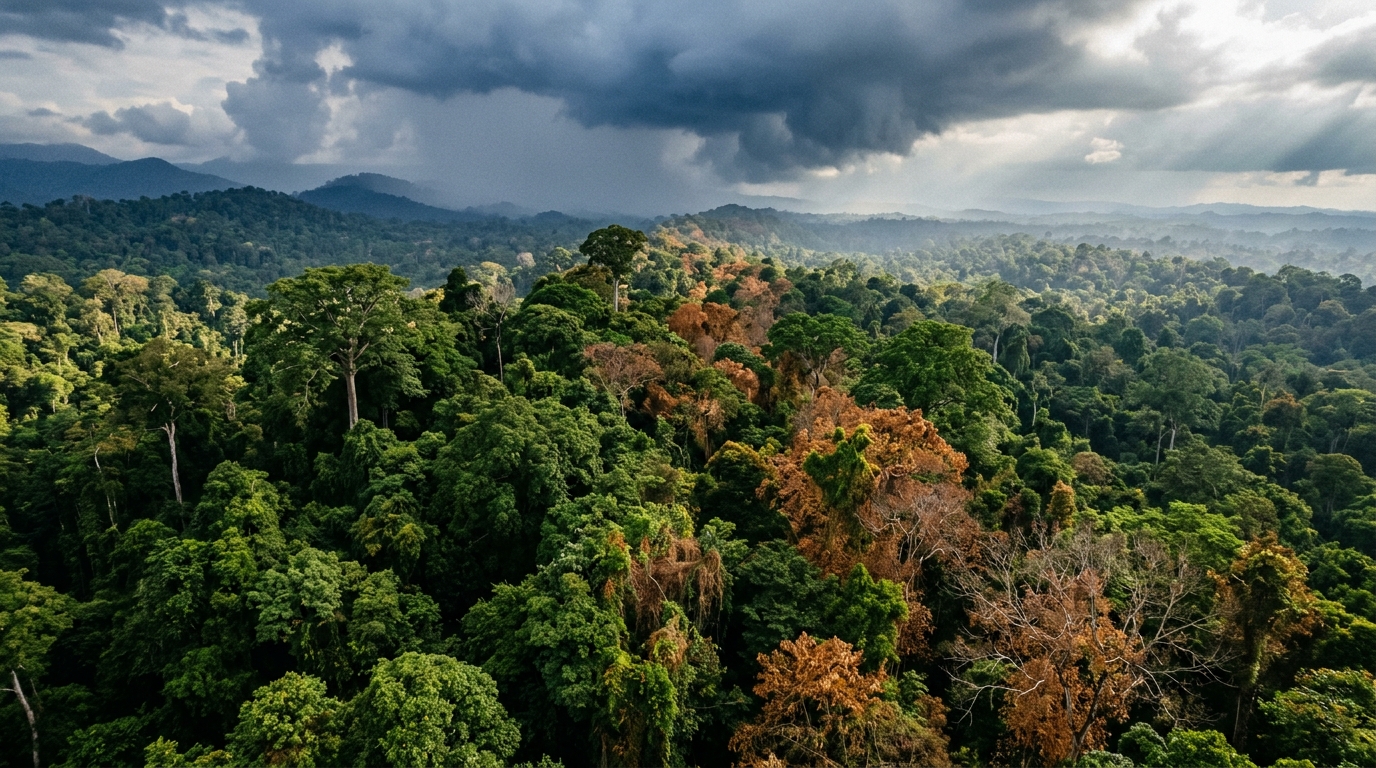
A new study published in PLOS Climate reveals that tropical areas often perceived as stable and insulated from the effects of climate change are experiencing significant shifts in rainfall patterns and extreme temperature events. The research, led by Alonso Ramirez of North Carolina State University, analyzed long-term hydroclimatic data from two active Caribbean research sites: the La Selva Research Station in Costa Rica and the El Verde Field Station in Puerto Rico. The findings challenge the conventional wisdom that protected tropical areas remain largely unaffected by anthropogenic impacts, demonstrating instead that clear changes in climate are already altering the functioning of these ecosystems.
The study utilized continuous monitoring data from automatic and manual sensors to assess long-term trends in air and water temperature, precipitation, and stream water levels. The researchers focused on identifying changes in extreme events, defined as conditions exceeding specific statistical thresholds, such as the 95th, 97th, and 99th percentiles of historical records. By examining data spanning several decades, the team aimed to provide a detailed account of how these specific locations are responding to global climate shifts, offering a site-level perspective that is often under-documented in broader tropical regions.
At La Selva, the mean daily temperature recorded between 1992 and 2024 was 25.1 degrees Celsius, with a range of 19.5 to 29.6 degrees Celsius. In contrast, El Verde recorded a mean daily temperature of 23.6 degrees Celsius between 2000 and 2024, with a range of 17.7 to 28.2 degrees Celsius. Despite these differences in baseline temperatures, both locations exhibited a decadal warming trend of 0.29 degrees Celsius.
The analysis of extreme temperature events revealed a significant increase in frequency at both sites. Using the 95th percentile as a threshold and applying a fitted generalized linear model, the researchers found that both locations experienced approximately eight extreme temperature events per year at the beginning of the study period. By 2024, this number had risen to approximately 35 events per year. Alonso Ramirez, the lead author and a professor in the Department of Applied Ecology at North Carolina State University, noted that in La Selva prior to 2024, the average number of hot days, defined as days where the temperature exceeded the 95th percentile, was eight per year. Now that number has increased to 30, indicating that these spikes in temperature are becoming both more severe and more common.
Precipitation patterns showed contrasting trends between the two sites, despite their relative geographic proximity. La Selva experienced an increase in heavy-rain events and a decrease in zero-rain days. Specifically, instances where rainfall exceeded the 99th percentile rose from around one event per year between 1983 and 1985 to six per year in 2024. In contrast, El Verde showed no significant increase in heavy-precipitation events. Instead, El Verde experienced an increase in dry extremes, with the number of dry days, defined as days with less than 1.4 millimeters of precipitation, rising from 152 to 170 days per year.
Marcelo Ardon, a co-author of the paper and a professor in the Department of Forestry and Environmental Resources and the Center for Geospatial Analytics at NC State, expressed surprise at the divergent precipitation trends. Given the close proximity of the two sites, the researchers had expected to find similar trends across both locations. The contrasting outcomes highlight the complex and localized nature of climate change impacts, demonstrating that even nearby ecosystems can experience different hydroclimatic shifts. This variability underscores the importance of site-level monitoring in understanding the full scope of climate change effects on tropical forests.
The study also examined the influence of the El Niño Southern Oscillation, or ENSO, on air temperatures. At El Verde, the La Niña phase was associated with higher daily temperatures, with an estimated increase of 0.02 degrees Celsius per day, with a 95 percent confidence interval ranging from 0.002 to 0.042 degrees Celsius per day. However, no detectable effect of ENSO on air temperature was observed at La Selva. This difference in response to ENSO phases further illustrates the distinct regional changes in climate occurring over the Caribbean region, which have important consequences for ecosystem conservation and management.
In addition to air temperature and precipitation, the researchers analyzed stream water temperature and water levels. Stream water temperature showed a moderate but significant increase at both locations. At La Selva, water temperature increased by 0.2 degrees Celsius, while at El Verde, it increased by 0.9 degrees Celsius. An increasing tendency in high-water-level conditions was also observed at both sites, although this trend had only marginal statistical support. The estimated durations above extreme thresholds for high water levels roughly doubled over the study period, with a p-value of 0.08 for the 99th percentile at La Selva and the 95th percentile at El Verde.
The paper, titled “Shifting climate in Caribbean tropical forests: Long-term trends at La Selva (Costa Rica) and El Verde (Puerto Rico),” was published in PLOS Climate on October 12, 2026. The co-authors include Pavel Garcia of Universidad de San Carlos de Guatemala, Nicholas S. Marzolf of The Jones Center at Ichauway, and David Genereux of North Carolina State University. The authors report no conflicts of interest in the study. The research contributes to the growing body of evidence that tropical ecosystems are not immune to the impacts of climate change, even in protected areas that were previously thought to be stable.
These findings have significant implications for the conservation and management of tropical forests.
Subject of Research: Long-term hydroclimatic trends and extreme events in Caribbean tropical forests
Article Title: Climate change is making the tropics hotter
Article References: Climate change is making the tropics hotter. Original publication (Bibliographic details unavailable.)
Image Credits: AI Generated
DOI: Not provided
Keywords: climate change, tropical forests, extreme weather, precipitation, temperature, Caribbean, ecosystem, hydroclimatic trends, La Selva, El Verde, Climate, change
Cite Scienmag News
Russell Cooper. (November 7, 2026). Tropical Forests Show Shifting Climate Extremes. Scienmag. https://scienmag.com/tropical-forests-show-shifting-climate-extremes/
Russell Cooper. "Tropical Forests Show Shifting Climate Extremes." Scienmag, 7 November 2026, https://scienmag.com/tropical-forests-show-shifting-climate-extremes/. Accessed 14 November 2026.
Russell Cooper. "Tropical Forests Show Shifting Climate Extremes." Scienmag. November 7, 2026. https://scienmag.com/tropical-forests-show-shifting-climate-extremes/




