


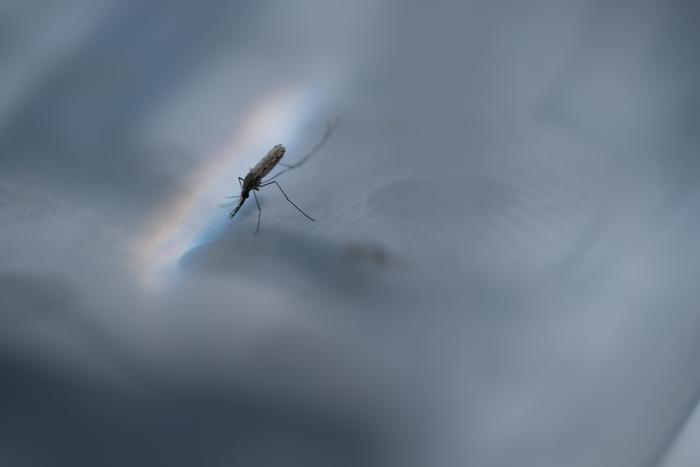
More than a quarter of Australians over the age of 50 take cholesterol-lowering drugs to prevent heart disease and strokes, but our bodies also need cholesterol to survive. Now, scientists from The Australian National University (ANU) say its role as a basic building block of life holds the key to treating deadly diseases caused by parasites, including malaria.

Credit: Must credit Jack Fox/ANU
More than a quarter of Australians over the age of 50 take cholesterol-lowering drugs to prevent heart disease and strokes, but our bodies also need cholesterol to survive. Now, scientists from The Australian National University (ANU) say its role as a basic building block of life holds the key to treating deadly diseases caused by parasites, including malaria.
The researchers have developed a trojan horse method that tricks malaria parasites into ingesting a fatal dose of drugs by exploiting the parasite’s need for cholesterol to survive. By attaching cholesterol to drugs, the scientists can “smuggle” the drugs into the parasite where they can exert their killing effect.
The new trojan horse method could lead to more effective and longer-lasting treatments for malaria. According to the scientists, the findings also have implications for the agricultural industry, as parasites can infect and kill livestock, leading to billion-dollar losses for farmers.
Lead researcher Professor Alex Maier from ANU said the trojan horse method of smuggling drugs into the parasites is three to 25 times more effective at eliminating the parasites compared to drugs that aren’t attached to cholesterol.
“Due to its bad reputation, people often forget that cholesterol is a basic building block of life and humans and animals need it to function and survive. Parasites are particularly desperate for cholesterol, since they have lost the ability to make their own,” Professor Maier said.
“Since parasites can’t produce cholesterol of their own, they steal it from their hosts and stockpile it.”
After a mosquito injects the malaria parasites into humans, the parasites eventually enter red blood cells where they hide from the immune system. Although malaria can be cured with drugs, malaria parasites are smart. They are continually finding new ways to adapt and build resistance to current therapies, keeping scientists on their toes.
But the ANU scientists say their new technique, which disguises the drugs under the veil of the cholesterol, addresses this long-standing issue.
“Existing drugs used to treat malaria are taken up passively by the parasite, meaning they’re not as effective as they could be,” Professor Maier said.
“By attaching the drugs to cholesterol, the parasite actively latches onto and eats the cholesterol. This allows us to smuggle drugs into optimal killing zones inside the parasite where the drugs can inflict the most damage.
“Using this approach, we can also repurpose existing drugs that have lost their bite and make them effective again. Essentially, we’re giving new life to existing drugs that have since become redundant.
“This research also paves the way for the development of new, more efficient drugs that are also cheaper to manufacture.”
According to the ANU scientists, this new drug delivery system of coupling drugs with cholesterol could also be used to treat other diseases including giardia, an intestinal disease responsible for causing diarrhoea.
It could also help treat leishmaniasis, a skin, mouth, nose and throat disease that disproportionally impacts some of the world’s poorest people. If not treated, leishmaniasis can be fatal.
Professor Maier said the research could also unlock new and more effective therapies to treat parasitic diseases in companion animals and livestock, which would prevent billions of dollars in damages and provide a major boost to the agricultural industry, including in Australia.
The research is published in EMBO Molecular Medicine. This work was a collaboration between scientists at the Research School of Biology and Research School of Chemistry at ANU and researchers from Germany.
Journal
EMBO Molecular Medicine
Method of Research
Experimental study
Subject of Research
Cells
Article Title
Harnessing cholesterol uptake of malaria parasites for therapeutic applications
Article Publication Date
11-Jun-2024
Cite Scienmag News
William Thompson. (August 14, 2024). Trojan horse method gives malaria parasites a taste of their own medicine. Scienmag. https://scienmag.com/trojan-horse-method-gives-malaria-parasites-a-taste-of-their-own-medicine/
William Thompson. "Trojan horse method gives malaria parasites a taste of their own medicine." Scienmag, 14 August 2024, https://scienmag.com/trojan-horse-method-gives-malaria-parasites-a-taste-of-their-own-medicine/. Accessed 5 September 2026.
William Thompson. "Trojan horse method gives malaria parasites a taste of their own medicine." Scienmag. August 14, 2024. https://scienmag.com/trojan-horse-method-gives-malaria-parasites-a-taste-of-their-own-medicine/

