


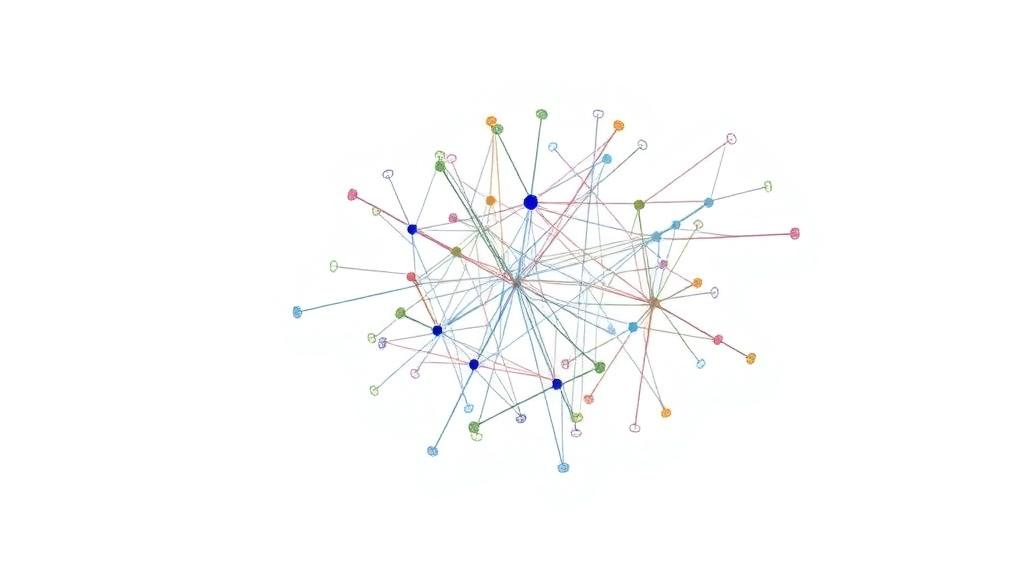
Every network, whether it carries viral content across social media, electricity through a power grid, or pathogens through a human population, has a small set of nodes whose failure or activation can reshape the behavior of the entire system. Finding those nodes has been one of the most persistent challenges in network science, because influence is not a single property that can be read off a node’s connection count. A node with many direct neighbors may be locally popular yet globally peripheral, while a node with fewer links may sit at a junction that channels information across the whole graph. A new study published in Data Mining and Knowledge Discovery by Chommaphat Malang and Aniwat Phaphuangwittayakul of Chiang Mai University introduces a method called Triplet Node Influence, or TNI, which tackles this ambiguity by fusing three complementary views of what makes a node important.
The core idea behind TNI is that node influence should be evaluated simultaneously from local, global, and gravitational perspectives. The local component is built on degree centrality, the simplest and fastest measure of how many immediate connections a node possesses. Degree centrality captures the first-order reach of a node but says nothing about how well connected those neighbors are or how far a signal can travel beyond them. To correct for this blindness, the method incorporates communicability, a measure rooted in the work of Ernest Estrada and Naomichi Hatano that counts not just the shortest paths between nodes but all possible walks between them, weighting longer walks less heavily. Communicability therefore rewards nodes that sit within richly interconnected neighborhoods, where information can circulate through many redundant routes.
The third component is the most conceptually distinctive: a gravity-based H-index. The H-index, originally devised by physicist Jorge Hirsch to quantify the citation impact of individual researchers, has been adapted in network science as a way of measuring a node’s influence through the influence of its neighbors. A node’s H-index is high when it is connected to other nodes that are themselves well connected. By embedding this measure into a gravity model, the authors borrow an analogy from Newtonian physics: each node exerts an attractive force on every other node proportional to the product of their importance scores and inversely related to the distance between them. A node’s gravitational influence thus grows with its own quality and the quality of distant partners, but decays as separation increases, capturing a genuinely global sense of reach that neither degree nor communicability alone can supply.
Combining three measures across every pair of nodes in a large network would ordinarily be computationally punishing, because gravity-style calculations scale poorly as graphs grow. The authors address this with an optimal truncation radius, a cutoff distance beyond which the gravitational contribution of a pair of nodes is considered negligible. The truncation is not arbitrary; the study frames it as an optimization that preserves the precision of the full calculation while discarding terms that contribute little to the final ranking. This design choice allows TNI to retain the accuracy of a global method while keeping its running time within acceptable bounds, which is essential for practical deployment on the large, sparse networks that dominate real applications.
Evaluating a new influence measure is as difficult as designing one, because there is no single ground truth for which nodes truly matter. The study therefore triangulates with three independent metrics. The first is epidemic simulation: the authors run susceptible-infected-removed, or SIR, spreading dynamics seeded at nodes ranked highly by each method, then compare the resulting outbreak sizes using Kendall’s tau, a rank correlation statistic that quantifies how well a method’s ordering of nodes matches the ordering implied by actual spreading power. A method scores well when the nodes it ranks as influential genuinely produce the largest epidemics when infection begins there.
The second metric is the Monotonicity Index, which addresses a subtle but important failure mode of influence rankings. Many centrality measures assign identical scores to large numbers of nodes, producing ties that make the ranking ambiguous and less useful in practice. The Monotonicity Index, which ranges from zero to one, measures how strictly a ranking is ordered, with values near one indicating that nearly every node receives a distinct score. A method with strong discriminatory power can tell apart nodes that coarser measures lump together, which matters enormously when the goal is to select a small handful of targets for vaccination campaigns, security hardening, or marketing interventions.
The third evaluation axis is robustness analysis through node removal. In this test, nodes are deleted from the network in the order prescribed by each ranking, and the researchers track how quickly the network disintegrates as measured by the size of its largest connected component. A good influence ranking should identify nodes whose removal fragments the network rapidly, because those are precisely the nodes whose protection, or whose targeted attack, would have the greatest structural consequence. Robustness analysis connects the abstract ranking problem to concrete engineering questions about cascading failures, infrastructure resilience, and the design of systems that can survive the loss of critical components.
The empirical scope of the study is unusually broad. TNI was tested on twelve unweighted and three weighted real-world networks, spanning the kinds of heterogeneous structures where influence measures are actually deployed, from social and biological systems to technological and informational graphs. Across this suite, the authors report that TNI consistently outperformed several state-of-the-art algorithms in accuracy, as judged by the SIR-based Kendall’s tau comparison, while also achieving strong discriminatory power on the Monotonicity Index. Importantly, the method maintained acceptable network robustness outcomes and competitive time performance, suggesting that the truncation strategy succeeds in its goal of delivering global-quality rankings at a computational cost that scales to real problems. The authors also emphasize that TNI offers a more generalized and adaptable framework, capable of handling both weighted and unweighted graphs without fundamental redesign.
The significance of this work lies less in any single component than in the architecture of the combination. Hybrid approaches to influence identification have proliferated in recent years, with researchers integrating local and global information in various ways, but TNI’s triplet structure is notable for drawing on three theoretically distinct traditions: classical graph-theoretic centrality, spectral-style walk counting through communicability, and physics-inspired gravity modeling filtered through the H-index’s recursive notion of quality. Each tradition compensates for the blind spots of the others. Degree centrality is cheap but shallow; communicability is sensitive to local clustering but expensive and locally biased; gravity models capture long-range importance but depend on a sensible definition of node mass and distance. The truncation radius acts as the practical hinge that makes the synthesis feasible.
The potential applications extend across domains where identifying a few critical nodes changes outcomes. Public health officials could use such rankings to prioritize vaccination or information campaigns during an epidemic, targeting the individuals most likely to seed large outbreaks. Engineers responsible for power grids, transportation systems, and communication networks could harden the nodes whose failure would trigger cascading collapses, a problem that has motivated substantial prior work on critical element identification under multi-objective optimization. In biology, influence measures help pinpoint essential proteins whose removal is lethal to cellular function, while in marketing and social media analytics they identify the accounts through which content spreads most efficiently. The authors have made their implementation publicly available through a GitHub repository, lowering the barrier for other researchers to test the method on their own data.
As with any methodological advance, open questions remain. The optimal truncation radius must be selected for each network, and the interplay between the three components of the triplet score could be tuned differently for graphs with unusual topologies, such as strongly community-structured networks or those with extreme degree heterogeneity. The evaluation, while thorough, relies on simulated spreading dynamics, and translating rankings into real-world interventions always involves factors beyond topology, from temporal dynamics to behavioral responses. Nevertheless, the study offers a carefully validated addition to the toolkit of network science, one that demonstrates that blending local, global, and gravitational perspectives, disciplined by an efficient truncation scheme, can produce rankings that are simultaneously more accurate, more discriminating, and more computationally practical than what any single perspective achieves alone. For a field whose central task is to find the few nodes that matter most in systems of millions, that combination is a meaningful step forward.
Subject of Research: Hybrid centrality methods for identifying influential nodes in complex networks
Article Title: Critical node identification through triplet node influence in complex networks
Article References: Malang, C., & Phaphuangwittayakul, A. (2026). Critical node identification through triplet node influence in complex networks. Data Mining and Knowledge Discovery, 40(6), Article 113. https://doi.org/10.1007/s10618-026-01285-w
Image Credits: AI Generated
DOI: 10.1007/s10618-026-01285-w
Keywords: complex networks, influential nodes, centrality measures, gravity model, H-index, communicability, SIR model, network robustness, data mining, Kendall's tau, node ranking, Chiang Mai University
Cite Scienmag News
Denise Maddox. (October 10, 2026). Triplet Node Influence: A New Hybrid Method Finds the Hidden Hubs of Complex Networks. Scienmag. https://scienmag.com/triplet-node-influence-a-new-hybrid-method-finds-the-hidden-hubs-of-complex-networks/
Denise Maddox. "Triplet Node Influence: A New Hybrid Method Finds the Hidden Hubs of Complex Networks." Scienmag, 10 October 2026, https://scienmag.com/triplet-node-influence-a-new-hybrid-method-finds-the-hidden-hubs-of-complex-networks/. Accessed 10 October 2026.
Denise Maddox. "Triplet Node Influence: A New Hybrid Method Finds the Hidden Hubs of Complex Networks." Scienmag. October 10, 2026. https://scienmag.com/triplet-node-influence-a-new-hybrid-method-finds-the-hidden-hubs-of-complex-networks/


