


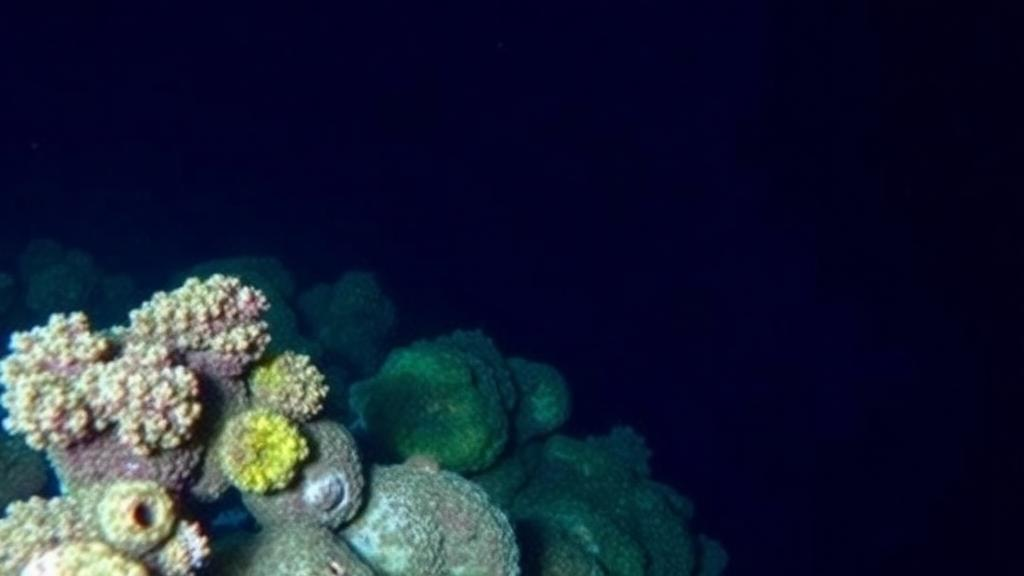
Trinidad and Tobago is famous for its carnival, its pitch lake, and its bustling energy industry, but its largest ecosystem lies far below the waves and has remained almost entirely invisible. Now, the first systematic assessment of the nation’s deep-sea biodiversity has pulled together every biological record ever collected below 200 meters in the country’s waters, and the results reveal both a hidden wealth of life and a startling depth of ignorance. The deep sea covers more than 54,000 square kilometers, or roughly 69 percent of Trinidad and Tobago’s Exclusive Economic Zone, yet only 451 animal morphospecies from 218 families have ever been documented there. With deepwater oil and gas extraction accelerating across the region, researchers warn that decisions about one of the country’s most valuable environments are currently being made in the dark.
The new study, published open access in Discover Oceans, was led by Jaime-Leigh Lue Chin of the University of the West Indies with colleagues from the Natural History Museum in London, the University of British Columbia, the Institute of Marine Affairs, and the University of California, Santa Barbara. The team scoured biodiversity databases such as the Global Biodiversity Information Facility and the Ocean Biogeographic Information System, combed through the collections of major museums including the Smithsonian National Museum of Natural History and Harvard’s Museum of Comparative Zoology, searched more than 1,300 literature results, and physically examined reference collections held in Trinidad and Tobago itself. Every record had to meet strict criteria: confirmed coordinates inside the Exclusive Economic Zone, a depth of at least 200 meters, a date, and a named expedition or institution.
What emerged was a dataset of 1,342 unique biological records spanning ten animal phyla, gathered over 57 years between 1957 and 2014. Of the documented morphospecies, 315 are benthic, living on or in the seafloor, while 136 are pelagic, drifting or swimming in the water column. Chordates dominated the records with 254 morphospecies, followed by arthropods with 96. Most of what has been found so far is megafauna, the large animals visible to cameras and trawls, while the smaller macrofauna, meiofauna, and microbes that drive deep-sea ecosystem functioning remain essentially unstudied. Among the most frequently recorded species were the methane-seep mussel Gigantidas childressi, logged 101 times, and tubeworms of the genus Lamellibrachia, recorded 68 times, both foundation species that create habitat for entire communities.
The geography of discovery is strikingly uneven. Sampling has clustered east of Tobago and along the 200-meter contour of the continental slope in the southeastern waters, with the 400 to 600 meter depth band surveyed most intensively. The two densest hotspots of biological records sit alarmingly close to leased oil and gas blocks: the El Pilar methane seeps and mud volcanoes in the northeast, and the Orenoque-A site in the southeast. Below roughly 2,049 meters, an area covering about 20 percent of the entire Exclusive Economic Zone, no biological research has ever been conducted. The deep pelagic zone, which constitutes the majority of the nation’s living space, has received almost no attention, with no pelagic records at all from depths beyond 2,000 meters.
Statistical analysis makes clear how incomplete the picture remains. Using the Chao2 incidence-based estimator, the team projected a total benthic species richness of around 828 and a pelagic richness of around 772, compared with the 313 benthic and 137 pelagic species actually observed. Family-level richness was estimated at 346 against 218 recorded. The rarefaction and extrapolation curves remain far from their asymptotes, meaning that every additional expedition keeps adding new species. That pattern strongly suggests a large reservoir of undiscovered biodiversity. The most recent expedition to the area, which sampled only about 0.002 percent of the deep sea, still turned up 83 megafaunal morphospecies, at least five of which appeared to be new to science.
The geological setting helps explain why this deep sea is so unusual. Trinidad and Tobago sits on the southern edge of the Barbados Accretionary Prism, one of the largest sediment wedges on Earth, formed where the Atlantic Plate slides beneath the Caribbean Plate. The same tectonic processes that scrape up sediment also generate large oil and natural gas reserves, mud volcanoes, and methane seeps, where chemical-rich fluids carrying sulphide and methane fuel chemosynthesis-based ecosystems that thrive without sunlight. Some of the tubeworms found in these waters, such as Escarpia laminata, live for more than 300 years, meaning damage from industrial activity could take centuries to heal. Deep-sea communities generally recover far more slowly than shallow-water ones, making them especially vulnerable to physical disturbance, pollution, and sediment resuspension from drilling.
The study also exposes a stark legacy of what researchers call parachute science. Not a single one of the eleven vessels or expeditions that have sampled the nation’s deep sea originated from Trinidad and Tobago or anywhere else in the Caribbean. Five were linked to United States institutions, one to France, one to Norway, one to Canada, and two were likely commercial vessels tied to the oil and gas industry. Just three foreign-led expeditions, the R/V Dr. Fridtjof Nansen in 1988, the R/V Atlantis II in 1973, and the E/V Nautilus in 2014, account for nearly three quarters of all records. Perhaps most tellingly, an estimated less than 9 percent of the physical samples collected in the country’s waters have remained in-country. Over 89 percent are housed abroad, with 72.7 percent in the United States and 15.3 percent in the United Kingdom, including large holdings at Harvard, the Smithsonian, the University of Southampton, and the Florida Museum of Natural History.
The methodological record is equally lopsided. Trawling was the workhorse of most expeditions, with eight of the eleven using net-based gear, which explains the apparent dominance of fishes and crustaceans and the near-total absence of delicate soft-bodied animals such as cnidarians, bryozoans, ctenophores, and nemerteans. Only two expeditions deployed remotely operated or human-occupied vehicles, yet those dives recorded the greatest taxonomic diversity, capturing every phylum identified and revealing habitat-specific communities like chemosynthetic mussels and tubeworms that trawls would have shredded or missed entirely. ROV surveys averaged depths of about 1,223 meters compared with just 484 meters for benthic trawling, showing how technology determines what science can see. Image-based surveys, meanwhile, often cannot resolve species without physical specimens for morphological or molecular analysis, leaving many animals unidentified.
The authors argue that closing these gaps demands a multipronged strategy tailored to a Small Island Developing State that cannot afford its own research vessel, given that deep-sea expeditions cost anywhere from tens of thousands to millions of dollars. They propose shared regional assets coordinated through the Caribbean Community, equitable international partnerships in which local scientists lead study design and interpretation, and targeted investment in education and technology transfer. They also point to an underused resource close to home: the offshore oil and gas industry, the only stakeholder currently operating at scale in the deep sea, holds high-resolution bathymetric maps, sampling platforms, and environmental data that could transform baseline knowledge if made accessible. Models such as the SERPENT Project have already shown that scientific partnerships with offshore operators can yield valuable biodiversity data.
Ultimately, the researchers frame this baseline as a foundation for stewardship rather than an endpoint. The findings support a precautionary approach, pointing to vulnerable marine ecosystems such as the El Pilar methane seeps, which remain entirely unprotected despite supporting dense aggregations of ecosystem engineers and playing roles in oceanic food webs and climate regulation. Evidence of regional connectivity, with faunal links to Grenada, the Mid-Cayman Spreading Centre, the Gulf of Mexico, and even Brazil, means that what happens in Trinidad and Tobago’s deep sea resonates across the wider Atlantic. Notable records, including the first Caribbean sighting of the tanaid Carpoapseudes heardi, the recently described tubeworm Lamellibrachia judigobini, and the lithodid crab Paralomis arethusa, hint at how much more awaits discovery. With the government actively leasing deepwater blocks and climate pressures mounting, the authors conclude that the time to invest in deep-sea knowledge, local capacity, and evidence-based ocean governance is now, before the country’s largest and least understood ecosystem is altered beyond recognition.
Subject of Research: Deep-sea biodiversity baseline assessment in Trinidad and Tobago's Exclusive Economic Zone
Article Title: A baseline assessment of deep-sea biodiversity, and guide for future actions to inform stewardship, in Trinidad and Tobago
Article References: Lue Chin, J.-L., Rabone, M., Palacios-Abrantes, J., Gobin, J., Jute, A., Kanhai, L. D. K., & Amon, D. J. (2026). A baseline assessment of deep-sea biodiversity, and guide for future actions to inform stewardship, in Trinidad and Tobago. Discover Oceans, 3(1), Article 18. https://doi.org/10.1007/s44289-026-00119-3
Image Credits: AI Generated
DOI: 10.1007/s44289-026-00119-3
Keywords: deep-sea biodiversity, Trinidad and Tobago, methane seeps, marine conservation, Exclusive Economic Zone, parachute science, oil and gas, Small Island Developing States, species richness estimation, Barbados Accretionary Prism, ocean stewardship, benthic ecosystems
Cite Scienmag News
Violet Maxwell. (October 3, 2026). Trinidad and Tobago’s Deep Sea Holds Hundreds of Species Scientists Have Barely Seen. Scienmag. https://scienmag.com/trinidad-and-tobagos-deep-sea-holds-hundreds-of-species-scientists-have-barely-seen/
Violet Maxwell. "Trinidad and Tobago’s Deep Sea Holds Hundreds of Species Scientists Have Barely Seen." Scienmag, 3 October 2026, https://scienmag.com/trinidad-and-tobagos-deep-sea-holds-hundreds-of-species-scientists-have-barely-seen/. Accessed 4 October 2026.
Violet Maxwell. "Trinidad and Tobago’s Deep Sea Holds Hundreds of Species Scientists Have Barely Seen." Scienmag. October 3, 2026. https://scienmag.com/trinidad-and-tobagos-deep-sea-holds-hundreds-of-species-scientists-have-barely-seen/


