

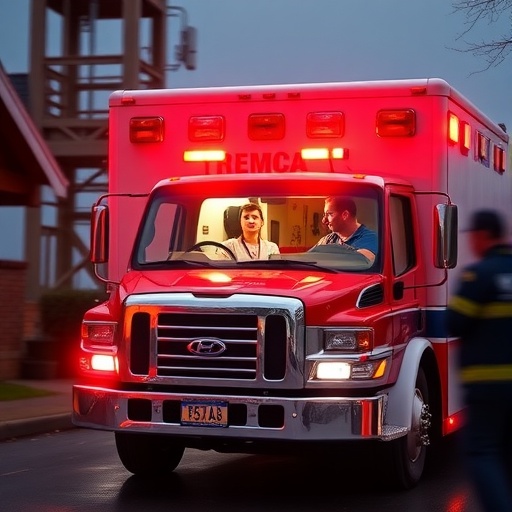
In the intricate and time-critical world of trauma care, the skills and experience of emergency medical services (EMS) clinicians on the front lines can mean the decisive difference between life and death. Recent groundbreaking research led by physician-scientists at UPMC and the University of Pittsburgh School of Medicine elucidates an essential yet previously underappreciated factor in trauma survival outcomes: the individual clinical volume of EMS providers. This study reveals that EMS clinicians who frequently treat trauma patients dramatically improve survival rates, irrespective of their length of service. The findings mark a pivotal shift in our understanding of prehospital trauma care, highlighting clinical volume rather than tenure as the critical driver of patient outcomes.
Published in the February 2026 issue of JAMA Surgery, the study represents the first robust evidence linking the number of trauma patients managed by individual EMS clinicians to early mortality improvements. By analyzing data from a network of EMS providers and trauma research registries, the research team discovered that each increment of five additional trauma patients attended annually by a clinician corresponded with a 10% reduction in mortality within six hours post-injury. These revelations underscore the importance of exposure and hands-on experience in developing the rapid decision-making acumen required in the chaotic environments characteristic of severe trauma incidents.
Dr. Joshua Brown, a leading trauma surgeon at UPMC and senior author on the study, articulates the implication succinctly: “EMS clinicians serve as the initial point of contact within the trauma system. Their expertise sets the foundation for downstream care, given that in the prehospital phase, they are often the sole healthcare providers stabilizing the patient.” This realization challenges traditional assumptions that years of work experience directly translate to clinical effectiveness in trauma care. Instead, it is the frequency of real-world trauma encounters that hones the critical clinical judgment and technical skills necessary for managing life-threatening injuries.
Trauma patients typically present with complex physiological challenges, such as hemorrhage, traumatic brain injury, and compromised airway patency. Unlike more routine EMS interventions—like administering established pharmacological treatments or performing basic monitoring—trauma scenarios demand a nuanced appraisal of rapidly evolving clinical signs and often necessitate invasive procedures. Intubation, needle thoracostomy, and hemorrhage control maneuvers require decisive action supported by experiential knowledge. The study’s findings emphasize that repeated exposure to these scenarios enables EMS clinicians to better anticipate complications, tailor interventions, and mobilize resources efficiently, thereby improving patient survival trajectories.
This investigation builds on prior research published in the Annals of Surgery, which identified correlations between agency-level trauma volume and patient outcomes. The current study refines this knowledge by focusing on the individual EMS practitioner, utilizing merged data sets from Pittsburgh’s Bureau of EMS, STAT MedEvac air medical services, and linked trauma patient outcomes collected through the Linking Investigations in Trauma and Emergency Services (LITES) research network. The integration of prehospital data with hospital outcomes represents a methodological advancement, enabling precise attribution of patient survival benefits to frontline provider experience rather than institutional factors alone.
The implications for EMS system design are profound and represent a call to action for policymakers, healthcare administrators, and emergency response leadership. The traditional model, where clinical volume is diffused across multiple providers and agencies, may dilute expertise and inadvertently compromise patient outcomes by underexposing clinicians to trauma cases. However, centralizing trauma cases could increase response times and reduce geographical coverage, illustrating the complexity of potential operational changes. The study authors advocate for innovative solutions that preserve rapid access while enhancing provider expertise.
Specifically, the researchers propose the institution of national EMS quality benchmarking initiatives analogous to trauma center accreditation programs. Such systems could enable standardized performance measurement and foster a culture of continuous improvement. Additionally, leveraging artificial intelligence-based staffing models could intelligently distribute EMS personnel, ensuring that low-volume clinicians are paired with high-volume counterparts to promote on-the-job learning and optimize patient care dynamics. Simulation training, including virtual reality experiences replicating high-acuity trauma scenarios, could serve as valuable adjuncts to real-world exposure, compensating for variability in clinical volume and elevating proficiency.
Mentorship programs bridging high- and low-volume EMS agencies also hold promise as effective strategies to disseminate experience and best practices. By fostering relationships and knowledge transfer between seasoned trauma responders and their less experienced peers, EMS systems can better harmonize care standards across disparate geographic and organizational settings. These approaches collectively offer a multipronged framework for enhancing the trauma competencies of EMS clinicians without compromising service accessibility to communities.
Community engagement emerges as another critical dimension, as public and governmental support directly influences EMS operational capacity. Sustainable funding streams, policy advocacy, and public awareness can reinforce EMS training infrastructure and technological innovation—factors essential for maintaining an experienced, well-equipped emergency workforce. “When communities value and invest in EMS systems, it translates directly into saved lives,” Dr. Brown emphasizes, underscoring the societal relevance of the research findings beyond clinical environments.
The study analyzed outcomes from 3,649 severely injured trauma patients treated by 359 distinct EMS clinicians over a four-year period (2017-2021). The consistent pattern of decreased mortality linked to higher clinical volumes held across diverse EMS configurations, supporting the generalizability of the findings. Importantly, the researchers found no association between the number of years an EMS clinician had been in service and patient survival, illustrating that time alone does not substitute for high-frequency trauma exposure in developing emergency care competence.
This distinction challenges longstanding metrics of clinical experience that privilege longevity over intensity and specificity of practice. It prompts EMT and paramedic training curricula, as well as certification frameworks, to reconsider emphasis on maintaining clinical volume and trauma case exposure when assessing provider readiness. As trauma patterns evolve with emerging public health challenges, this evidence supports dynamic, experience-focused professional development to maintain a trauma-ready EMS workforce.
The study received funding from several prestigious organizations, including the American College of Surgeons, the U.S. Department of Defense, and the U.S. Army Medical Research Acquisition Activity. Such support underlines the priority placed on advancing trauma systems science and improving outcomes for a population vulnerable to sudden, catastrophic injury. Collaborative efforts among academic institutions, clinical leaders, and EMS agencies exemplify the translational research model necessary to convert observational insights into actionable improvements in emergency care.
In an era where moments define survival chances, this research offers a compelling mandate: prioritizing clinical volume and targeted exposure within EMS not only enriches individual practitioner skill sets but translates into measurable reductions in trauma mortality. Efforts to redesign EMS staffing, training, and quality assurance around this principle could revolutionize prehospital care delivery and set new standards for responsiveness in trauma systems nationwide.
Subject of Research: Impact of individual clinical trauma volume among emergency medical services clinicians on mortality outcomes in severely injured trauma patients.
Article Title: Emergency Medical Individual Clinical Volume and Mortality in Trauma Patients
News Publication Date: 18-Feb-2026
Web References:
- JAMA Surgery article
- UPMC
- University of Pittsburgh
- City of Pittsburgh’s Bureau of EMS
- STAT MedEvac
- LITES research network
References:
Brown J., et al. Emergency Medical Individual Clinical Volume and Mortality in Trauma Patients. JAMA Surgery. 2026. DOI: 10.1001/jamasurg.2025.6741.
Image Credits: UPMC
Keywords: Emergency medicine, Health care delivery, Health care policy, Epidemiology, Traumatic injury, Public health


