
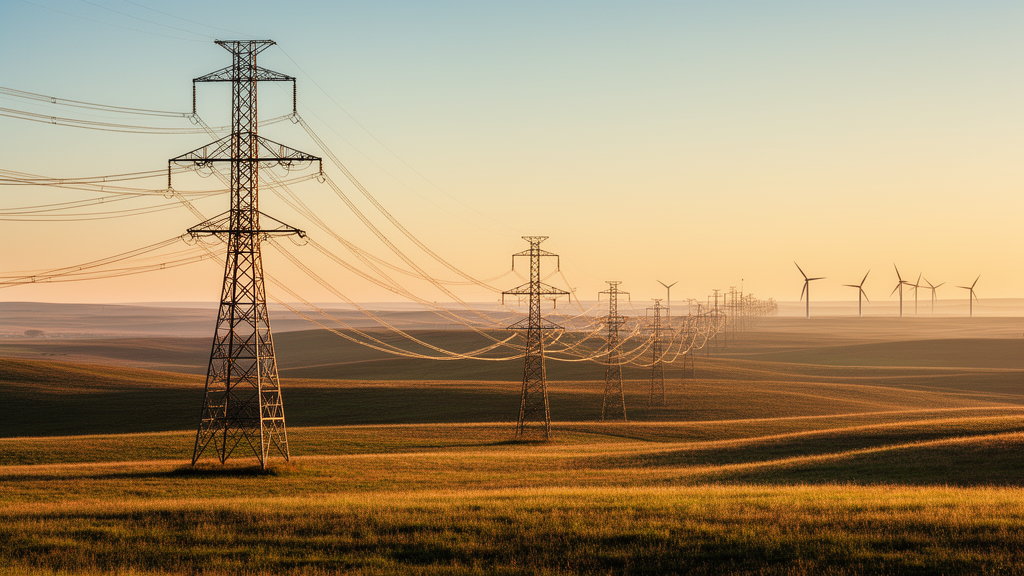
Keeping the lights on across the United States is a feat of engineering that depends on millions of miles of power lines and thousands of power-generation plants. Now, a new Stanford-led analysis published in the journal Environmental Research Letters offers a data-driven answer to a question that has grown increasingly urgent: which investments in the nation’s power grid are most likely to pay off, no matter which way federal policy swings? The study’s conclusion is strikingly consistent. Across a wide range of policy and technology scenarios, building more transmission lines and more wind power infrastructure emerges as a likely winner, with the potential to reduce the costs of producing and providing electricity by several billion dollars per year, savings that could ultimately flow through to consumers as lower electricity rates.
The research arrives at a moment of genuine uncertainty for the U.S. power sector. Important grid investment decisions must be made in an environment of shifting federal priorities, from the Biden administration’s Inflation Reduction Act to the Trump administration’s One Big Beautiful Bill Act. A range of regional market and policy environments, some with ambitious emissions-reduction goals, adds to the complexity. On top of this, power plants and transmission lines are notoriously difficult to site and permit, and they often face backlash from local communities. Meanwhile, demand for electricity is growing, driven by AI data centers, electric vehicles, and other uses. The study, published Oct. 13, was designed to support informed decision-making and durable solutions for the grid amid this policy turbulence, revealing which investments are most likely to keep costs down, clean energy flowing, and lights on regardless of the policy landscape.
“Our team is driven by enabling the country, and in particular policymakers, to make better decisions that can help with affordability while reducing environmental impacts and continuing to leverage the best part of our R&D and innovation for new energy technologies,” said study senior author Inês Azevedo, the Perry L. McCarty Director of the Stanford Woods Institute for the Environment. Azevedo is also a professor of energy science and engineering, a professor by courtesy of Earth system science, and a senior fellow at the Precourt Institute for Energy, all in the Stanford Doerr School of Sustainability, as well as a professor by courtesy of civil and environmental engineering.
The study’s modeling found that across a wide range of scenarios, including policies supportive of different energy sources, some investments consistently bring benefits, such as reducing greenhouse gas emissions and lowering operating costs. Specifically, building more transmission and wind power infrastructure could reduce the costs of producing and providing electricity by several billion dollars per year, which could potentially lower electricity rates for consumers. “Regardless of federal policy, we can move towards decarbonization by focusing on long-lived investments like transmission,” said study lead author Kamran Tehranchi, a PhD student in civil and environmental engineering at the Stanford Doerr School of Sustainability and the Stanford School of Engineering. “Expanding interregional transmission lowers costs and improves access to renewables even without federal tax policy support for renewables.”
The numbers behind that claim are concrete. Across the policy scenarios modeled, building more transmission infrastructure lowers total system costs in every case. Doubling today’s transmission capacity would reduce total annual system costs by 0.2 to 3.4 percent in 2035 and by 1.3 to 7.3 percent in 2050, depending on the scenario. “Transmission is a relatively small line item on your electricity bills compared to generation and distribution costs, but it can play a powerful role in making the generation portion of your bill cheaper,” Azevedo said.
The mechanics of why transmission pays for itself are central to the study’s findings. In the results, transmission accounts for roughly 10 percent of annual costs to build and operate power plants and transmission lines, but each dollar spent on it saves more than a dollar in generation and storage costs. The reason is that expanded transmission lets the system reach the cheapest wind resources and share capacity across regions. In the zero-emissions scenarios for 2050, roughly $20 billion a year of additional transmission spending avoids about $34 billion a year in other costs. In other words, the wires themselves are a comparatively small investment that unlocks much larger savings elsewhere in the system.
The cost benefit of expanding transmission is largest for the standalone grid run by the Electric Reliability Council of Texas, known as ERCOT, which serves about 90 percent of the state’s electricity demand. When the model allows the national grid to expand by 20 percent, ERCOT costs fall by 4 to 9 percent in scenarios with tax credits or zero-emissions goals, not counting the cost of the credits. Those scenarios allow ERCOT to sell more of its power to other grids. “Texas has a very small, almost negligible, amount of power transfer capacity to the rest of the country,” said Tehranchi. “When Texas could benefit from the cheap wind in the mid-west, or when Texas could export its cheap electricity there isn’t sufficient transmission to bring those resources to the demand. Sharing resources reduces costs for everyone.”
Building additional transmission also leads to building more renewable energy generation capacity, according to the model, because it allows more access to regions with high-quality resources, such as Texas’s plentiful wind. In turn, wind capacity lowers generation costs in all four policy scenarios examined. This coupling between wires and turbines is a key insight of the analysis: transmission is not merely a passive conduit but an enabler that changes which generation resources are economically reachable. It helps explain why the two investments, transmission and wind, appear together as consistent winners across the modeling rather than as independent bets.
“Certain investments de-risk the next 25 years no matter what the policy landscape is, and should provide ground for strong bipartisan support,” said Tehranchi. “We should be paying close attention to them.” That framing is aimed squarely at policymakers navigating the competing priorities of different federal administrations and regional markets. The study’s coauthors include Trevor Barnes of Simon Fraser University and Martha Frysztacki of Open Energy Transition. The research was funded by the Stanford Doerr School of Sustainability’s Department of Energy Science & Engineering and the U.S. Department of Energy, with additional support from the Bits & Watts Initiative, an industrial affiliates program of the Precourt Institute for Energy.
The researchers are not stopping with transmission. The team is using the same modeling approach to explore other grid questions, such as where to site data centers, how to sustainably power these centers, and how new technologies such as enhanced geothermal, small modular nuclear reactors, or offshore wind may play a role in providing low-emissions electricity.
Subject of Research: Modeling of U.S. transmission and wind power investments under different federal policy scenarios
Article Title: How to keep electricity costs down amid uncertain federal policy
Article References: How to keep electricity costs down amid uncertain federal policy. Original publication (Bibliographic details unavailable.)
Image Credits: AI Generated
DOI: Not provided
Keywords: electricity grid, transmission, wind power, energy policy, ERCOT, cost savings, decarbonization, Stanford University, Environmental Research Letters, power demand, AI data centers, renewable energy
Cite Scienmag News
Faith Mcneil. (October 28, 2026). Transmission and wind emerge as no-regret bets for a cheaper U.S. power grid. Scienmag. https://scienmag.com/transmission-and-wind-emerge-as-no-regret-bets-for-a-cheaper-u-s-power-grid/
Faith Mcneil. "Transmission and wind emerge as no-regret bets for a cheaper U.S. power grid." Scienmag, 28 October 2026, https://scienmag.com/transmission-and-wind-emerge-as-no-regret-bets-for-a-cheaper-u-s-power-grid/. Accessed 29 October 2026.
Faith Mcneil. "Transmission and wind emerge as no-regret bets for a cheaper U.S. power grid." Scienmag. October 28, 2026. https://scienmag.com/transmission-and-wind-emerge-as-no-regret-bets-for-a-cheaper-u-s-power-grid/