


In a major advancement for plant biology and agriculture, researchers have developed a novel method for systemic gene silencing in plants using engineered dsRNA-protein nanoparticles. This technique, which rapidly characterizes gene functions, could revolutionize in planta gene editing. The new approach addresses the longstanding challenge of transporting RNA molecules across plant cell membranes, providing a faster, non-transgenic solution for enhancing crop productivity.

Credit: Horticulture Research
In a major advancement for plant biology and agriculture, researchers have developed a novel method for systemic gene silencing in plants using engineered dsRNA-protein nanoparticles. This technique, which rapidly characterizes gene functions, could revolutionize in planta gene editing. The new approach addresses the longstanding challenge of transporting RNA molecules across plant cell membranes, providing a faster, non-transgenic solution for enhancing crop productivity.
Gene silencing in plants has faced significant challenges, primarily due to the difficulty of transporting RNA molecules across plant cell membranes and achieving systemic effects. Traditional genetic engineering methods are time-consuming and often limited by plant genotype. Due to these challenges, there is a pressing need for innovative solutions to facilitate efficient gene silencing and enhance crop productivity.
Researchers from the University of Connecticut and Oak Ridge National Laboratory have developed an innovative method using cationized bovine serum albumin (cBSA) and double-stranded RNA (dsRNA) nanocomplexes to achieve effective systemic gene silencing in plants. Published (DOI: 10.1093/hr/uhae045) in Horticulture Research on February 22, 2024, this study demonstrates the potential of these nanocomplexes to overcome the limitations of traditional RNA delivery methods, offering a new tool for plant biotechnology.
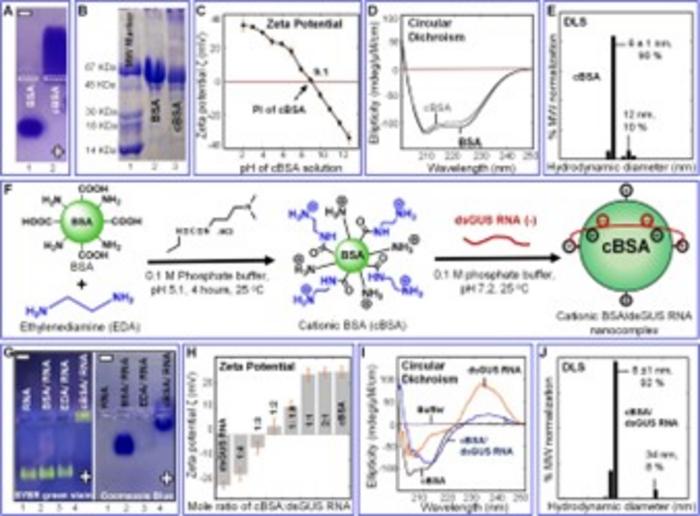
The study presents the development of cBSA/dsRNA nanocomplexes for systemic gene silencing in tobacco and poplar plants. By modifying bovine serum albumin to carry a positive charge, researchers created nanocomplexes that bind dsRNA molecules, facilitating their transport and systemic gene silencing. Experiments demonstrated successful silencing of the DR5-GUS and 35S-GUS genes, achieving significant reductions in gene expression. This technology proved effective in delivering RNA molecules across plant cell membranes, overcoming the negative charge barrier of naked RNA applications. Offering a convenient, fast, and non-transgenic approach, this method holds promise for gene function characterization, crop improvement, and large-scale agricultural applications due to its scalability and cost-effectiveness.
Dr. Yi Li, a lead researcher on the project, stated, “The development of cBSA/dsRNA nanocomplexes represents a significant advancement in plant biotechnology. This technology not only facilitates efficient gene silencing but also offers a practical and scalable solution for improving crop productivity. We believe this method will pave the way for new applications in gene editing and agricultural research.”
The implications of this research are vast, offering a potential solution for transient gene silencing in field-grown crops, including orchard trees. This technology could enhance crop productivity by targeting genes that influence drought tolerance, fruit development, and stress resistance, all without the need for genetic modification. The scalable and inexpensive nature of this method could make it a game-changer for sustainable agriculture.
###
References
Original Source URL
Funding information
This work was supported by the USDA National Institute of Food and Agriculture SCRI (grant no. 2015-70016-23027) and the Connecticut-Storrs Agriculture Experimental Station.
About Horticulture Research
Horticulture Research is an open access journal of Nanjing Agricultural University and ranked number one in the Horticulture category of the Journal Citation Reports ™ from Clarivate, 2022. The journal is committed to publishing original research articles, reviews, perspectives, comments, correspondence articles and letters to the editor related to all major horticultural plants and disciplines, including biotechnology, breeding, cellular and molecular biology, evolution, genetics, inter-species interactions, physiology, and the origination and domestication of crops.
Journal
Horticulture Research
Subject of Research
Not applicable
Article Title
Engineered dsRNA–protein nanoparticles for effective systemic gene silencing in plants
Article Publication Date
22-Feb-2024
COI Statement
The authors declare that they have no competing interests.
Cite Scienmag News
Juliet Wilcox. (June 7, 2024). Transforming agriculture: engineered nanoparticles for plant gene regulation. Scienmag. https://scienmag.com/transforming-agriculture-engineered-nanoparticles-for-plant-gene-regulation/
Juliet Wilcox. "Transforming agriculture: engineered nanoparticles for plant gene regulation." Scienmag, 7 June 2024, https://scienmag.com/transforming-agriculture-engineered-nanoparticles-for-plant-gene-regulation/. Accessed 4 September 2026.
Juliet Wilcox. "Transforming agriculture: engineered nanoparticles for plant gene regulation." Scienmag. June 7, 2024. https://scienmag.com/transforming-agriculture-engineered-nanoparticles-for-plant-gene-regulation/

