


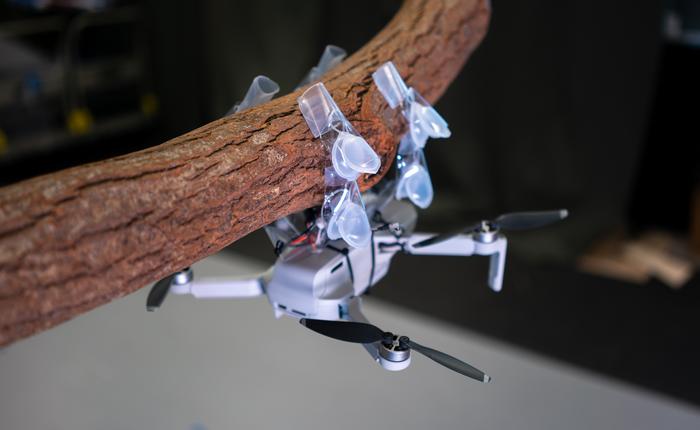
Researchers from the Singapore University of Technology and Design (SUTD), the National University of Singapore (NUS) and Queensland University of Technology (QUT) have made groundbreaking advancements in the field of soft robotics by developing film-balloon (FiBa) soft robots. These innovative robots, designed by a team led by Dr Terry Ching and corresponding author Professor Michinao Hashimoto, introduce a novel fabrication approach that enables lightweight, untethered operation with advanced biomimetic locomotion capabilities.

Credit: SUTD
Researchers from the Singapore University of Technology and Design (SUTD), the National University of Singapore (NUS) and Queensland University of Technology (QUT) have made groundbreaking advancements in the field of soft robotics by developing film-balloon (FiBa) soft robots. These innovative robots, designed by a team led by Dr Terry Ching and corresponding author Professor Michinao Hashimoto, introduce a novel fabrication approach that enables lightweight, untethered operation with advanced biomimetic locomotion capabilities.
The core innovation for these robots involves the development of FiBa modules, which combine transversely curved polymer thin films with three-dimensional printed pneumatic balloons. This combination significantly reduces the weight of soft actuators, enabling untethered operations. The FiBa modules serve as essential building blocks for creating soft robots that can mimic a wide range of natural movements. The soft robots assembled using the FiBa modules can replicate various natural movements, including turtle-inspired crawling, inchworm-inspired climbing, bat-inspired perching, and ladybug-inspired flying. These modes of locomotion demonstrate the versatility and potential of the FiBa modules in numerous applications, showcasing their ability to operate in diverse and challenging environments.
The development of FiBa modules addresses one of the major challenges in the field of soft robotics: untethering robots from electrical or pneumatic power sources. By significantly reducing the weight of soft actuators, the researchers have enabled the integration of essential components such as pumps, valves, batteries, and control boards, paving the way for fully autonomous soft robots. This breakthrough enhances the operational capabilities and potential applications of soft robots.
FiBa soft robots’ ability to mimic natural locomotion strategies demonstrates their exceptional versatility. These capabilities could potentially allow the robots to operate in diverse and challenging environments previously inaccessible to traditional rigid robots, such as disaster zones, uneven terrains, and delicate biological settings.
The lightweight design of FiBa modules increases energy efficiency and operational periods, which is advantageous for space exploration and search and rescue operations. Their adaptability and customisability make them suitable for various industries, including manufacturing, healthcare, and agriculture.
Dr Ching, who completed this work during his joint PhD at SUTD and NUS, drew inspiration from the transversal curvature in a carpenter’s tape. He explained, “When I was thinking about creating lightweight actuators, the idea struck me while using a carpenter’s tape. Its ability to return to its original position, thanks to the transversal curvature, gave me the inspiration for the FiBa modules. Our FiBa modules offer a new tool for designing and customising lightweight, untethered soft robots with advanced functionalities. This breakthrough has the potential to transform the way we approach robotic design, particularly for applications in challenging environments where traditional rigid robots fall short.”
A particularly groundbreaking application is the development of aerial robots with the ability to autonomously unfold their wings, inspired by the flight mechanics of ladybugs. This innovation allows for compact transportation and deployment in confined spaces, followed by autonomous wing unfolding for flight.
Professor Foong Shaohui, head of the SUTD Aerial Innovation Research (AIR) Laboratory, added: “The ability to autonomously unfold the wings mid-air is a significant advancement in aerial robotics. This capability enhances the operational flexibility of aerial robots and opens up new possibilities for deployment in challenging environments such as disaster zones and remote locations.”
Prof Hashimoto, the corresponding author, concluded: “This research is a testament to the power of interdisciplinary collaboration. By leveraging the unique strengths of our team members and institutions, we have developed a solution that addresses a critical challenge in soft robotics. The FiBa modules provide a versatile and scalable platform for creating soft robots that can perform a variety of tasks in different environments.”
This research involved collaborative efforts with expertise from multiple labs, including the SUTD Soft Fluidics Laboratory led by Prof Hashimoto, the SUTD Aerial Innovation Research AIR Laboratory led by Prof Foong and the QUT MicroTE Laboratory led by Professor Toh Yi-Chin. This interdisciplinary collaboration harnesse expertise from various fields to address the complex challenges in soft robotics.
Journal
Science Robotics
Article Title
Crawling, Climbing, Perching, and Flying by FiBa Soft Robots
Article Publication Date
17-Jul-2024
Cite Scienmag News
Denise Maddox. (August 16, 2024). Transformative FiBa soft actuators pave the way for future soft robotics. Scienmag. https://scienmag.com/transformative-fiba-soft-actuators-pave-the-way-for-future-soft-robotics/
Denise Maddox. "Transformative FiBa soft actuators pave the way for future soft robotics." Scienmag, 16 August 2024, https://scienmag.com/transformative-fiba-soft-actuators-pave-the-way-for-future-soft-robotics/. Accessed 3 September 2026.
Denise Maddox. "Transformative FiBa soft actuators pave the way for future soft robotics." Scienmag. August 16, 2024. https://scienmag.com/transformative-fiba-soft-actuators-pave-the-way-for-future-soft-robotics/

