

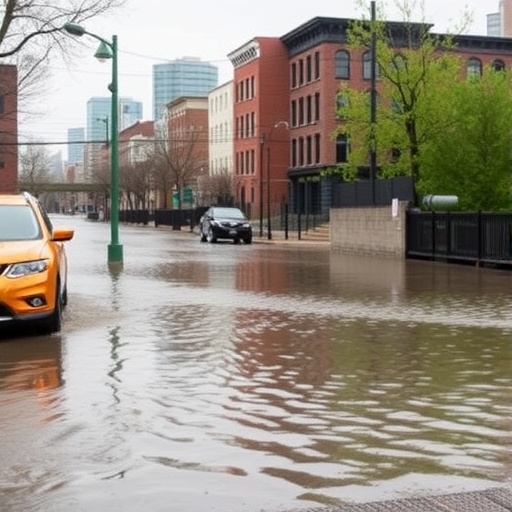
As global temperatures climb and extreme weather events become more frequent, urban areas worldwide face an escalating barrage of water-related hazards. Among these, urban flooding stands as a particularly destructive force, threatening lives, infrastructure, and economic stability. Yet the risks posed by flooding are neither uniform nor random; they are deeply entwined with historical inequities, systemic oppression, and socio-political legacies that have engineered vulnerability into the urban fabric. As detailed in a groundbreaking 2026 study by Hale, Capps, Cook, and colleagues, the current trajectory of urban flood management, if left unaltered, risks perpetuating cycles of inequity and injustice in communities already bearing disproportionate burdens.
Urban flood hazards do not operate in isolation from social contexts. Instead, they intersect with the spatial and institutional footprints left by decades—and sometimes centuries—of discriminatory planning, economic marginalization, and governance decisions. This systemic layering creates a skewed landscape wherein marginalized neighborhoods disproportionately experience the brunt of flood events. Factors such as historical redlining, segregated housing policies, and underinvestment in critical infrastructure concentrate flood exposure and amplify risk for low-income and minority populations. The study underscores that flooding is as much a social challenge as it is a climatic one, necessitating a profound reimagining of flood management through the lens of justice.
Traditional flood adaptation strategies have predominantly embraced a technocratic ethos—engineered barriers, drainage improvements, and infrastructural upgrades designed to stave off inundation. While valuable, these measures often neglect the social dynamics that render certain communities more vulnerable. Without deliberate inclusion of local histories and socio-economic realities, such interventions risk exacerbating disparities rather than alleviating them. The authors argue that many existing adaptation efforts inadvertently sustain or even deepen environmental injustices by privileging protected investments in economically advantaged neighborhoods, while leaving marginalized areas under-protected and overlooked.
The uneven distribution of urban flood risk both within and among cities reveals stark contrasts shaped by political economy and systemic discrimination. Wealthier neighborhoods frequently benefit from robust flood defenses, comprehensive urban planning, and rapid emergency responses. In contrast, marginalized populations often confront aging, poorly maintained infrastructure, limited access to flood insurance, and constrained adaptive capacity. Moreover, the cumulative impacts of climate change interact with these social inequities, intensifying the vulnerabilities of historically oppressed communities and challenging their resilience in unprecedented ways.
Beyond immediate physical impacts, urban flooding inflicts cascading social and economic costs, from disrupted livelihoods and health hazards to long-term displacement and loss of communal cohesion. The study highlights that current disaster response mechanisms frequently overlook these dimensions, perpetuating cycles of vulnerability. For transformative adaptation to be effective, flood management must transcend technical fixes and embed equity at its core—addressing both the legacies of oppression and the contemporary structures that sustain them.
Integral to this transformative agenda is the call for systemic changes in urban governance and planning frameworks. Adaptive management must be fundamentally participatory, empowering community voices historically marginalized in decision-making processes. Equity-driven policies necessitate transparency, accountability, and collaborations that foster inclusive resilience. This means dismantling institutional barriers that have historically restricted access to resources and participation for vulnerable groups, enabling them to co-create solutions aligned with their lived experiences and needs.
Financing mechanisms for flood adaptation also require overhaul to ensure equitable distribution of resources. Current funding models often prioritize large-scale engineering ventures and favor established urban centers with political clout. Equitable adaptation calls for reallocating investments to uplift marginalized communities, supporting localized green infrastructure, nature-based solutions, and socio-economic support systems that augment community resilience holistically. Emphasizing social justice in funding strategies can catalyze more sustainable and inclusive outcomes.
Perhaps most crucially, the research points out that transformative flood adaptation must address the root causes of vulnerability—not merely its symptoms. This involves confronting historic injustices embedded in urban landscapes, including discriminatory land-use policies, entrenched poverty, and systemic racism. Adaptation pathways that integrate social justice principles can disrupt cycles of inequitable risk accumulation, fostering urban environments that are safer, fairer, and more adaptive to changing climate realities.
The authors advocate for an intersectional approach to urban flood risk management, recognizing that vulnerabilities are shaped by complex, overlapping social identities—race, class, gender, and more. Effective adaptation strategies must therefore be sensitive to these nuances, resisting one-size-fits-all solutions. Instead, tailored interventions should be designed with a deep understanding of local context, power dynamics, and community histories, ensuring that the benefits of resilience-building are distributed justly and comprehensively.
The climate crisis presently offers a paradoxical opportunity. While urban flood risks intensify, the urgency for adaptation mobilizes political will, resources, and innovation at unprecedented scales. Harnessing this momentum to pursue transformative, justice-centered flood management can enable cities not only to withstand climate shocks but also to rectify long-standing social inequities. By embedding social justice within climate adaptation, urban centers can evolve into more inclusive spaces that prioritize the dignity and wellbeing of all residents.
In demonstrating the interplay between climatological phenomena and socio-political systems, the study highlights the necessity of integrated interdisciplinary approaches. Collaboration between climatologists, urban planners, sociologists, and community organizations is vital for crafting holistic solutions. These alliances can bridge knowledge gaps and foster adaptive strategies grounded in scientific rigor and social empathy, advancing equitable resilience.
Technological innovation also plays a critical role, but must be wielded judiciously. Smart flood warning systems, real-time data analytics, and resilient infrastructure design can enhance adaptive capacities if deployed with inclusivity in mind. Technology-driven interventions must be accessible, culturally appropriate, and coupled with community engagement to ensure they empower rather than alienate vulnerable populations.
Moreover, legal and policy reforms are necessary to enforce equity in urban flood management. This can include updating land-use regulations to prevent development in high-risk zones, instituting anti-displacement protections during recovery phases, and establishing frameworks for climate justice that embed equity as a non-negotiable component of adaptation funding and governance. Such reforms underline the political dimensions of flood risk and stress the role of policy as a lever for transformational change.
The research signals a critical juncture: failing to embed equity in flood adaptation threatens to entrench unequal vulnerabilities and social stratification further. Conversely, embracing justice-centered approaches offers the promise of resilient, inclusive urban futures where climate risks are mitigated in ways that recognize and redress historic wrongs. Cities, as frontline arenas of climate impacts, hold the key to pioneering these paradigmatic shifts.
In sum, urban flooding is both a symptom and amplifier of social inequalities deeply woven into the urban condition. The 2026 study by Hale and colleagues illuminates these systemic dynamics and presents a compelling case for reimagining flood adaptation through a transformative lens grounded in social justice. As climate change accelerates, the urgency to break cycles of inequitable flood management grows, demanding bold, inclusive, and intersectional action to protect vulnerable communities and promote equitable urban resilience.
Subject of Research: Urban flood hazards, climate change impacts on cities, social justice in flood risk management, inequitable infrastructure investment and adaptation strategies.
Article Title: Transformative adaptation needed to break cycles of inequitable urban flood management
Article References:
Hale, R.L., Capps, K., Cook, E.M. et al. Transformative adaptation needed to break cycles of inequitable urban flood management. Nat Water (2026). https://doi.org/10.1038/s44221-025-00569-7
Image Credits: AI Generated


