


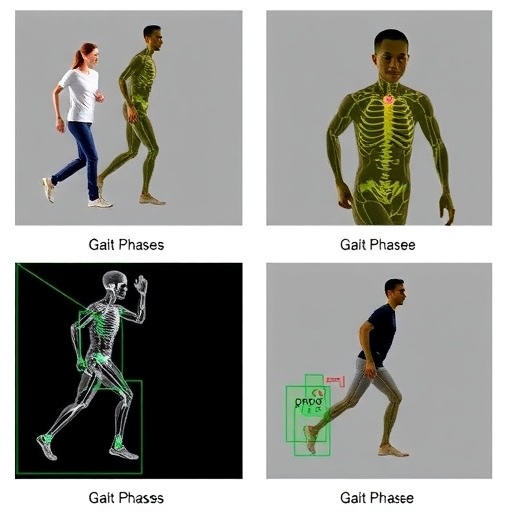
In the rapidly evolving realm of wearable technology, accurately analyzing human gait has become a focal point of research, owing to its vast applications in health monitoring, rehabilitation, and sports sciences. A groundbreaking advancement in this domain has recently emerged from Shandong University, where researchers have introduced a sophisticated transfer learning framework designed explicitly for wearable gait analysis. This novel approach bridges two complementary tasks — predicting the continuous gait cycle percentage and classifying the discrete phases of gait, such as stance and swing — to enhance the accuracy and efficiency of real-time locomotion monitoring.
The intrinsic challenge in gait analysis lies in the complexity of capturing precise temporal dynamics of locomotion outside controlled laboratory settings. Conventional systems typically rely on bulky and costly equipment, restricting their usability to specialized clinical environments. However, inertial measurement units (IMUs), compact sensors capable of capturing accelerometer and gyroscope data, present a portable alternative. Nonetheless, converting the raw IMU data into meaningful insights such as discrete gait phases requires sophisticated modeling, often constrained by computational resources inherent to wearable devices.
Addressing these challenges, the research deploys a regression-to-classification transfer learning strategy. Initially, the system employs deep neural networks trained to predict the continuous gait cycle percentage — a regression task that inherently encourages the model to learn smooth, temporally structured walking patterns that occur during a gait cycle. This preliminary training serves as an effective feature extractor, enabling the model to understand the fluid progression of walking dynamics. Subsequently, the knowledge acquired from this regression model is transferred to the classification task, wherein the framework identifies discrete gait phases like stance and swing.
This two-step learning paradigm leverages the advantages of continuous-to-discrete transition, deftly overcoming several obstacles typical in conventional gait phase recognition methods, including data scarcity and domain shifts. The transfer can occur through two mechanisms: model transfer, where the pretrained neural backbone is fine-tuned on classification data, and feature transfer, which uses embeddings from the regression model as fixed features for classification. Notably, the study found that model transfer yields superior performance, implying that fine-tuning allows better adaptation to the classification task while preserving learned temporal representations.
The team examined two architectures for this approach: a compact deep neural network (DNN) with approximately 0.3 million parameters, optimized for minimal computational overhead, and a Transformer model, well-known for its prowess in modeling sequential data. Various sliding-window sizes of sensor input data were rigorously tested to calibrate temporal resolution and latency trade-offs. Among configurations tested, the model-transfer approach with the compact DNN consistently delivered the best results, registering an impressive F1-score of 0.9788, indicating near-perfect classification accuracy while maintaining computational efficiency.
Efficiency remains paramount when deploying wearable sensor models in real-world scenarios due to limited processing capabilities and battery constraints. Impressively, the compact DNN’s CPU inference latency was measured at under 0.07 milliseconds, an extraordinary speed that facilitates real-time gait phase recognition without taxing the device’s hardware. This efficiency represents a significant step forward in making wearable gait analysis viable for continuous monitoring, potentially transforming clinical diagnostics and personalized health feedback.
Beyond technical performance within the training cohort of older adults, the framework’s generalizability was verified using an independent dataset comprising healthy young adults. Remarkably, the system achieved a classification accuracy of 92.3% on this cross-population test, signaling that the representations learned during continuous gait cycle regression encapsulate fundamental dynamics that transcend demographic variations. Such cross-subject robustness bodes well for broader adoption in diverse populations and real-world conditions.
Fundamentally, this research introduces a paradigm shift in wearable gait analysis workflows. Instead of designing separate models for discrete classification tasks from scratch, it proposes a unified scheme where a continuous regression-pretrained model provides a foundational understanding of gait dynamics. This approach not only streamlines training pipelines but also enhances model robustness and interpretability by exploiting the intrinsic continuity in human locomotion.
In practical terms, the implications for rehabilitation technology are profound. Wearable devices equipped with this transfer learning framework could assist clinicians in monitoring patient progress more accurately, detecting subtle changes in gait that may signal improvement or deterioration. Such real-time feedback could enable timely therapeutic interventions, ultimately improving patient outcomes and enabling more personalized care regimens.
From the perspective of sports science and performance tracking, this innovation facilitates finer-grained gait stage recognition during dynamic activities, thereby offering athletes and coaches insights into motion mechanics, balance, and potential injury risks. The lightweight nature of the model ensures that such analytics can be seamlessly integrated into everyday wearables, making continuous performance monitoring feasible during training and competition.
The scientific community also stands to benefit, as the methodological insights extend beyond gait analysis to other temporal biomechanical signals captured via wearables. The concept of leveraging regression tasks to bootstrap classification performances via transfer learning could inspire analogous frameworks in motion capture, activity recognition, and neurological movement disorder diagnostics.
Ultimately, this study published in Artificial Intelligence and Autonomous Systems underscores the compelling synergy between deep learning, wearable sensor technology, and biomechanical analysis. It exemplifies how innovative computational frameworks can surmount longstanding barriers in mobility assessment, creating pathways to smart, efficient, and accessible health monitoring solutions.
The pioneering work by Huanghe Zhang and colleagues thus represents a critical milestone in the journey toward intelligent wearable systems capable of nuanced gait interpretation, promising transformative impacts spanning health care, sports, and human-computer interaction domains.
Keywords
Artificial intelligence, wearable sensors, gait analysis, transfer learning, deep neural networks, regression-to-classification, real-time processing, inertial measurement units, compact DNN, Transformer model
Cite Scienmag News
Denise Maddox. (May 29, 2026). Transfer Learning Enhances Accuracy and Efficiency of Gait Phase Classification in Wearable Sensors. Scienmag. https://scienmag.com/transfer-learning-enhances-accuracy-and-efficiency-of-gait-phase-classification-in-wearable-sensors/
Denise Maddox. "Transfer Learning Enhances Accuracy and Efficiency of Gait Phase Classification in Wearable Sensors." Scienmag, 29 May 2026, https://scienmag.com/transfer-learning-enhances-accuracy-and-efficiency-of-gait-phase-classification-in-wearable-sensors/. Accessed 4 September 2026.
Denise Maddox. "Transfer Learning Enhances Accuracy and Efficiency of Gait Phase Classification in Wearable Sensors." Scienmag. May 29, 2026. https://scienmag.com/transfer-learning-enhances-accuracy-and-efficiency-of-gait-phase-classification-in-wearable-sensors/


