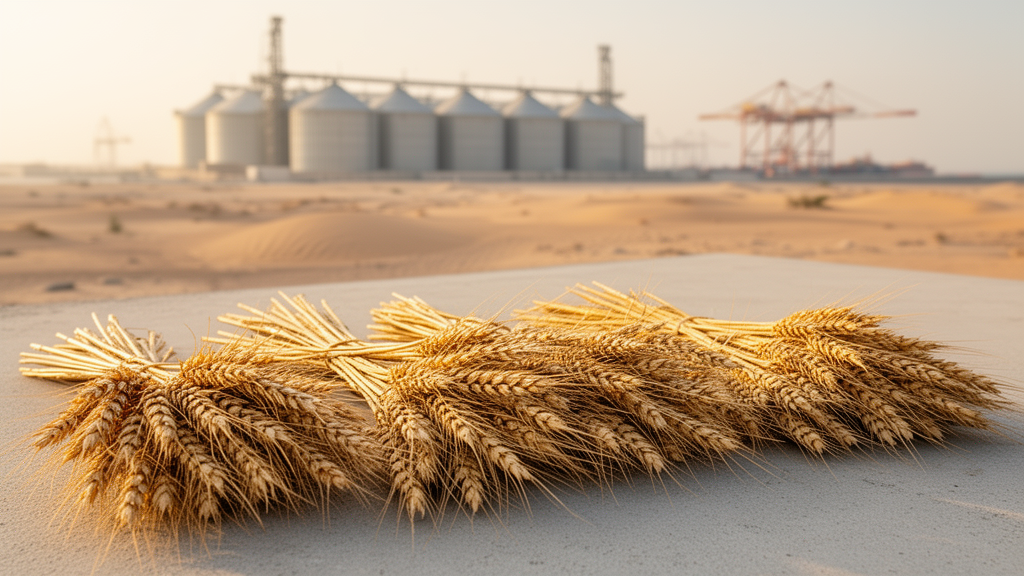
The United Arab Emirates imports most of the cereals its population consumes, a dependence that leaves the country exposed to geopolitical conflict, export restrictions, market volatility and supply-chain disruptions. A new stakeholder-based study, published as open access research in Discover Sustainability, has used exploratory scenario planning to map how the country’s cereal security could evolve through 2050 under different combinations of global trade stability and domestic production capacity. The research team, led by Tolera Senbeto Jiren with colleagues including Khalil A. Ammar and Balan Sundarakani, began with a review of academic publications and official reports.
They then engaged 35 stakeholders through a structured online survey, an online driver-sorting exercise and a validation workshop. Responses from these activities informed the assessment of drivers, the mapping of the cereal security system and the development of scenarios. The process initially identified 85 potential drivers of change, which the researchers refined into 30 distinct drivers.
When stakeholders rated these drivers for importance and uncertainty, two stood out: global trade stability and domestic cereal production capacity. Because these factors scored highest on both measures, they were chosen as the axes of the scenario matrix. Crossing the two axes produced four plausible futures for UAE cereal security.
The researchers named them Vulnerable Dependence, System Shock, Adaptive Sufficiency and Strategic Surplus. Each scenario represents a different combination of how stable global trade proves to be and how much domestic production capacity the country develops over the coming decades. Among the four possibilities, workshop participants identified Strategic Surplus as their preferred future for the country’s cereal security.
According to the study, progress toward that outcome would require expanding water-efficient domestic production and diversifying the sources and routes through which imports reach the country. The findings carry implications beyond the Gulf. The authors argue that arid, import-dependent regions generally need integrated cereal resilience strategies that combine water-efficient production, agricultural research and innovation, trade diversification and stronger coordination across the cereal supply chain.
Because contemporary agrifood systems increasingly rely on global trade and value chains, the connections that improve food access also heighten exposure to instability in international markets, particularly for countries that meet most of their demand through imports. Scenario planning of this exploratory kind does not predict which future will occur; instead, it outlines plausible alternatives that can help decision-makers test strategies against a range of outcomes.
As an accepted article shared ahead of final editorial completion, the work is citable and carries a permanent DOI, though the version is subject to further edits before the final Version of Record replaces it. For a nation whose cereal demand sits almost entirely in the hands of global markets, the study’s central message is that resilience depends on acting on both axes at once: securing trade relationships while building domestic capacity suited to a water-scarce environment.
Subject of Research: Stakeholder-informed scenario planning for cereal food security under trade and production risks in the United Arab Emirates
Article Title: Assessing the future of food security under trade and production risks in the United Arab Emirates
Article References: Jiren, T. S., Ammar, K. A., Gebre, G. G., Mohammed, M. J., Tiba, T. K., & Sundarakani, B. (2026). Assessing the future of food security under trade and production risks in the United Arab Emirates. Discover Sustainability, 7(1), Article 1498. https://doi.org/10.1007/s43621-026-04617-4
Image Credits: AI Generated
DOI: 10.1007/s43621-026-04617-4
Keywords: food security, United Arab Emirates, cereal imports, scenario planning, trade risks, domestic production, water-efficient agriculture, supply chain resilience, stakeholder survey, agrifood systems, Assessing, future
Cite Scienmag News
Violet Maxwell. (October 28, 2026). Trade and Production Risks Shape Four Futures for UAE Cereal Security. Scienmag. https://scienmag.com/trade-and-production-risks-shape-four-futures-for-uae-cereal-security/
Violet Maxwell. "Trade and Production Risks Shape Four Futures for UAE Cereal Security." Scienmag, 28 October 2026, https://scienmag.com/trade-and-production-risks-shape-four-futures-for-uae-cereal-security/. Accessed 30 October 2026.
Violet Maxwell. "Trade and Production Risks Shape Four Futures for UAE Cereal Security." Scienmag. October 28, 2026. https://scienmag.com/trade-and-production-risks-shape-four-futures-for-uae-cereal-security/