

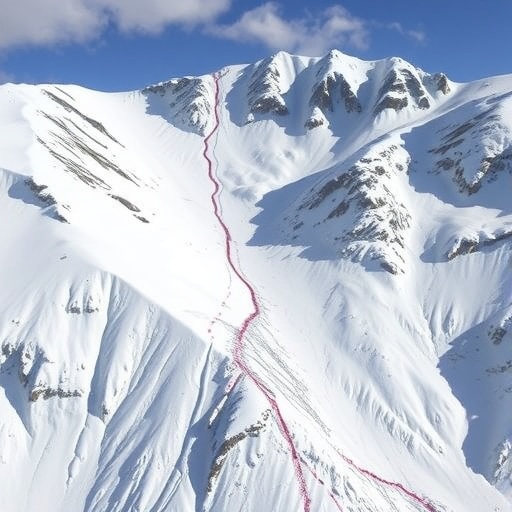
In a groundbreaking advancement in avalanche science, researchers have unveiled the elusive fracture dynamics lurking beneath snow avalanches, shedding light on the transition from sub-Rayleigh to supershear fracture speeds. This profound insight, recently published in Nature Communications, is set to revolutionize our understanding of how snow masses fracture and accelerate, with significant implications for hazard prediction and mitigation in alpine regions.
Snow avalanches are powerful natural phenomena, often devastating and unpredictable, primarily due to the rapid and complex processes by which the snowpack fractures and initiates movement. Until now, the detailed fracture mechanics — especially the transition from sub-Rayleigh speeds, typical of classical crack propagation, to supershear speeds that exceed the shear wave velocity of the medium — remained largely theoretical or modeled without direct experimental evidence in snow. The latest experiments have cracked open this black box, demonstrating clear signatures of this transition through sophisticated laboratory avalanche simulations.
Central to this study is the meticulous reproduction of snow fracture conditions under controlled settings. By engineering laboratory snowpacks designed to mimic natural avalanche-ready layers, the research team was able to systematically trigger fractures and observe the resulting fracture fronts. This experimental ingenuity allowed for precise measurements of fracture speeds and the identification of the critical velocity thresholds marking the switch from sub-Rayleigh to supershear regimes.
Fracture propagation in solids is typically limited by the speed at which stress waves travel through the material — the Rayleigh wave speed is a classical limit. Exceeding this limit, though theoretically possible, was rarely observed in natural or synthetic materials without exotic conditions. In snow, with its granular and porous structure, the dynamics are even more complex. The team’s findings suggest that snow fracture fronts can indeed accelerate beyond the traditional sub-Rayleigh regime to a supershear state, an insight that recalibrates previous assumptions about avalanche fracture mechanics.
The implications of observing the sub-Rayleigh to supershear transition are manifold. Supershear fractures propagate faster than the seismic waves they generate, producing unique acoustic and vibrational signatures that can be harnessed for real-time avalanche monitoring and early warning systems. By characterizing these seismic fingerprints, scientists and engineers could enhance detection capabilities, potentially providing crucial seconds to minutes for evacuation and hazard response.
Moreover, the study reveals that the fracture energy dissipation, crack path stability, and the resultant snow displacement patterns vary dramatically between the two fracture regimes. Sub-Rayleigh fractures produce more gradual snow disintegration, whereas supershear fractures result in abrupt, high-energy events, contributing to faster avalanche initiation and propagation. Understanding these nuances is essential for improving numerical models that simulate avalanche dynamics and predict runout distances.
A striking element of this research is the interdisciplinary approach combining fracture mechanics, materials science, and seismology. The team incorporated high-speed imaging, digital image correlation techniques, and acoustic emission monitoring to capture the intricate fracture dynamics. These complementary methodologies enabled a multi-scale analysis, from microscale crack front propagation to macroscale avalanche snow layer failure.
Furthermore, the study advances the theoretical framework of fracture physics in porous, heterogeneous media. Snow, as a quasi-brittle material with varying densities, introduces complex interactions between stress fields and the microstructural arrangement of ice grains and air pockets. The researchers’ findings leverage these interactions to explain the conditions under which fracture speeds can supremely escalate, challenging prevailing frameworks that treated snow avalanche fractures as purely sub-Rayleigh phenomena.
The laboratory avalanche experiments also provide empirical data to refine seismic hazard models for mountainous areas. Natural avalanches generate ground vibrations detected by seismometers, but linking these signals directly to fracture dynamics was previously speculative. By correlating fracture velocities with spectral features of seismic data, this work bridges a critical gap between laboratory physics and field observations, opening new avenues for geophysical monitoring.
Importantly, this research may influence engineering practices for avalanche defense infrastructures. Designing barriers and control systems increasingly relies on accurate simulations of avalanche mechanics and impact forces. Integrating knowledge about supershear fracture phenomena could lead to the development of structures more resilient to the sudden and intense loading generated by high-velocity snow fractures.
The article also underscores the potential effect of environmental variables such as temperature, snow density, and layering on fracture transition behavior. Variations in these parameters alter snow mechanical properties, thus modulating the threshold at which fractures accelerate beyond the Rayleigh speed. This contextual sensitivity highlights the necessity of localized assessments to predict avalanche behavior accurately for different mountainous regions.
While the experimental setup simulates many aspects of natural snowpacks, the authors acknowledge limitations including scale effects and the intrinsic anisotropy of natural conditions. Future work is suggested to include in situ experiments using instrumented snow slopes, complemented by numerical modeling capturing more complex boundary conditions and snow heterogeneity.
Overall, the discovery of supershear propagation within avalanche fractures signifies a paradigm shift, emphasizing that snow fracture behavior is not merely a slow, progressive failure but can involve rapid, sonic-speed transitions. It opens the door to cross-disciplinary innovations in avalanche science, including improved forecasting tools and better risk assessment frameworks for alpine communities worldwide.
This pioneering study heralds a new era in understanding snow mechanics, blending high-precision experimental physics with geophysical applications. As climate change continues to affect mountain environments by altering snowpack stability, the refined knowledge of fracture propagation speeds and transitions is timely. It enhances our capacity to safeguard lives and infrastructure by anticipating and mitigating avalanche hazards with unprecedented accuracy.
In conclusion, the research delineates clear experimental signatures of the sub-Rayleigh to supershear transition in snow avalanche fractures, substantiating theories long debated in fracture mechanics. By illuminating the underpinnings of fracture velocity regimes in snow, it sets a foundation for advancing both scientific knowledge and practical avalanche hazard management — a breakthrough with global relevance for anyone living in or interacting with mountainous snow-covered terrains.
Subject of Research: Snow avalanche fracture mechanics, specifically the transition from sub-Rayleigh to supershear fracture propagation.
Article Title: Signatures of the sub-Rayleigh to supershear fracture transition in snow avalanche experiments.
Article References:
Bergfeld, B., Gaume, J., Bobillier, G. et al. Signatures of the sub-Rayleigh to supershear fracture transition in snow avalanche experiments. Nat Commun 16, 11153 (2025). https://doi.org/10.1038/s41467-025-65825-6
Image Credits: AI Generated


