

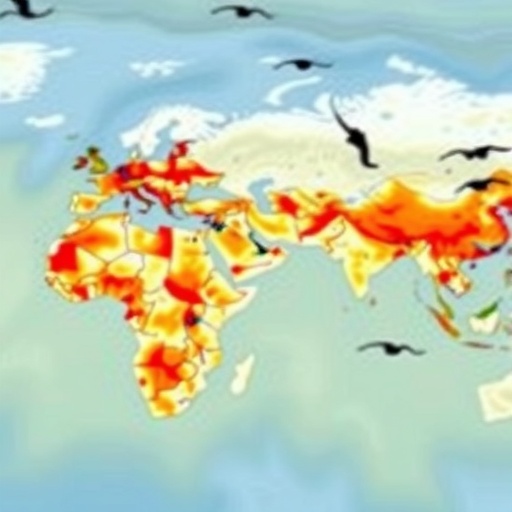
As global society grapples with the ongoing challenges of emerging infectious diseases, a groundbreaking study published recently in Nature Communications has unveiled innovative methodologies that revolutionize our understanding of avian influenza risks worldwide. The research, led by Li, Y., Qiao, Y., Zhan, Y., and their team, presents a novel approach to mapping the patterns of avian influenza through the lens of waterbird activity entropy, offering insights that could dramatically enhance early warning systems and containment strategies for this pervasive zoonotic threat.
Avian influenza, commonly known as bird flu, has persistently posed a significant threat to both poultry industries and public health due to its capacity for rapid mutation and interspecies transmission. Traditional surveillance systems have relied heavily on static observational data and localized outbreak reports, limiting the scope and predictability needed for global response frameworks. The study at hand circumvents these limitations by harnessing the dynamic behavioral patterns of waterbirds as key vectors in the viral dissemination process.
Central to this research is the concept of “activity entropy,” a quantitative measure borrowed from statistical physics and information theory, applied creatively to the behavioral randomness and movement heterogeneity of waterbird populations. By analyzing large datasets of satellite-tracked migratory routes, stopover sites, and foraging behaviors, the researchers have constructed spatial-temporal models that capture the complexity of avian mobility in unprecedented detail.
The integration of activity entropy into epidemiological modeling enables the identification of regions where waterbird behaviors exhibit high degrees of unpredictability, paradoxically correlating with elevated risks of avian influenza transmission. The entropy-based framework thus serves as a proxy for virus dissemination potential, highlighting ecological niches where viral spillover and reassortment events are most probable.
This methodological advancement was underpinned by extensive collaborations between virologists, ecologists, and data scientists, reflecting the multidisciplinary nature of contemporary infectious disease research. The team’s analytical pipeline incorporated over a decade’s worth of telemetry data across multiple continents, supplemented by viral genomic sequences to validate hotspots of influenza activity identified via entropy metrics.
One of the study’s pivotal findings is the global risk map it produced, delineating hotspot zones that transcend geopolitical boundaries and traditional epidemiological categorizations. These high-risk areas frequently coincide with critical waterbird congregation sites such as major wetland complexes and migratory corridors, corroborating the hypothesis that the spatial-temporal complexity of host species movement directly influences epidemic potential.
Moreover, the authors discuss how anthropogenic factors intersect with natural behaviors to modulate these risk patterns. Land-use changes, wetland degradation, and climate variability were all shown to alter waterbird movement entropy, suggesting that environmental management could play a crucial role in mitigating future avian influenza outbreaks.
The research also delves into the mechanistic underpinnings of viral survival and transmission amid waterbird communities. Viral shedding rates, interspecies contact frequencies, and environmental viral persistence were modeled in relation to entropy-driven movement patterns, unveiling the subtle interplay between host ecology and viral epidemiology. This level of mechanistic detail enriches our understanding of how influenza viruses maintain circulation across diverse aquatic ecosystems.
Importantly, this entropy-centric perspective provides practical applications for public health and wildlife management agencies. By prioritizing surveillance resources toward areas with elevated activity entropy, agencies can preemptively detect early incursions of highly pathogenic strains, enabling swifter containment responses. This risk-based allocation strategy represents a substantial improvement over reactive approaches relying on outbreak detection alone.
The study’s implications extend beyond avian influenza. The conceptual framework of activity entropy has potential utility in unraveling the transmission dynamics of other zoonotic diseases involving wildlife reservoirs with complex movement behaviors. This cross-cutting applicability underscores the transformative impact of integrating ecological complexity into infectious disease modeling.
Furthermore, the authors emphasize the value of open data sharing to amplify the effectiveness of such models. The aggregation of telemetry data from multiple bird monitoring programs worldwide was critical to their analysis, advocating for expanded global collaboration in wildlife tracking and epidemiological monitoring.
Critically, the study recognizes the limitations inherent in the approach, including data gaps in certain geographic regions, potential biases in species sampling, and the stochastic nature of viral mutation. Nonetheless, the entropy framework provides a robust scaffold upon which more refined models incorporating additional ecological and virological variables can be constructed.
The innovative use of information theory metrics to parse biological movement patterns signifies a paradigm shift in how researchers conceptualize disease ecology. By quantifying behavioral uncertainty, this research unlocks new paths to anticipating outbreak emergence rather than simply reacting to it.
This pioneering work arrives at a crucial juncture as zoonotic diseases continue to challenge global health infrastructures. Its blend of computational sophistication and ecological nuance offers a powerful toolset for policymakers, epidemiologists, and conservationists aiming to mitigate the risks of future pandemics emanating from wildlife reservoirs.
In summary, Li and colleagues have set a new standard in infectious disease risk mapping through their creative application of activity entropy to waterbird movements. Their integrative approach promises to reshape surveillance strategies, foster international cooperation, and deepen our fundamental understanding of the ecological drivers underpinning avian influenza transmission across the planet.
Subject of Research:
Global avian influenza risk patterns and their relationship to waterbird behavioral dynamics using activity entropy.
Article Title:
Mapping global avian influenza risk patterns through waterbird activity entropy.
Article References:
Li, Y., Qiao, Y., Zhan, Y. et al. Mapping global avian influenza risk patterns through waterbird activity entropy. Nat Commun (2026). https://doi.org/10.1038/s41467-026-70432-0
Image Credits: AI Generated


