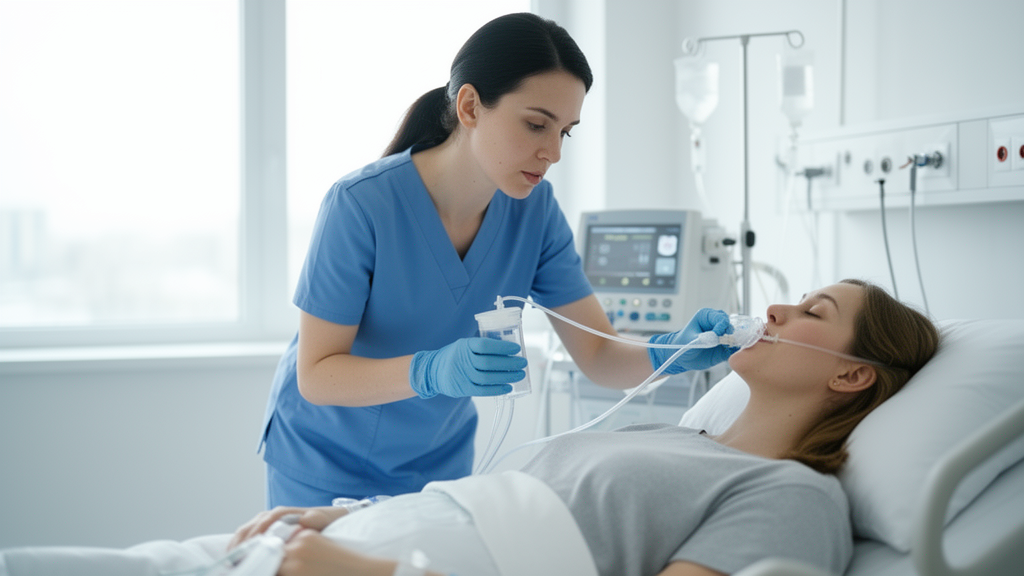
Intensive care units are among the most energy-hungry corners of modern medicine, and a new study from Paris suggests that even the humble diagnostic procedure can carry a surprisingly large carbon price tag. Researchers at La Pitié-Salpêtrière University Hospital measured the greenhouse gas emissions, financial costs and waste produced by three techniques used to sample the airways of mechanically ventilated patients with suspected ventilator-associated pneumonia. Their verdict: tracheal aspiration, the simplest of the three, generated just 0.57 kilograms of carbon dioxide equivalents per procedure and cost around €4, while bronchoalveolar lavage performed with a single-use bronchoscope emitted 6.60 kilograms of carbon dioxide equivalents and cost €209 per test.
The study, published in Annals of Intensive Care, was conducted as a prospective observational assessment in one of the hospital’s medical intensive care units. The team, led by Adam Celier, directly observed three routine procedures for each technique without altering clinical practice or collecting any patient-identifiable data. They documented every item used—drugs, medical devices and consumables, down to the packaging—while timing each procedure. The French Intensive Care Society’s ethics committee waived formal submission requirements because no patient-identifiable data were collected.
To calculate emissions, the researchers applied a simplified Life Cycle Assessment methodology using the Carebone tool, developed by Assistance Publique–Hôpitaux de Paris in 2023. This approach traces each product from raw material extraction to final disposal, a “cradle-to-grave” model that assigns specific emission factors to individual drugs and devices. The team defined the functional unit as a single respiratory sampling procedure in a ventilated patient with suspected ventilator-associated pneumonia, a choice intended to make the results relevant for clinical practice and international comparison. Emission categories included personal protective equipment, infection control supplies, medication administration materials, sampling devices, sample transport packaging, staff time, biocleaning, laundry and building energy use. Laboratory analysis and downstream waste processing of samples were excluded because these steps were considered comparable across the three techniques.
The results revealed a steep gradient. Blind bronchial sampling, in which a protected specimen catheter is threaded through the endotracheal tube without direct visualization, produced 2.82 kilograms of carbon dioxide equivalents per procedure—4.9 times more than tracheal aspiration. Bronchoalveolar lavage, which requires a disposable flexible bronchoscope inserted under direct visual guidance, emitted 11.3 times more than tracheal aspiration and 2.3 times more than blind bronchial sampling. For the lavage procedure, the single-use bronchoscope alone accounted for 2.2 kilograms of carbon dioxide equivalents, and the preparation of neuromuscular blocking drugs, including material use and two minutes of nurse time, added another 0.9 kilograms.
Waste told a similar story. Tracheal aspiration generated the least material, about 165 grams per procedure, mostly plastic. Blind bronchial sampling produced 295 grams, while bronchoalveolar lavage with a disposable scope produced a striking 1,125 grams per procedure, driven largely by the bronchoscope and its packaging. The cost analysis, which combined device and drug acquisition prices negotiated by the hospital network with staff time valued through a time-driven activity-based costing method using French public hospital salary scales, showed bronchoalveolar lavage was nine times more expensive than blind bronchial sampling and 52 times more expensive than tracheal aspiration. Blind bronchial sampling, in turn, cost six times more than tracheal aspiration.
When the researchers scaled these figures to a full year of activity, the stakes became clearer. In 2023, the unit performed 341 respiratory sampling procedures: 73 percent were blind bronchial sampling, 21 percent bronchoalveolar lavage and 6 percent tracheal aspiration. Together they generated 1,181 kilograms of carbon dioxide equivalents and cost €20,835. Blind bronchial sampling accounted for 699 kilograms of the emissions and €5,897 of the cost; bronchoalveolar lavage contributed 469 kilograms and €14,850; tracheal aspiration added just 13 kilograms and €88. The team noted that the annual total equaled roughly 3.2 round-trip flights from Paris to New York, using a benchmark of 364 kilograms of carbon dioxide equivalents per one-way flight.
The researchers also modeled what would happen if the unit adopted a single technique for all procedures. Switching entirely to tracheal aspiration would cut emissions by 84 percent and costs by 93 percent relative to the current mix, bringing the annual footprint down to 194 kilograms and €1,367. Exclusive use of blind bronchial sampling would reduce emissions by 19 percent and costs by 61 percent. Adopting bronchoalveolar lavage across the board, by contrast, would raise emissions by 91 percent and costs by 242 percent, reaching 2,251 kilograms and €71,320 per year.
Nursing staff offered a practical perspective through a survey distributed to 41 ICU nurses, with 30 responding. Respondents were predominantly female and mostly under 30, and 40 percent had less than two years of professional experience. When asked about technical difficulty, 87 percent considered tracheal aspiration the least challenging, while 83 percent identified bronchoalveolar lavage as the most demanding. Tracheal aspiration was ranked fastest by 93 percent, and bronchoalveolar lavage was unanimously reported as the slowest. On first-attempt success, 47 percent rated bronchoalveolar lavage as most effective, though 57 percent identified tracheal aspiration as least effective, noting that repeat sampling decisions rest on operator judgment rather than predefined criteria. When asked which technique fit best into daily workflow, 63 percent favored blind bronchial sampling, 30 percent preferred tracheal aspiration and only 7 percent chose bronchoalveolar lavage.
The authors caution that the environmental advantage of tracheal aspiration must be weighed against its clinical trade-offs. Tracheal aspiration risks overdiagnosing pneumonia because it is difficult to distinguish colonization from infection, potentially driving unnecessary antibiotic use—a burden with its own substantial carbon footprint and a contribution to antimicrobial resistance. Blind bronchial sampling, with its moderate footprint, relative simplicity and good diagnostic specificity, may represent what the researchers call the most pragmatic balance between diagnostic efficacy and environmental responsibility. Bronchoalveolar lavage remains highly specific and supports optimized antibiotic stewardship, but it is resource-intensive, demands more staff time and carries adverse events in roughly 14 percent of cases, often related to operator experience.
Several limitations shape the interpretation. The study evaluated only single-use bronchoscopes; prior work indicates reusable devices carry a lower footprint over multiple uses, though the researchers note that even excluding the disposable scope’s 2.2 kilograms, the remaining lavage footprint of about 4.4 kilograms would still exceed the other techniques even when accounting for uncertainty, which the Carebone tool reported at 19 to 25 percent across techniques. The annual tally also included samples collected for community-acquired or nosocomial pneumonia in ventilated patients and procedures in immunocompromised patients with respiratory failure, so it overestimates the true number of ventilator-associated pneumonia procedures, and the authors stress that a complete shift to tracheal aspiration alone is neither realistic nor desirable. Technical practices such as neuromuscular blockade during lavage may vary between centers, and occasional repeat attempts with tracheal aspiration or blind bronchial sampling could modestly raise their footprints, though only the sampling device is typically reused. Even so, the researchers argue that the choice of sampling technique, while clinically driven, can serve as a meaningful lever for reducing the carbon footprint of intensive care without compromising care quality.
Subject of Research: Comparing the carbon footprint, cost and nursing impact of three respiratory sampling techniques for ventilator-associated pneumonia in an intensive care unit.
Article Title: Choosing wisely: comparing the carbon footprint of three respiratory sampling techniques for ventilator-associated pneumonia
Article References: Celier, A., Correard, C., de Maisoncelle, I., Dupont, E., Demoule, A., & Lecronier, M. (2025). Choosing wisely: comparing the carbon footprint of three respiratory sampling techniques for ventilator-associated pneumonia. Annals of Intensive Care, 15(1), Article 191. https://doi.org/10.1186/s13613-025-01597-y
Image Credits: AI Generated
DOI: 10.1186/s13613-025-01597-y
Keywords: ventilator-associated pneumonia, carbon footprint, intensive care, tracheal aspiration, bronchoalveolar lavage, blind bronchial sampling, single-use bronchoscope, life cycle assessment, healthcare emissions, medical waste, sustainable healthcare, nursing survey
Cite Scienmag News
Ophelia Keating. (October 28, 2026). Tracheal aspiration emerges as the greenest way to test for ventilator-associated pneumonia. Scienmag. https://scienmag.com/tracheal-aspiration-emerges-as-the-greenest-way-to-test-for-ventilator-associated-pneumonia/
Ophelia Keating. "Tracheal aspiration emerges as the greenest way to test for ventilator-associated pneumonia." Scienmag, 28 October 2026, https://scienmag.com/tracheal-aspiration-emerges-as-the-greenest-way-to-test-for-ventilator-associated-pneumonia/. Accessed 28 October 2026.
Ophelia Keating. "Tracheal aspiration emerges as the greenest way to test for ventilator-associated pneumonia." Scienmag. October 28, 2026. https://scienmag.com/tracheal-aspiration-emerges-as-the-greenest-way-to-test-for-ventilator-associated-pneumonia/