


The development of human societies is concurrent with infrastructural changes, evidenced by rapid urbanization in recent years. We are moving towards the era of ‘smart cities’ powered by advanced technology—such as artificial intelligence (AI), the Internet of Things, and big data analytics—for sustainable urban development. However, climate change has been hampering this growth—earthquakes and other natural hazards negatively impact buildings and other structures in their wake.

Credit: Professor Shinya Inazumi from Shibaura Institute of Technology, Japan
The development of human societies is concurrent with infrastructural changes, evidenced by rapid urbanization in recent years. We are moving towards the era of ‘smart cities’ powered by advanced technology—such as artificial intelligence (AI), the Internet of Things, and big data analytics—for sustainable urban development. However, climate change has been hampering this growth—earthquakes and other natural hazards negatively impact buildings and other structures in their wake.
Soil liquefaction is an example of a natural hazard where saturated soil substantially loses strength and stiffness in response to stress, typically due to earthquake-related shaking or other rapid loading. This process causes the soil to behave like a liquid, reducing its ability to support infrastructure. Overcoming challenges such as soil liquefaction is, thus, the need of the hour.
Accordingly, researchers from the Shibaura Institute of Technology, Japan, developed a predictive model using AI capable of generating comprehensive soil liquefaction risk maps. The study was led by Professor Shinya Inazumi and involved Ms. Arisa Katsuumi and Ms. Yuxin Cong. Their findings were published on 17 July 2024 in the journal Smart Cities.
Regarding his motivation to pursue this research, Prof. Inazumi says, “We were motivated to pursue this research after we recognized the urgent need to improve urban resilience to earthquakes, especially in rapidly urbanizing areas prone to seismic activity—there are critical weaknesses in existing geotechnical risk assessments and urban planning strategies. Since traditional methods for predicting soil liquefaction are often limited by the scale of data integration and speed of analysis, resulting in gaps in emergency preparedness and risk management, we decided to leverage advanced technologies such as AI and machine learning to develop a more dynamic and accurate predictive model.”
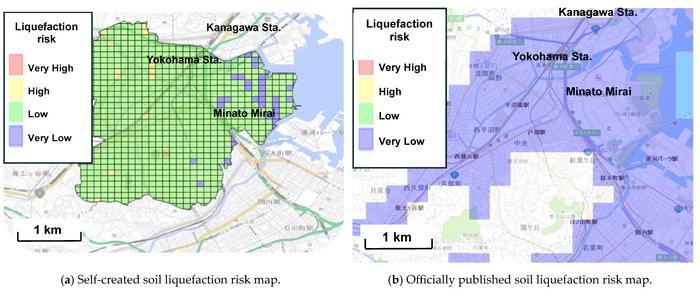
Indeed, Prof. Inazumi and his research group integrated advanced machine learning techniques with geotechnical and geographical data to develop this predictive model. They then successfully applied this model to enhance urban planning and infrastructure development in Yokohama, Japan—an area particularly vulnerable to soil liquefaction due to its extensive reclaimed lands and frequent seismic activity.
Notably, the developed model used a combination of machine learning model—such as artificial neural networks and gradient-boosting decision trees—to improve the accuracy in predicting soil liquefaction risk. The researchers achieved high accuracy in predicting soil classifications and N-values (crucial for evaluating soil liquefaction risk). They validated the effectiveness of the model against extensive geotechnical survey data.
Prof. Inazumi says, “The real-world application of our research is the development of hazard maps which can help urban planners and engineers to visualize and identify areas at high risk for soil liquefaction and make informed decisions regarding the development of infrastructures.” He adds, “Apart from bolstering emergency response planning, this AI-driven approach can also facilitate community engagement and education by providing clear and accessible information about at-risk areas.”
The study, thus, highlights transformative developments in geotechnical engineering involving AI integration into soil liquefaction risk prediction. This novel approach bolsters the efforts for urban resilience and corresponding sustainability.
***
Reference
About Shibaura Institute of Technology (SIT), Japan
Shibaura Institute of Technology (SIT) is a private university with campuses in Tokyo and Saitama. Since the establishment of its predecessor, Tokyo Higher School of Industry and Commerce, in 1927, it has maintained “learning through practice” as its philosophy in the education of engineers. SIT was the only private science and engineering university selected for the Top Global University Project sponsored by the Ministry of Education, Culture, Sports, Science and Technology and had received support from the ministry for 10 years starting from the 2014 academic year. Its motto, “Nurturing engineers who learn from society and contribute to society,” reflects its mission of fostering scientists and engineers who can contribute to the sustainable growth of the world by exposing their over 9,500 students to culturally diverse environments, where they learn to cope, collaborate, and relate with fellow students from around the world.
About Professor Shinya Inazumi from SIT, Japan
Dr. Shinya Inazumi is a professor at the Department of Civil Engineering, College of Engineering, Shibaura Institute of Technology, Japan. He is a pioneering researcher in civil and geotechnical engineering, particularly in adaptive social infrastructure that can mitigate the effects of climate change. Accordingly, he has authored more than 250 research publications in national and international journals. Notably, he won the “ICE Publishing Awards 2020 (Environmental Geotechnics Prize)” from the Institution of Civil Engineers (ICE) in 2020 and the “MEXT Young Scientists’ Prize” from the Ministry of Education, Culture, Sports, Science and Technology (MEXT) in 2015.
Funding Information
This research received no external funding.
Journal
Smart Cities
Method of Research
Computational simulation/modeling
Subject of Research
Not applicable
Article Title
AI-driven prediction and mapping of soil liquefaction risks for enhancing earthquake resilience in smart cities
Article Publication Date
17-Jul-2024
COI Statement
The authors declare no conflicts of interest.
Cite Scienmag News
Blake Davidson. (August 1, 2024). Towards smart cities: Predicting soil liquefaction risk using artificial intelligence. Scienmag. https://scienmag.com/towards-smart-cities-predicting-soil-liquefaction-risk-using-artificial-intelligence/
Blake Davidson. "Towards smart cities: Predicting soil liquefaction risk using artificial intelligence." Scienmag, 1 August 2024, https://scienmag.com/towards-smart-cities-predicting-soil-liquefaction-risk-using-artificial-intelligence/. Accessed 4 September 2026.
Blake Davidson. "Towards smart cities: Predicting soil liquefaction risk using artificial intelligence." Scienmag. August 1, 2024. https://scienmag.com/towards-smart-cities-predicting-soil-liquefaction-risk-using-artificial-intelligence/

