


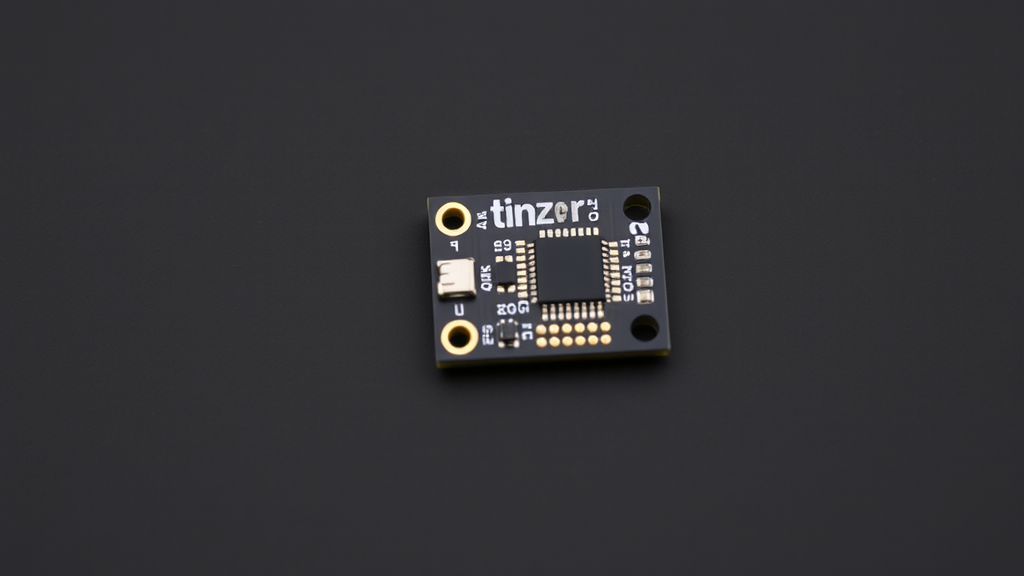
A pocket-sized circuit board measuring just 25 by 25 millimeters could change how researchers build wearable health devices. Engineers have unveiled TinZr, a compact, fully wireless microcontroller platform designed to integrate multiple physiological sensors, log their data locally, and stream it over Wi-Fi or Bluetooth — all in an open-source package costing roughly $65 per unit, including shipping and customs duties. The platform, described in the journal HardwareX, is released under permissive open licenses, with complete design files, schematics, and firmware freely available to anyone who wants to build, modify, or extend it.
The team behind TinZr, led by Ludvik Alkhoury of the New Jersey Institute of Technology together with colleagues from Weill Cornell Medicine and collaborating institutions, set out to solve a persistent problem in wearable sensing research. Commercial microcontroller boards tend to force compromises: the Seeed XIAO ESP32-C3 is tiny and wireless but lacks a microSD card reader and a standardized connector for plug-and-play sensors; the Adafruit GEMMA v2 is featherweight but has no charging circuitry or storage; the popular Teensy 4.1 offers generous processing power and an SD card slot but no Wi-Fi or Bluetooth and a bulkier footprint. TinZr was engineered to combine all of these missing pieces in a single module sized for wearables.
At the heart of the platform sits Espressif’s ESP32-C3 microcontroller, a single-core RISC-V processor clocked at up to 160 MHz with native 2.4 GHz Wi-Fi and Bluetooth Low Energy 5.0 built in. The designers acknowledge that the chip offers fewer general-purpose input-output pins than larger development boards, but they argue the pin allocation was deliberately optimized for the interfaces that matter most in physiological sensing: digital, analog, I2C, SPI, and UART buses. An onboard QWIIC connector exposes the I2C bus along with power and ground, letting researchers snap on compatible sensors — optical, environmental, or electrophysiological — without touching a soldering iron.
Motion sensing is handled by an STMicroelectronics LSM6DS3TR-C inertial measurement unit, which pairs a three-axis accelerometer with a three-axis gyroscope in a single low-power package. The accelerometer can be configured for full-scale ranges up to plus or minus 16 g, while the gyroscope measures angular rates up to 2000 degrees per second, with output data rates reaching several kilohertz. In practice, the team envisions this motion data serving double duty: capturing physical activity directly and supporting artifact detection, so that movement contamination in physiological recordings can be identified and flagged during mobile experiments.
Power management, often the Achilles heel of battery-powered wearables, is entrusted to a Texas Instruments BQ24075RGTR charging chip with power-path management. This means the device can run from USB power while simultaneously charging its 150 mAh lithium-polymer battery, and can switch seamlessly to battery operation when unplugged — without interrupting a recording. The charge current is set to roughly 100 mA via an external resistor, matched to the small battery’s 0.67C charge rate, with safety timeouts and input current limits configured to stay comfortably within USB power budgets. The resistors can be swapped to accommodate larger batteries for longer studies.
Battery life figures vary dramatically by operating mode. In deep sleep with everything disabled, TinZr sips just 0.376 mA, enough for an estimated 16.6 days of standby on the standard battery. Active idle draws 14.8 mA, or about ten hours. Streaming inertial or physiological data over Bluetooth pushes consumption into the 41 to 61 mA range, yielding runtimes between roughly 2.5 and 3.7 hours depending on the sensor load — for example, 3.13 hours while streaming dual-wavelength photoplethysmography at 100 Hz, and 2.46 hours when acquiring ECG and PPG simultaneously at the highest tested rates. Wi-Fi transmission is the most power-hungry mode at 93 mA, draining the battery in under two hours. The platform also monitors its own battery voltage, enabling firmware-level low-battery warnings or automatic recording stops.
The validation experiments demonstrate why the platform matters for real research. In a multi-modal demonstration, TinZr simultaneously acquired a single-lead electrocardiogram from a MAX30001-based front-end and red and infrared photoplethysmographic signals from a MAX30102 optical sensor, streaming both over Bluetooth while packet timestamps and sample counters kept the mismatched sampling rates aligned for later analysis. The resulting ten-second recording showed crisp cardiac cycles with clearly distinguishable QRS complexes alongside pulsatile PPG waveforms. Separately, inertial recordings captured repetitive hand motion at metronome-controlled frequencies of 50 and 100 beats per minute, with the oscillation rate on the accelerometer and gyroscope traces tracking the tempo precisely.
Wireless reliability testing yielded striking results. A single TinZr transmitting inertial-style data at 100 Hz over Bluetooth recorded zero packet loss across 180-second trials at every distance tested, from under one foot up to twenty feet, both under direct line-of-sight and with a wooden door blocking the signal path. Signal strength, measured as RSSI, degraded with distance and obstruction as expected, falling to around -89 dBm at the far end, yet the connection held throughout. In a swarm-style test, five TinZr devices streamed simultaneously to a single laptop at 10 Hz each — again with zero packet loss across all conditions — demonstrating that coordinated multi-node deployments, from distributed body sensor networks to collaborative robotics, are practical with the stock hardware.
Perhaps the most consequential design decision is accessibility. TinZr is programmed through the Arduino ecosystem using an accompanying library called TinZrConnect, which ships with example sketches covering everything from basic button and LED control to a full communication framework in which multiple devices connect to a central PC hub over Wi-Fi for broadcast and individual addressing. Companion Python-based graphical interfaces — available both as source code and as installable executables — let researchers control recording start and stop and visualize data without writing firmware. The designers also provide 3D-printable enclosure files that house the board and battery in a wearable unit measuring just 29.5 by 29 by 20 millimeters, printable on an entry-level hobbyist 3D printer in PLA plastic.
The team is careful to note the platform’s limits: TinZr provides no medical-grade electrical isolation, is not certified for clinical use, and users connecting sensors to human subjects are responsible for ensuring the complete measurement chain meets applicable safety standards. Within research settings, however, the board’s combination of local storage, wireless flexibility, standardized sensor interfacing, and a $65 price point positions it as a serious alternative to commercial controllers for prototyping wearables, field data collection, and multi-device experiments. With hardware licensed under the CERN Open Hardware Licence and software under GPLv3, and all production files published on Zenodo with OSHWA certification, the barrier to building a custom multi-sensor wearable has arguably never been lower.
Subject of Research: An open-source ESP32-C3 microcontroller platform for multi-modal wearable physiological sensing and wireless data acquisition
Article Title: TinZr: A compact wireless ESP32-C3 platform for multi-modal physiological sensor integration and data acquisition
Article References: Alkhoury, L., Moore, T., Swissler, P., Hill, N. J., Shah, S. A., & Kam, M. (2026). TinZr: A compact wireless ESP32-C3 platform for multi-modal physiological sensor integration and data acquisition. HardwareX, 28, Article e00833. https://doi.org/10.1016/j.ohx.2026.e00833
Image Credits: AI Generated
DOI: 10.1016/j.ohx.2026.e00833
Keywords: TinZr, ESP32-C3, open-source hardware, wearable sensors, physiological monitoring, ECG, PPG, inertial measurement unit, Bluetooth Low Energy, data acquisition, HardwareX, battery-powered electronics
Cite Scienmag News
Denise Maddox. (September 23, 2026). TinZr: A $65 Open-Source Wearable Puts Multi-Sensor Health Tracking on a Single Tiny Board. Scienmag. https://scienmag.com/tinzr-a-65-open-source-wearable-puts-multi-sensor-health-tracking-on-a-single-tiny-board/
Denise Maddox. "TinZr: A $65 Open-Source Wearable Puts Multi-Sensor Health Tracking on a Single Tiny Board." Scienmag, 23 September 2026, https://scienmag.com/tinzr-a-65-open-source-wearable-puts-multi-sensor-health-tracking-on-a-single-tiny-board/. Accessed 4 October 2026.
Denise Maddox. "TinZr: A $65 Open-Source Wearable Puts Multi-Sensor Health Tracking on a Single Tiny Board." Scienmag. September 23, 2026. https://scienmag.com/tinzr-a-65-open-source-wearable-puts-multi-sensor-health-tracking-on-a-single-tiny-board/


