


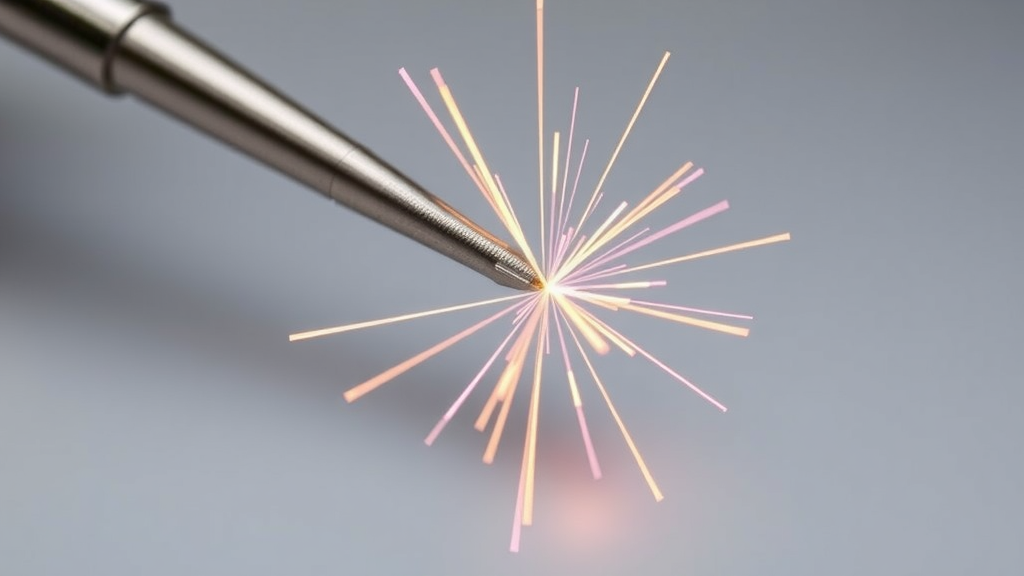
The medical devices saving lives today are marvels of miniaturization, packing sensors, antennas, electrodes and structural elements into spaces smaller than a fingertip. Yet the unsung hero behind these innovations is a fabrication science that rarely makes headlines: microjoining, the art and science of bonding components measured in fractions of a millimeter. A new perspective article published in the journal Advanced Materials Joining by Kaiping Zhang, Y. Norman Zhou and Peng Peng of the University of Waterloo argues that the future of implants, stents, guidewires and robotic surgical tools depends directly on how well researchers can master joining at this tiny scale.
Microjoining, as the authors define it, covers the joining of thin sheets up to 0.5 millimeters thick and fine wires with diameters no greater than one millimeter. The scale is not merely a smaller version of conventional welding. At these dimensions, physics itself changes character. Surface and interfacial effects begin to dominate bulk behavior, capillary forces can overwhelm gravity, and the limited material volume means heat transfer and solidification kinetics behave in ways that defy macroscale intuition. The result is that micro-joints carry thermal stresses and microstructures fundamentally different from their large-scale counterparts, making microjoining a discipline that demands its own scientific foundation rather than a simple downscaling of established practice.
The range of materials involved is striking. Metals remain the workhorses of the field, with stainless steel, titanium and magnesium alloys long favored for their mechanical performance, biocompatibility and cost-effectiveness. Stainless steel has served in surgical implants since the 1920s, but modern demands have pushed far beyond. Shape-memory alloys, particularly nickel-titanium or NiTi, owe their indispensability to reversible martensitic phase transformations that produce the shape memory effect and superelasticity, properties exploited in orthodontic archwires, stents and guidewires. Laser microwelding between NiTi microtubes and platinum-iridium wires has even been used to tailor transformation temperatures for specific device needs. Biodegradable magnesium and zinc alloys, noble metals such as gold, silver and platinum that enhance X-ray visibility, and refractory metals like niobium that serve as biocompatible intermediates round out an expanding metallic palette.
Polymers and composites bring their own advantages, particularly deformability, corrosion resistance and machinability. Laser welding has successfully bonded three-dimensional polymer fabrics for orthopedic applications, achieving reliable fiber-to-fiber joints without surface damage. Researchers have also microjoined polymers to dissimilar materials, as in polyimide-titanium and PETG-stainless steel systems, and integrated metal-coated chips into the inner surfaces of polymer stents. Commercially, the FARAWAVE pulsed field ablation catheter relies on joining metal-ring electrodes to polymer wires, balancing flexible motion with X-ray mapping capability. The looming replacement of PFAS with environmentally sustainable polymers, the authors note, may create new joining challenges as unfamiliar materials enter the production pipeline.
Ceramics present the steepest hurdles. Bioinert oxides and nitrides, bioresorbable calcium phosphates and bioactive glasses are prized for bone and dental restoration, but their high melting points and poor deformability restrict both fusion and solid-state joining at the microscale. Soldering, brazing and adhesive bonding dominate instead. Implantable neural stimulators demonstrate the feasibility of micro-brazing platinum-iridium pins into ceramic substrates, and hermetically packaged neurostimulation devices have been built by co-firing ceramics with platinum tracks, pointing toward a ceramic-rich future for next-generation implantables.
Four families of joining methods have been adapted to the microscale. Fusion welding, the most widely used, employs laser beams, electron beams, plasma arcs or contact-based resistance heating to melt and re-solidify base materials. Laser microwelding leads the field thanks to its high energy density and precise controllability. Yet fusion welding of dissimilar metals reveals the discipline’s central difficulty: when NiTi wires are laser welded to stainless steel, rapid heating and cooling produce uneven mixing and non-equilibrium solidification, filling the fusion zone with brittle intermetallic compounds that cripple joint strength. Resistance microwelding offers an elegant workaround. Using miniature copper-chromium electrodes roughly one millimeter in diameter, researchers have squeezed molten liquid out of the interface entirely, achieving quasi-solid-state direct bonding between NiTi and stainless steel while preserving flexible deformability on one side and superelasticity on the other.
Solid-state welding sidesteps melting altogether, relying on interdiffusion under pressure through friction, ultrasonic vibration or diffusion bonding. Ultrasonic microwelding of thin titanium sheets produces interfacial regions less than five micrometers thick, while vapor foil actuator welding joins NiTi wires to brass sheets without significant alloy intermixing, suppressing intermetallic formation. Brazing and soldering with low-melting-point fillers enable complex configurations, exemplified by furnace micro-brazing of shape-memory alloy wires into honeycomb stent architectures that retain superelastic response, and laser micro-brazing of platinum rings to copper-coated stainless steel wires for interventional devices requiring both radiopacity and signal feedback. Adhesive bonding remains indispensable for assembling thermoplastic microfluidic substrates used in bioanalysis and diagnostics, though surface preparation through plasma cleaning proves critical to joint quality.
Evaluating micro-joints for biomedical service requires far more than simple strength measurements. Digital image correlation has revealed high strain localization around weld nuggets in resistance-welded shape-memory alloy sheets, identifying crack nucleation sites, while scanning electron microscopy enables in-situ testing of wire joints too small for optical strain mapping. Functional performance matters as much as mechanics: arc-welded NiTi wires show markedly increased residual strain during superelastic cycling compared with base material, attributed to grain coarsening and microstructural evolution in the weld zone. Thermomechanical fatigue testing under cyclic martensitic transformations shows welded joints suffer reduced fatigue life, though post-weld heat treatment can homogenize microstructure and restore durability. Corrosion and biocompatibility add further complexity, with studies showing that beneficial alloying element mixing during fusion welding can improve passive film formation, while toxic elements like copper, cobalt and nickel must be rigorously avoided.
The perspective outlines four frontiers for the coming decade. Smart devices such as MEMS sensor-equipped fractional flow reserve guidewires will demand increasingly sophisticated multi-material joining strategies combining soldering, adhesive bonding and fusion welding in a single assembly. Process optimization offers immediate gains, as demonstrated by electromagnetic-field-assisted laser microwelding of NiTi to stainless steel, where induced Lorentz forces drive the liquid fusion zone toward the steel side, limiting brittle iron-titanium phases and boosting tensile strength by 28 percent and ductility by 137 percent. Deeper fundamental understanding will come from in-situ X-ray imaging, smoothed particle hydrodynamics simulations and density functional theory calculations applied at microscale resolution. Finally, the authors call for standardized joining and testing protocols, whose current absence limits cross-study comparison and industrial adoption. With human lifespans lengthening and medical technology accelerating, the researchers argue that microjoining stands poised to become a defining enabler of the next generation of reliable, multifunctional biomedical devices.
Subject of Research: Microjoining technologies for the fabrication of biomedical devices
Article Title: Microjoining for biomedical device fabrication: a perspective
Article References: Zhang, K., Zhou, Y. N., & Peng, P. (2026). Microjoining for biomedical device fabrication: a perspective. Advanced Materials Joining, 1(1), Article 3. https://doi.org/10.1007/s44500-026-00006-z
Image Credits: AI Generated
DOI: 10.1007/s44500-026-00006-z
Keywords: microjoining, biomedical devices, laser microwelding, shape memory alloys, NiTi, stents, resistance welding, solid-state welding, brazing, biocompatibility, intermetallic compounds, implantable sensors
Cite Scienmag News
Denise Maddox. (September 12, 2026). Tiny Welds, Big Stakes: How Microjoining Shapes the Future of Medical Implants. Scienmag. https://scienmag.com/tiny-welds-big-stakes-how-microjoining-shapes-the-future-of-medical-implants/
Denise Maddox. "Tiny Welds, Big Stakes: How Microjoining Shapes the Future of Medical Implants." Scienmag, 12 September 2026, https://scienmag.com/tiny-welds-big-stakes-how-microjoining-shapes-the-future-of-medical-implants/. Accessed 4 October 2026.
Denise Maddox. "Tiny Welds, Big Stakes: How Microjoining Shapes the Future of Medical Implants." Scienmag. September 12, 2026. https://scienmag.com/tiny-welds-big-stakes-how-microjoining-shapes-the-future-of-medical-implants/


