

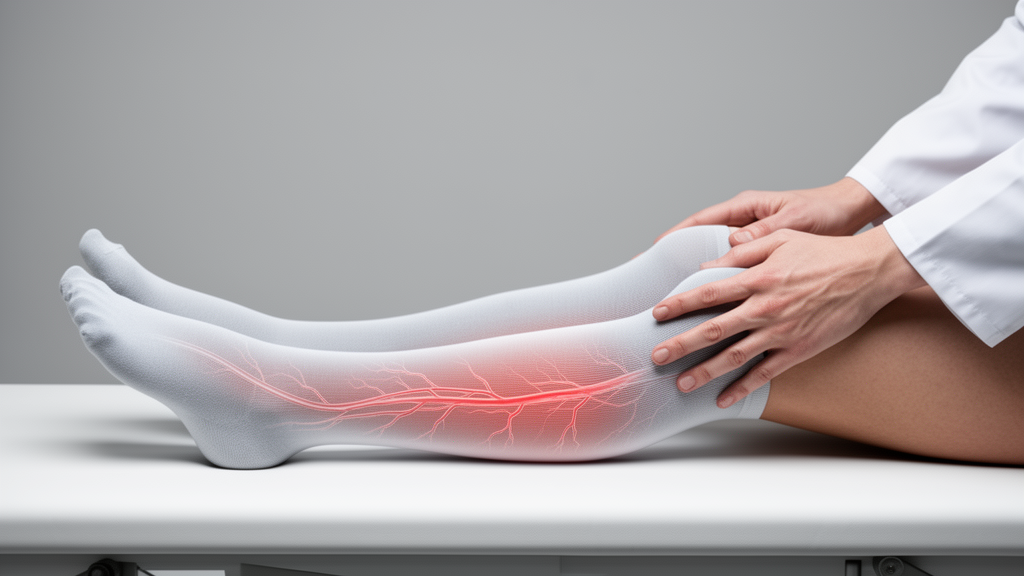
Blood flow restriction training has quietly become one of the most talked-about techniques in modern exercise science. By wrapping a band or cuff around a limb and partially limiting arterial inflow, athletes and rehabilitation patients can gain strength and muscle from loads far lighter than those normally required. Yet behind the popularity lies an awkward problem: in many gyms and clinics, the tightness of the band is judged not by instruments but by how the wearer feels. A new experimental study published in PLOS One now offers some of the clearest evidence yet on what those subjective sensations actually mean for the arteries underneath.
Researchers led by Meltem Ozagir and colleagues set out to answer a deceptively simple question. When a person reports that a compression band feels loose, moderate, or extremely tight, does the blood flowing through the major artery of the leg actually change in a predictable, graded way? The answer, according to their cross-sectional study of 42 healthy, physically active adults aged 18 to 37, is a resounding yes. As perceived compression increased, blood flow velocity in the popliteal artery, the vessel running behind the knee, fell step by step, with statistically significant differences between every compression level tested.
The method was deliberately practical. Rather than using pneumatic cuffs with pressure gauges, the team applied a 5 centimeter elastic band wrapped twice around the proximal thigh, the kind of low-cost approach that defines practical blood flow restriction, or pBFR. Participants then reported their perceived compression on a simple numerical scale at four anchor points: free flow at 0 out of 10, light compression at 3 to 4, moderate compression at 6 to 7, and high compression at 9 to 10. This subjective rating system is common in real-world settings precisely because it requires no specialized equipment, which is exactly why scientists have been eager to know whether it bears any relationship to actual physiology.
To find out, the researchers turned to Doppler ultrasound, the same technology obstetricians use to monitor fetal circulation and cardiologists use to assess heart valves. By bouncing high-frequency sound waves off moving blood cells, Doppler ultrasound can measure both the velocity of blood flow and the diameter of a vessel in real time. The team focused on the popliteal artery, which carries blood to the lower leg and sits downstream of the thigh compression, making it an ideal window into how the elastic band was affecting circulation. Measurements were taken at each of the four subjective compression levels, and the data from men and women were pooled for analysis.
The results were strikingly orderly. Blood flow velocity declined progressively as compression tightened, and repeated-measures analysis of variance confirmed that the differences between all compression levels were significant, with p values below 0.001. In other words, the transition from free flow to light, from light to moderate, and from moderate to high compression each produced a measurable and distinct drop in arterial flow velocity. The velocity values at different compression levels were also significantly correlated with one another, suggesting that the hemodynamic response to the band behaves in a consistent, dose-dependent fashion rather than in an unpredictable all-or-nothing manner.
Perhaps the most reassuring finding was what the researchers did not see. Complete arterial occlusion, the full shutdown of blood flow that would raise safety concerns, was not observed in any participant, even at the highest subjective compression ratings of 9 to 10 out of 10. This matters because the entire premise of blood flow restriction training is partial restriction: enough venous pooling and reduced arterial inflow to amplify the metabolic stress of light exercise, but never so much that the limb is starved of blood. The study suggests that a simple elastic band, even wrapped to what feels like very tight compression, tends to leave arterial flow intact in healthy adults.
The team also probed whether body characteristics could predict how strongly the band would affect an individual’s circulation. Thigh circumference and skinfold thickness, two measures that might plausibly influence how a band transmits pressure to the underlying vessels, showed no significant associations with blood flow velocity. This null result is notable for practitioners, because it hints that a person’s build may not be a reliable shortcut for guessing their hemodynamic response. Two participants with similar thighs could, in principle, experience different arterial flow changes at the same perceived tightness, and anthropometry alone would not reveal the difference.
For the growing community of trainers, physiotherapists, and athletes who use pBFR, the study offers both validation and a caution. The validation is that subjective compression scales appear to track real physiology: when a wearer says the band has gone from light to moderate, the artery behind the knee genuinely slows down in a graded way. This gives the humble 0-to-10 rating a physiological anchor it previously lacked. The caution lies in the study’s design and scope. The measurements were taken at rest, capturing acute hemodynamic responses rather than the adaptations that develop over weeks of training, and the authors are explicit that the findings should not be generalized to exercise conditions or long-term outcomes.
That distinction is more than academic fine print. During exercise, contracting muscles dramatically change the pressure environment inside the limb, squeezing vessels, altering perfusion, and interacting with the external compression in ways that resting measurements cannot capture. Whether the neat, stepwise relationship between perceived tightness and arterial flow velocity holds up when a person is actually performing repetitions with a restricted limb remains an open question, and the researchers call for further work to determine the translational relevance of subjective compression levels during active training. Until such studies arrive, the current results describe what happens on the treatment table, not necessarily under the barbell.
Still, the study fills an important gap in a field that has often raced ahead of its evidence. Blood flow restriction training has moved from rehabilitation wards into professional sports and mainstream fitness with remarkable speed, yet many practical applications still rest on subjective judgment. By demonstrating that perceived compression levels correspond to distinct, ordered reductions in popliteal artery blood flow velocity, and that complete occlusion does not occur even at the highest ratings, the researchers have given practitioners a firmer physiological footing for a technique they already use daily. The elastic band, it turns out, speaks a language the artery understands, and now science has begun to translate it.
Subject of Research: Effects of subjective compression levels on popliteal artery blood flow velocity during practical blood flow restriction training
Article Title: Investigation of arterial blood flow changes according to compression level in a practical blood flow restriction training method: A cross-sectional experimental study
Article References: Investigation of arterial blood flow changes according to compression level in a practical blood flow restriction training method: A cross-sectional experimental study. (n.d.). https://doi.org/10.1371/journal.pone.0359341
Image Credits: AI Generated
DOI: 10.1371/journal.pone.0359341
Keywords: blood flow restriction training, pBFR, popliteal artery, Doppler ultrasound, compression levels, arterial blood flow velocity, elastic band, exercise physiology, hemodynamics, thigh circumference, PLOS One, rehabilitation
Cite Scienmag News
Scienmag. (October 9, 2026). Tightness on a Scale of 10: How Compression Levels Steadily Slow Leg Artery Blood Flow. https://scienmag.com/tightness-on-a-scale-of-10-how-compression-levels-steadily-slow-leg-artery-blood-flow/
Scienmag. "Tightness on a Scale of 10: How Compression Levels Steadily Slow Leg Artery Blood Flow." Scienmag, 9 October 2026, https://scienmag.com/tightness-on-a-scale-of-10-how-compression-levels-steadily-slow-leg-artery-blood-flow/. Accessed 9 October 2026.
Scienmag. "Tightness on a Scale of 10: How Compression Levels Steadily Slow Leg Artery Blood Flow." Scienmag. October 9, 2026. https://scienmag.com/tightness-on-a-scale-of-10-how-compression-levels-steadily-slow-leg-artery-blood-flow/


