


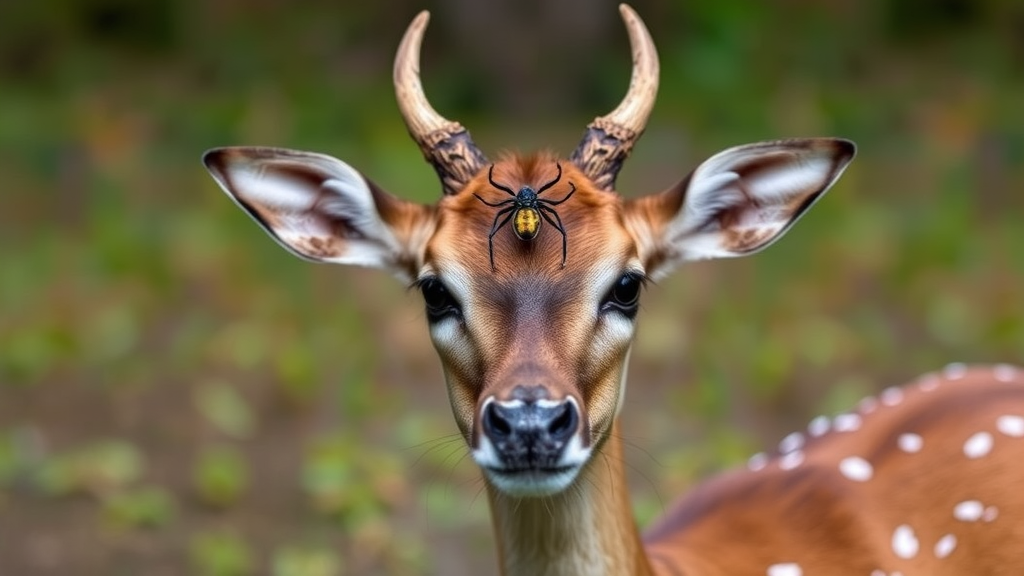
A team of researchers working across both halves of Malaysia has documented, for the first time using molecular methods, two tick species infesting captive Sambar deer and has uncovered a striking triple co-infection of tick-borne pathogens within a single tick specimen. The study, published in Acta Parasitologica, focused on Haemaphysalis ticks collected from Sambar deer (Rusa unicolor) at a biopark in Bintulu, East Malaysia, and at a slaughterhouse in Gombak, West Malaysia. The findings provide the first molecular evidence that Haemaphysalis shimoga and Haemaphysalis bispinosa parasitize captive Sambar deer in the country, and they reveal that one of these ticks carried Theileria cervi, Theileria capreoli, and the human-relevant bacterium Anaplasma phagocytophilum simultaneously. For a region where tick surveillance of captive wildlife has historically been thin, the results offer both a taxonomic milestone and a public health signal.
Haemaphysalis ticks belonging to the subgenus Kaiseriana are recognized as important vectors of tick-borne pathogens throughout tropical Asia. Yet, despite their medical and veterinary significance, data on which tick species infest captive wildlife in East Malaysia have remained scarce. Captive animals such as Sambar deer, a large cervid native to South and Southeast Asia, can act as amplifying hosts for ticks and the agents they transmit, and facilities like bioparks and teaching farms create conditions in which ticks, wildlife, livestock, and people come into close and repeated contact. Understanding exactly which tick species are present, and which pathogens they harbor, is therefore a prerequisite for any meaningful risk assessment. The new study set out to close that gap by combining classical morphological identification with DNA-based species confirmation and pathogen screening.
Between 2021 and 2022, the researchers collected a total of 60 ticks from five Sambar deer at the two Malaysian sites. Each specimen was first identified morphologically using standard taxonomic keys, an approach that relies on subtle differences in body structures such as the palps, scutum, and spiracular plates. The team then attempted to extract DNA from 49 of the specimens. Here the study encountered a practical constraint familiar to anyone working with field-collected arthropods: specimen degradation. Because the ticks had been preserved and stored under conditions that compromised their genetic material, only seven samples retained DNA of sufficient quality and quantity for downstream molecular analysis. Rather than discarding the morphological work, the researchers treated the seven genetically tractable ticks as a focused molecular window onto the broader collection.
For species identification, the team sequenced the mitochondrial cytochrome c oxidase subunit I gene, known as cox1, a workhorse marker in animal DNA barcoding. The resulting sequences were compared against reference databases and subjected to phylogenetic analysis using maximum likelihood methods, which infer evolutionary trees by finding the branching pattern that best explains the observed genetic differences. Two Haemaphysalis species emerged with strong statistical support. Sequences assigned to Haemaphysalis shimoga showed 97.88 to 99.27 percent identity to reference material, while those assigned to Haemaphysalis bispinosa were even more convincing at 99.5 to 100 percent identity. Crucially, each species resolved in its own well-supported monophyletic clade on the phylogenetic trees, meaning that all sequences of each species descended from a common ancestor to the exclusion of the other, a pattern that reinforces the species-level assignments.
The identification of H. shimoga in Malaysia is particularly noteworthy. The taxon was originally described from southern India as a subspecies of Haemaphysalis cornigera, and its presence on Sambar deer in Malaysian Borneo extends the known geographic footprint of this tick considerably. H. bispinosa, by contrast, has a long and somewhat complicated history in the region. Work dating back to the late 1960s argued, on biogeographic grounds, that H. bispinosa should be considered an introduced species in the Malay Peninsula and Borneo, likely arriving with domesticated animals. Its confirmation here on captive Sambar deer, at sites on both sides of the country, is consistent with that picture of a tick that thrives wherever its preferred hosts and suitable climatic conditions coincide, including in managed wildlife settings.
With the tick species confirmed, the researchers turned to the pathogens. They screened the seven molecularly characterized specimens for bacteria of the genus Anaplasma using sequencing of the 16S ribosomal DNA gene, and for protozoan parasites of the genus Theileria using the 18S ribosomal DNA gene. Both gene targets are standard markers for detecting and differentiating these organisms, and the resulting sequences were again placed into phylogenetic frameworks by maximum likelihood analysis. The results were remarkable for a sample set of just seven ticks. Five of the seven, comprising four H. shimoga and one H. bispinosa, were infected with Theileria species. Sequences matched Theileria capreoli at 98.83 to 100 percent identity and Theileria cervi at 95.07 to 99.74 percent identity, two protozoans associated with cervid hosts in various parts of the world.
The single H. bispinosa specimen proved to be the study’s most consequential finding. It tested positive for Anaplasma phagocytophilum, with sequence identities of 99.53 to 100 percent, and it simultaneously harbored both Theileria cervi and Theileria capreoli, making it a documented triple co-infection in a single tick. Anaplasma phagocytophilum is the agent of human granulocytic anaplasmosis as well as tick-borne fever in ruminants, and it is regarded as a widespread, multi-host pathogen with highly adaptive strategies that allow it to persist across ticks, wild and domestic mammals, and occasionally humans. Its detection in a Haemaphysalis tick infesting captive deer in Malaysia raises the possibility that the ecological circuitry needed to maintain this bacterium, competent tick vectors and susceptible mammalian hosts in close proximity, is already in place in the country.
Co-infections of this kind are increasingly understood to be the rule rather than the exception in tick microbiology. Individual ticks frequently carry multiple pathogens at once, and mixed infections can influence disease severity in hosts, complicate diagnosis, and alter transmission dynamics in ways that single-pathogen models fail to capture. The Malaysian finding, in which one tick carried two protozoan parasites and one bacterial pathogen simultaneously, is a vivid local illustration of that global pattern. It also underscores why molecular screening of even small numbers of well-characterized ticks can be informative: morphological identification alone would have revealed which tick species were present, but only DNA sequencing exposed the pathogen community hiding inside them.
The study’s authors are careful about the limits of their data. With only seven specimens yielding usable DNA, the prevalence estimates that could be calculated are statistically fragile, and the degraded condition of most of the collection means the true infection rates among the 60 ticks remain unknown. Detection of pathogen DNA in a tick also does not by itself demonstrate that the tick can biologically transmit the agent, nor does it confirm that the deer were infected. Those questions would require blood testing of the hosts, experimental vector competence studies, and larger, systematically designed tick surveys. What the study does establish, firmly, is a set of firsts: the first molecular confirmation of H. shimoga and H. bispinosa on captive Sambar deer in Malaysia, and the first molecular detection of A. phagocytophilum alongside Theileria co-infection in ticks from the country.
The practical implications extend in several directions. For wildlife managers and veterinarians responsible for captive deer, the results argue for routine tick surveillance and acaricide-based control at facilities where animals are held in semi-natural enclosures. For public health authorities, the presence of A. phagocytophilum DNA in a local tick vector warrants attention, particularly given that people working at bioparks, farms, and slaughterhouses occupy exactly the interfaces where tick bites are most likely. The researchers have deposited all their sequence data in GenBank, making the cox1, 16S, and 18S sequences available for future comparative studies across Southeast Asia. As climate change, land-use change, and the wildlife trade continue to reshuffle the distributions of ticks and their hosts in the tropics, baseline datasets of this kind, anchored in both morphology and molecular phylogenetics, will become only more valuable for tracking how tick-borne pathogen landscapes evolve in Malaysia and beyond.
Subject of Research: Molecular identification of Haemaphysalis tick species and detection of Anaplasma and Theileria co-infections in captive Sambar deer in Malaysia
Article Title: First Molecular Report of Haemaphysalis shimoga and Haemaphysalis bispinosa Infesting Captive Sambar Deer (Rusa unicolor) in Malaysia, with Detection of Anaplasma phagocytophilum and Theileria Co-infection
Article References: Altwaim, S. A., Kamaludeen, J., Mohammed, M. A., Suif, Z., Mustafa, S., Paul, B. T., Syed-Hussain, S. S., Aziz, N.-A. A., Numan, M., & Ali, A. (2026). First Molecular Report of Haemaphysalis shimoga and Haemaphysalis bispinosa Infesting Captive Sambar Deer (Rusa unicolor) in Malaysia, with Detection of Anaplasma phagocytophilum and Theileria Co-infection. Acta Parasitologica, 71(5), Article 212. https://doi.org/10.1007/s11686-026-01392-0
Image Credits: AI Generated
DOI: 10.1007/s11686-026-01392-0
Keywords: Haemaphysalis shimoga, Haemaphysalis bispinosa, Sambar deer, Anaplasma phagocytophilum, Theileria capreoli, Theileria cervi, tick-borne pathogens, co-infection, Malaysia, cox1 barcoding, tick surveillance, captive wildlife
Cite Scienmag News
Kristina Jarvis. (September 20, 2026). Ticks on Captive Sambar Deer in Malaysia Reveal Triple Co-infection of Tick-Borne Pathogens. Scienmag. https://scienmag.com/ticks-on-captive-sambar-deer-in-malaysia-reveal-triple-co-infection-of-tick-borne-pathogens/
Kristina Jarvis. "Ticks on Captive Sambar Deer in Malaysia Reveal Triple Co-infection of Tick-Borne Pathogens." Scienmag, 20 September 2026, https://scienmag.com/ticks-on-captive-sambar-deer-in-malaysia-reveal-triple-co-infection-of-tick-borne-pathogens/. Accessed 4 October 2026.
Kristina Jarvis. "Ticks on Captive Sambar Deer in Malaysia Reveal Triple Co-infection of Tick-Borne Pathogens." Scienmag. September 20, 2026. https://scienmag.com/ticks-on-captive-sambar-deer-in-malaysia-reveal-triple-co-infection-of-tick-borne-pathogens/


