


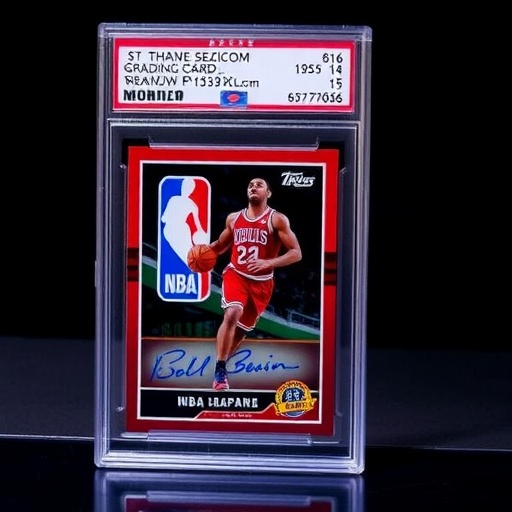
In the evolving landscape of collectibles, precise valuation metrics have long eluded economists and enthusiasts alike, especially for items where subjective factors intertwine with market dynamics. A groundbreaking study published in the Atlantic Economic Journal by researchers George Langelett and Zhu Wang takes a pioneering stride in this domain by examining the role of third-party grading as a potent and reliable indicator of consumer demand. Their analysis centers on the NBA cards market, a vibrant and high-stakes arena where evaluating the true worth of collectibles remains notoriously complex.
At the heart of Langelett and Wang’s exploration is the concept that external, expert scrutiny—in this case, third-party grading services—can substantially clarify and even predict market behavior. These grading services meticulously assess the condition of physical cards, applying a standardized numerical scale that ultimately influences the card’s market value. While such grading practices have become standard in many collectible markets, their utility as proxies for underlying demand and consumer preferences has not been extensively quantified until now.
The researchers utilized a robust dataset comprising NBA card transactions, correlating sales prices with assigned grades over a meaningful timespan. This dataset allowed them to dissect the nuanced interplay between card condition, as objectively measured by third-party grading agencies, and price variations driven by consumer demand. Their rigorous statistical methods illuminated that grading scores play a dual role, serving as both a quality signal and a demand metric, thereby enhancing market transparency while reducing information asymmetry.
Importantly, the study sheds light on the often overlooked feedback loop between grading agencies and market participants. Third-party graders influence the perceptions and expectations of buyers and sellers, thereby shaping the trading dynamics of NBA cards. By standardizing quality assessments, graders effectively reduce the risk premiums buyers might otherwise impose due to uncertainty. This reduction in asymmetric information fosters a more liquid and efficient market, facilitating quicker transactions and more accurate price discovery.
Langelett and Wang’s findings also challenge traditional economic assumptions that rely heavily on subjective consumer preferences and limited data proxies when valuing collectibles. The third-party grading framework introduces a scalable, objective standard into markets that historically depended on anecdotal reports and sporadic sales data. Through advanced econometric modeling, the authors demonstrate that this grading scale captures latent demand fluctuations more effectively than previous heuristic methods.
One of the most compelling revelations from the research is the graded cards’ ability to function as a sentiment gauge. Market participants often respond not just to intrinsic card qualities but to the reputations and ratings issued by authoritative graders. Thus, the study reveals how social proof and institutional endorsement mechanisms operate subtly but powerfully within secondary markets, forming a complex ecosystem of reputation, trust, and economic value.
The graphical analysis included in the study highlights the nonlinear relationship between price premiums and grading scores. Cards with near-perfect grades command disproportionally higher prices, underscoring the significant market premium associated with exceptional quality verification. This premium reflects both scarcity and the psychological impact the highest grades exert on consumer willingness to pay, illustrating a phenomenon not unlike luxury branding effects observed in broader economic contexts.
Technically, the research leverages regression discontinuity at various grade cutoffs to validate the causal impact of grading on demand. This methodological choice strengthens the claim that third-party grading is not merely correlative but causally linked to price formation and market activity. By statistically isolating the effect of slight differences in grade scores, the study offers convincing evidence that grading decisions materially influence the transactional landscape.
Beyond basketball cards, the implications of this research resonate broadly across collectible markets, from comic books and vintage wines to rare coins and fine art. The standardization and verification mechanisms that grading services provide could serve as invaluable tools to decode consumer preferences in markets characterized by high heterogeneity and information imperfections. This alignment of third-party validation with economic modeling provides a promising avenue for future empirical inquiry into other sectors.
The study also subtly hints at the emergence of blockchain and digital ledger technologies as complementary grading validation systems. While not directly addressed, the increasing digitization of certificates of authenticity and grading reports may further reduce fraud and enhance market efficiency, a frontier that future research is poised to explore extensively. Incorporating these technological advances could elevate grading services from purely physical inspection roles to integrated data platforms influencing market behavior dynamically.
Moreover, Langelett and Wang’s work contributes to a broader understanding of how expert evaluations intersect with behavioral economics. Third-party grading moderates cognitive biases and mitigates distrust, enabling consumers to make more informed decisions. This function is pivotal in markets where emotional investment and speculative tendencies often distort pricing, helping to anchor valuations in tangible, quantifiable attributes.
The ramifications for investors and collectors are significant. With clearer demand signals provided by grading scores, stakeholders can better gauge price trajectories and market bubbles, potentially avoiding overpayment or underleveraging assets. This enhanced transparency invites more participation and confidence, fueling market growth and sophistication, which can have ripple effects on ancillary industries such as insurance and appraisal services.
In closing, the research from Langelett and Wang outlines an elegant economic framework that redefines how intangible consumer preferences can be measured using tangible, third-party assessments. Their focus on NBA cards serves as a compelling case study for the broader potential embedded in grading as a demand indicator. By anchoring subjective demand in objective quality measures, the market for collectibles is poised to enter a new era of analytical precision and economic stability.
Their findings underscore a vital intersection of economics, psychology, and market structure, highlighting the profound impact standardized certification can have on perceived value and actual transaction outcomes. As the collectible marketplace continues to grow in complexity and scale, the integration of such third-party metrics will be indispensable for researchers, traders, and collectors alike, heralding a transformative shift in the economics of rarity and desirability.
Cite Scienmag News
Courtney Benton. (December 10, 2025). Third-Party Grading Boosts NBA Card Demand. Scienmag. https://scienmag.com/third-party-grading-boosts-nba-card-demand/
Courtney Benton. "Third-Party Grading Boosts NBA Card Demand." Scienmag, 10 December 2025, https://scienmag.com/third-party-grading-boosts-nba-card-demand/. Accessed 4 September 2026.
Courtney Benton. "Third-Party Grading Boosts NBA Card Demand." Scienmag. December 10, 2025. https://scienmag.com/third-party-grading-boosts-nba-card-demand/


