Engineers working with titanium have long faced a stubborn trade-off: the additive manufacturing methods that produce the most intricate parts often leave the finished metal too porous or too expensive for demanding structural roles. A new systematic study of binder jetting, one of the most industrially promising metal-printing processes, now shows that a seemingly mundane printing parameter—the thickness of each deposited powder layer—can decide whether a sintered Ti-6Al-4V component approaches the strength of wrought metal or falls dramatically short. By printing specimens with layer thicknesses of 40, 80, and 120 micrometers and sintering them at 1300 degrees Celsius for one to five hours, researchers found that the thinnest layers produced the densest green bodies, the fastest densification, and ultimately a tensile strength of 925 megapascals after just two hours of sintering, a value that meets the strength specification for wrought Ti-6Al-4V under ASTM B348.
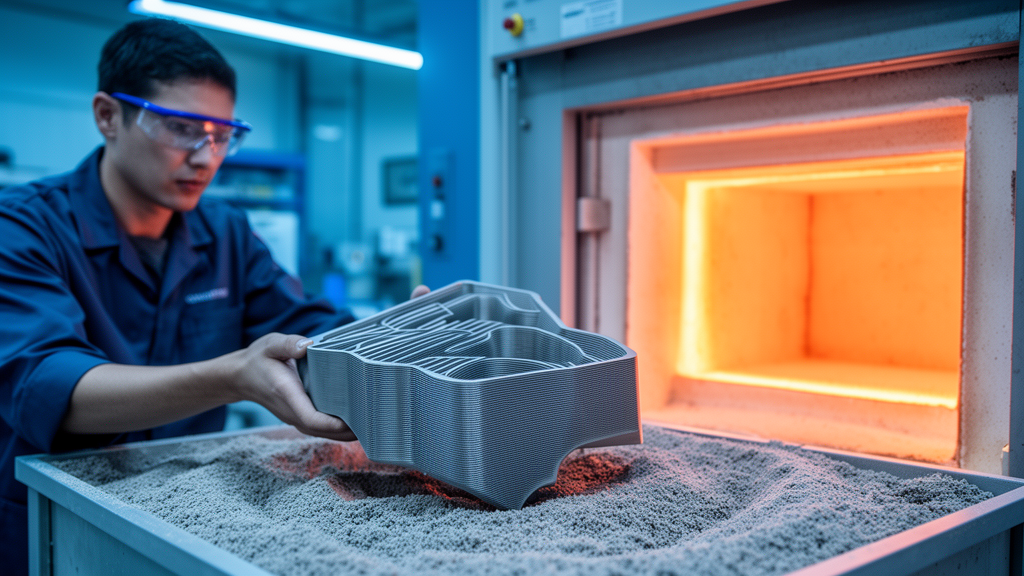
Binder jetting differs fundamentally from laser-based powder bed fusion processes such as selective laser melting and electron beam melting. Instead of melting powder with a focused energy beam, the printer deposits liquid binder onto a powder bed layer by layer, creating a fragile green part that must later be cured, debinded, and sintered at high temperature so that solid-state diffusion bonds the particles together. Because no melting occurs, the process avoids the large residual stresses that plague fusion-based printing, requires no support structures, and is well suited to batch production of geometrically complex titanium components with a buy-to-fly ratio approaching 1:1.
The catch is densification: the final microstructure and mechanical properties depend heavily on the green-body architecture established during printing, and achieving high density during sintering remains the central challenge for binder-jetted titanium alloys. The research team, publishing in Scientific Reports, chose layer thicknesses as multiples of the powder's median particle size of 33.63 micrometers, using spherical Ti-6Al-4V powder with a particle range of 15 to 53 micrometers produced by electrode induction melting gas atomization. Specimens were printed on an AFS-J160R binder jetting system with a water-based binder, cured at 175 degrees Celsius for three hours, and then sintered in a vacuum tube furnace following a carefully controlled schedule: heating to 450 degrees Celsius for debinding, then to 1300 degrees Celsius for holding times of one to five hours.
Density was measured by the Archimedes method, pore structure was quantified from electron microscopy images, and grain orientation, phase distribution, and lattice parameters were characterized with electron backscatter diffraction and X-ray diffraction. The green-density results reveal how powerfully layer thickness shapes the starting point for sintering. The 40-micrometer specimens achieved a green density of 52.74 percent, while the 80- and 120-micrometer specimens dropped to 46.33 percent and 40.78 percent respectively.
Two mechanisms explain this trend. First, a thinner powder layer allows the roller's compaction action to transmit through the entire layer, promoting more complete particle rearrangement and reducing large pores created by particle bridging; in thicker layers, compaction concentrates in the upper region while the lower portion remains loosely packed. Second, under a fixed jetting strategy, binder saturation is inversely proportional to layer thickness.
Increasing the layer from 40 to 80 and then 120 micrometers caused binder saturation to fall sequentially from 31.6 percent to 15.8 percent and 10.5 percent, diluting the effective binder available per unit pore volume and weakening interparticle bonding in the green state. During sintering, the three groups followed strikingly different densification trajectories. The 40-micrometer specimens densified rapidly, reaching a peak relative density of about 94.4 percent within two hours, after which density fluctuated only slightly through five hours of holding.
The 80-micrometer specimens climbed more slowly to a maximum of about 83.3 percent at four hours and then dropped to roughly 80.3 percent at five hours. The 120-micrometer specimens increased nearly monotonically but peaked at only about 83.5 percent at five hours. At every holding time, the thinnest-layer group outperformed the others, demonstrating that the green-body state constrains the maximum attainable density within the investigated process window.
In conventional powder metallurgy, compaction typically yields green densities of 65 to 80 percent, and sintered parts commonly reach around 95 percent relative density; the much lower green densities of binder jetting, roughly 40 to 53 percent here, make the final density gap difficult to close by thermal treatment alone. Porosity measurements told the same story with an important twist. All groups began with porosity near 25 percent after one hour, but the 40-micrometer specimens plunged to a minimum of 4.4 percent at two hours before rebounding to about 18.1 percent at three hours—a pronounced pore-regrowth event—then settling at lower levels through five hours.
The 80- and 120-micrometer groups bottomed out at 15.8 and 16.1 percent respectively and never approached the ultralow porosity of the thinnest layers. The researchers explain this plateau through the physics of closed pores: once pores isolate during intermediate-stage sintering, gas trapped inside them, originating from impurities and reaction gases such as carbon monoxide and carbon dioxide, generates internal pressure that counteracts the capillary driving force for shrinkage. For spherical pores, densification ceases when the gas pressure reaches the capillary stress of four times the surface energy divided by the pore diameter.
Larger pores mean lower capillary pressure, so coarse residual pores are readily held open by internal gas. Thin-layer specimens start with finer, more dispersed pores that can degas and shrink before closure, leaving small residual pores with strong capillary driving force, whereas thick-layer specimens stall at a high-porosity regime governed by this pressure balance. Microstructural characterization showed that phase constitution remained stable across all conditions.
X-ray diffraction detected the characteristic peaks of hexagonal close-packed alpha-titanium, and electron backscatter diffraction confirmed an alpha-dominated matrix with only trace amounts of beta phase along grain boundaries, consistent with extensive transformation during slow furnace cooling from the single-beta phase field at 1300 degrees Celsius. Grain orientation was essentially random, indicating that binder jetting introduces no strong textural bias. Grain size, however, grew steadily with holding time: the 80- and 120-micrometer groups coarsened from about 23.63 to 31.66 micrometers between one and five hours, following a cubic grain-growth law in which the cube of grain size scales linearly with time.
The 40-micrometer group generally showed the smallest grains at a given holding time, because its higher green density and finer initial pores limited the space available for growth as grains impinged earlier. The XRD analysis also uncovered a subtler effect with direct mechanical consequences. Lattice parameters increased slightly with holding time, from 2.907 angstroms at one hour to 2.929 angstroms at five hours, reflecting progressive dissolution of interstitial carbon and oxygen released from binder decomposition into octahedral sites of the titanium lattice.
While interstitial solid-solution strengthening can raise strength, the accompanying lattice distortion constitutes a fundamental microstructural origin of increased brittleness and reduced ductility in sintered specimens. The lattice parameter differences among the three layer-thickness groups were minor at any given time, indicating that interstitial uptake is governed primarily by thermal exposure rather than printing geometry. Tensile testing tied the processing variables to mechanical performance with unusual clarity.
The 120-micrometer specimens managed only about 300 megapascals after one to two hours, rising to 493 megapascals at five hours, while the 80-micrometer group peaked at 462 megapascals even after the longest hold—both limited by unhealed porosity that shrinks the load-bearing cross-section. The 40-micrometer specimens, by contrast, surged to 925 megapascals at two hours, coinciding with peak density, meeting the wrought benchmark of roughly 895 megapascals, and approaching the minimum ductility requirement of about 6 percent for structural powder-metallurgy applications with an elongation of 5.7 percent. Fracture surfaces told a mechanistic story: early-sintered and thick-layer specimens failed prematurely around unbonded particles and deep voids, while the best specimen showed fine dimples coexisting with cleavage facets in a mixed quasi-cleavage and microvoid-coalescence mode.
Energy-dispersive spectroscopy of bright particles on fracture surfaces revealed carbon-rich residues averaging 86.72 weight percent carbon and 8.90 weight percent oxygen, likely carbide-related particles from binder decomposition that act as stress concentrators and limit ductility, with several over-sintered conditions dropping to about 1 percent elongation. Rather than simply extending sintering time, the study demonstrates that optimizing printing layer thickness to raise green density and refine the initial pore architecture is a more effective route to high-performance binder-jetted parts, because a favorable green body shortens the sintering time needed for peak properties even though thinner layers increase build time. Ductility and residual defect control, particularly carbon management, remain the outstanding hurdles before binder-jetted Ti-6Al-4V can fully match wrought material, but the demonstration that a 40-micrometer layer and a two-hour hold can deliver near-wrought strength marks a concrete step toward cost-effective, batch-produced titanium components for aerospace, biomedical, and consumer applications.
Subject of Research: Effect of printing layer thickness and sintering time on densification, microstructure, and tensile properties of binder-jetted Ti-6Al-4V
Article Title: Effect of printing layer thickness and sintering time on the densification, microstructure and mechanical properties of binder-jetted Ti-6Al-4V alloy
Article References: Huang, S., Qi, C., Cui, X., Li, Z., Guan, D., Zhang, Y., Jia, W., & Li, F. (2026). Effect of printing layer thickness and sintering time on the densification, microstructure and mechanical properties of binder-jetted Ti-6Al-4V alloy. Scientific Reports, 16(1), Article 34416. https://doi.org/10.1038/s41598-026-62601-4
Image Credits: AI Generated
DOI: 10.1038/s41598-026-62601-4
Keywords: binder jetting, Ti-6Al-4V, additive manufacturing, sintering, powder metallurgy, green density, porosity, tensile strength, grain growth, titanium alloys, layer thickness, carbide embrittlement
Cite Scienmag News
Denise Maddox. (October 27, 2026). Thinner Layers and Shorter Sintering Unlock Near-Wrought Strength in Binder-Jetted Titanium. Scienmag. https://scienmag.com/thinner-layers-and-shorter-sintering-unlock-near-wrought-strength-in-binder-jetted-titanium/
Denise Maddox. "Thinner Layers and Shorter Sintering Unlock Near-Wrought Strength in Binder-Jetted Titanium." Scienmag, 27 October 2026, https://scienmag.com/thinner-layers-and-shorter-sintering-unlock-near-wrought-strength-in-binder-jetted-titanium/. Accessed 28 October 2026.
Denise Maddox. "Thinner Layers and Shorter Sintering Unlock Near-Wrought Strength in Binder-Jetted Titanium." Scienmag. October 27, 2026. https://scienmag.com/thinner-layers-and-shorter-sintering-unlock-near-wrought-strength-in-binder-jetted-titanium/