


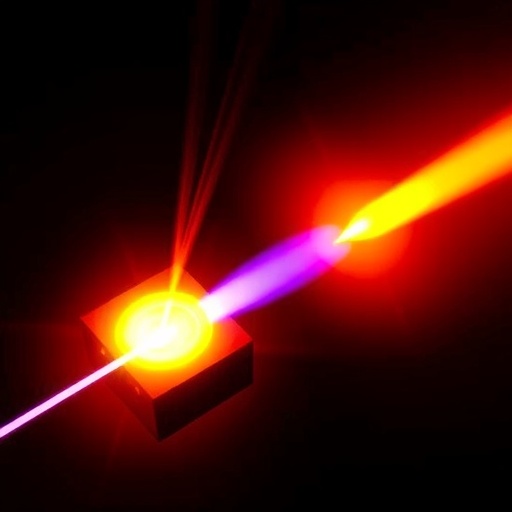
In a groundbreaking advancement poised to reshape photodetection technology, electrical engineers at Duke University have unveiled the fastest pyroelectric photodetector ever reported. This ultrathin device operates by absorbing the heat generated from incoming light across the entire electromagnetic spectrum, a feat hitherto unattainable with such speed and efficiency. Unlike traditional semiconductor photodetectors, which are limited to viewing a narrow range of visible frequencies and require external power, this new thermal photodetector functions at room temperature without any external power source, offering immense potential for integration into compact, chip-scale applications.
Traditional photodetectors based on semiconductors work by producing an electrical current when exposed to visible light, enabling the creation of digital images. However, their spectral sensitivity is inherently restricted, comparable to the human eye’s limited range. To overcome these limitations, researchers have explored pyroelectric detectors, which produce electrical signals in response to temperature changes caused by absorbed light. Historically, pyroelectric detectors lagged in responsiveness because generating sufficient heat at challenging wavelengths required bulky components, resulting in slow response times unsuitable for high-speed applications.
The Duke University team, led by Professor Maiken Mikkelsen, circumvented these issues by developing a novel “metasurface” structure that dramatically accelerates photodetection. This metasurface employs precisely engineered silver nanocubes residing merely 10 nanometers above an ultrathin gold film. When light interacts with these nanocubes, it excites localized surface plasmons—coherent oscillations of silver electrons—that trap and concentrate the light energy at specific frequencies controlled by the nanocubes’ geometric parameters such as size and spacing. This localization enhances light absorption with unprecedented efficiency.
By leveraging this plasmonic phenomenon, the system requires only an extremely thin pyroelectric layer beneath the metasurface to transduce the trapped heat into an electrical signal. This innovative design enables a response time of merely 125 picoseconds, corresponding to an operational frequency of up to 2.8 GHz. This speed eclipses conventional pyroelectric photodetectors by several orders of magnitude, which typically operate within the nano- to microsecond range. Such a dramatic improvement challenges longstanding assumptions about the intrinsic slowness of thermal photodetection mechanisms.
Previously, Mikkelsen’s laboratory demonstrated the effectiveness of this plasmonic nanocube design in 2019, though the experimental setup at that time precluded precise speed measurements. In subsequent years, doctoral candidate Eunso Shin has refined the device and devised a clever, cost-effective methodology to characterize its dynamic response. Utilizing two distributed feedback lasers whose frequencies are finely tuned near the device’s working bandwidth, Shin was able to accurately quantify the photodetector’s temporal resolution without resorting to prohibitively expensive instrumentation.
Optimizations to the device architecture included reshaping the metasurface from a rectangle to a circular configuration to maximize light exposure while minimizing the electrical signal’s traversal distance. Collaborations also secured even thinner pyroelectric materials to further enhance sensitivity. Additionally, advancements in circuit design were implemented to improve the efficiency of electrical signal readout and communication. Together, these enhancements contributed to achieving the record-breaking gigahertz-range operation.
The ultrafast response and multispectral capability of this pyroelectric photodetector imply transformative applications across various domains. Because the device functions without external power, it is particularly suitable for deployment in remote sensing platforms such as drones, satellites, and interplanetary spacecraft, where power consumption and weight are critical constraints. In precision agriculture, real-time multispectral imaging could enable farmers to monitor crop health, irrigation needs, and fertilizer application with unprecedented accuracy, fostering sustainability and improved yields.
Moreover, the wide spectral detection capability opens new horizons in medical diagnostics, including noninvasive skin cancer detection. The ability to simultaneously detect multiple light frequencies and polarizations could enhance imaging resolution and contrast, facilitating early disease identification and extending applications in food safety inspections by identifying contaminants or spoilage indicators invisible to conventional cameras. Such features position this technology as a potential cornerstone in next-generation imaging sensors.
Looking ahead, the researchers are targeting further performance gains by embedding the pyroelectric materials and their associated electrical circuitry directly within the plasmonic metasurface structure—specifically, the interstitial spaces between the silver nanocubes and the ultrathin gold layer. This integration promises to reduce thermal and electrical response times even further, potentially pushing the operational frequency beyond current limits.
Additionally, advanced device designs aim to incorporate multiple metasurfaces with varied geometrical parameters on a single chip, enabling simultaneous detection of distinct frequencies and polarities of light. This multiband detection capability would surpass current multispectral imaging systems, opening a new chapter in compact, low-power sensor technology with applications extending into environmental monitoring and defense.
This breakthrough was made possible through funding support from the Air Force Office of Scientific Research and the Gordon and Betty Moore Foundation. The published work in Advanced Functional Materials provides detailed experimental analyses and theoretical modeling that chart a path toward widespread adoption of ultrafast pyroelectric photodetectors. As the team continues to push boundaries, the implications for both fundamental science and applied technology promise to be profound.
The fundamental nature of this research, rooted in plasmonics, nanofabrication, and pyroelectric physics, underscores the interdisciplinary effort required to overturn entrenched technological barriers. It exemplifies how precise nanoscale engineering can unlock novel functionalities with real-world impact, offering a glimpse of the future where thermal imaging can be as fast, efficient, and versatile as conventional optical cameras, but with vastly expanded sensing capabilities.
In sum, the Duke University acquisition of a metasurface-enhanced pyroelectric photodetector operating at gigahertz frequencies inaugurates a new era for thermal imaging technology. Its capacity to operate at room temperature, autonomously and with exceptional speed and sensitivity, heralds transformative advancements across scientific research, industrial inspection, environmental monitoring, and medical diagnostics. As fabrication techniques mature and device designs evolve, this pioneering photodetector is set to become an indispensable tool heralding the future of multispectral imaging.
News Publication Date: 11-Dec-2025
Web References: https://advanced.onlinelibrary.wiley.com/doi/10.1002/adfm.202420953
References: Eunso Shin, Rachel E. Bangle, Nathaniel C. Wilson, Stefan B. Nikodemski, Jarrett H. Vella, Maiken H. Mikkelsen. “Metasurface-Enhanced Thermal Photodetector Operating at Gigahertz Frequencies.” Advanced Functional Materials, 2025. DOI: 10.1002/adfm.202420953
Keywords
Applied optics, Optical materials, Photonics, Imaging, Engineering, Electronics, Signal processing
Cite Scienmag News
Denise Maddox. (March 4, 2026). Thermal Photodetectors Break Speed Records with Advanced Light Trapping Technology. Scienmag. https://scienmag.com/thermal-photodetectors-break-speed-records-with-advanced-light-trapping-technology/
Denise Maddox. "Thermal Photodetectors Break Speed Records with Advanced Light Trapping Technology." Scienmag, 4 March 2026, https://scienmag.com/thermal-photodetectors-break-speed-records-with-advanced-light-trapping-technology/. Accessed 4 September 2026.
Denise Maddox. "Thermal Photodetectors Break Speed Records with Advanced Light Trapping Technology." Scienmag. March 4, 2026. https://scienmag.com/thermal-photodetectors-break-speed-records-with-advanced-light-trapping-technology/


