


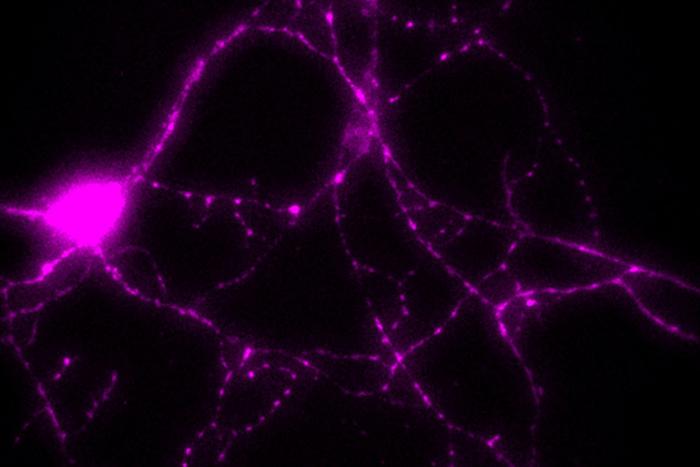
An enzyme called PGK1 has an unexpectedly critical role in the production of chemical energy in brain cells, according to a preclinical study led by researchers at Weill Cornell Medicine. The investigators found that boosting its activity may help the brain resist the energy deficits that can lead to Parkinson’s disease.

Credit: Ryan lab
An enzyme called PGK1 has an unexpectedly critical role in the production of chemical energy in brain cells, according to a preclinical study led by researchers at Weill Cornell Medicine. The investigators found that boosting its activity may help the brain resist the energy deficits that can lead to Parkinson’s disease.
The study, published Aug. 21 in Science Advances, presented evidence that PGK1 is a “rate-limiting” enzyme in energy production in the output-signaling branches, or axons, of the dopamine neurons that are affected in Parkinson’s disease. This means that even a modest boost to PGK1 activity can have an outsized effect at restoring the neuronal energy supply in low-fuel conditions—and the researchers showed that this could prevent the axon dysfunction and degeneration normally seen in an animal model of Parkinson’s disease.
“Our findings show that PGK1 can really make a big difference in Parkinson’s disease, in ways we didn’t anticipate,” said study senior author Dr. Timothy Ryan, the Tri-Institutional Professor of Biochemistry at Weill Cornell Medicine. “I’m very optimistic that this line of research has the potential to generate new Parkinson’s treatments.”
The study’s first author was Dr. Alexandros Kokotos, a postdoctoral researcher in the Ryan Laboratory.
Parkinson’s afflicts about one million Americans and is the second most common neurodegenerative disorder after Alzheimer’s. The disease hits key populations of dopamine-producing neurons, initially weakening their synapses, or connection points to other neurons, and ultimately killing them. The resulting signs and symptoms of the disease include movement impairments, sleep problems and eventually dementia. Current treatments address symptoms but do not stop the disease course.
For decades, studies of various kinds have pointed to a failure of neuronal energy supply as a factor in Parkinson’s—a disease that affects neurons with very high energy requirements. Even so, researchers have lacked a good energy-related target for disease treatments.
The new focus on PGK1 originated from recent studies showing that the Food and Drug Administration-approved drug terazosin, which is used to treat prostate enlargement, also happens to enhance PGK1’s energy-production activity and has beneficial effects in multiple animal models of Parkinson’s. In these studies, however, terazosin’s ability to boost PGK1 activity was quite weak, leaving uncertainty over its mechanism of action. Further evidence of the drug’s proposed role in boosting neural protection came from a retrospective study in humans showing that terazosin significantly reduced the risk of developing Parkinson’s.
“Pharma companies have been skeptical that this weak enhancement of PGK1 can explain these benefits in Parkinson’s models,” said Dr. Ryan, who is also a professor of biochemistry in anesthesiology at Weill Cornell Medicine.
In the new study, Dr. Ryan’s team helped resolve this issue with sensitive assays that elucidated PGK1’s role as an energy producer in neurons. This role, the researchers showed, is so important that even a small boost to PGK1 activity, such as terazosin provides, is enough to keep axons functioning when levels of glucose, which PGK1 helps convert to basic units of chemical energy, are low. The experiments included low-glucose situations caused by known Parkinson’s-linked gene mutations.
The team also made a surprising discovery concerning a protein called DJ-1, whose impairment through mutation is another known genetic cause of Parkinson’s. DJ-1 is a “chaperone” that is thought to protect neurons by preventing harmful protein aggregation. However, the team found that DJ-1 works in an unexpected energy-supplying role as a close partner of PGK1—and indeed is necessary for the benefits of PGK1 enhancement.
To Dr. Ryan, the results add weight to the theory that an energy supply deficit in the most vulnerable dopamine neurons—due to aging, genetic and environmental factors—is a general early driver of Parkinson’s, and that moderately enhancing the activity of just one enzyme, PGK1, may be enough to reverse this deficit and block the disease process.
“Now I can say I’m confident that this enzyme is what should be targeted,” Dr. Ryan said. “Given the positive impact of terazosin in protecting against Parkinson’s in humans, and the fact that this drug was never optimized for PGK1 enhancement, it is exciting to consider the possible clinical impact of new drugs that, compared with terazosin, can enhance PGK1 activity more potently and selectively.”
The research described in this story was supported in part by the National Institute of Neurological Disorders and Stroke and the National Institute of General Medical Sciences, both part of the National Institutes of Health, through grant numbers NS036942, NS11739, R35GM136686, and in part by Aligning Science Across Parkinson’s ASAP-000580 and ASAP-020608 through the Michael J. Fox Foundation for Parkinson’s Research.
Journal
Science Advances
Cite Scienmag News
Cassandra Pierce. (August 21, 2024). The role of an energy-producing enzyme in treating Parkinson’s disease. Scienmag. https://scienmag.com/the-role-of-an-energy-producing-enzyme-in-treating-parkinsons-disease/
Cassandra Pierce. "The role of an energy-producing enzyme in treating Parkinson’s disease." Scienmag, 21 August 2024, https://scienmag.com/the-role-of-an-energy-producing-enzyme-in-treating-parkinsons-disease/. Accessed 6 September 2026.
Cassandra Pierce. "The role of an energy-producing enzyme in treating Parkinson’s disease." Scienmag. August 21, 2024. https://scienmag.com/the-role-of-an-energy-producing-enzyme-in-treating-parkinsons-disease/

