


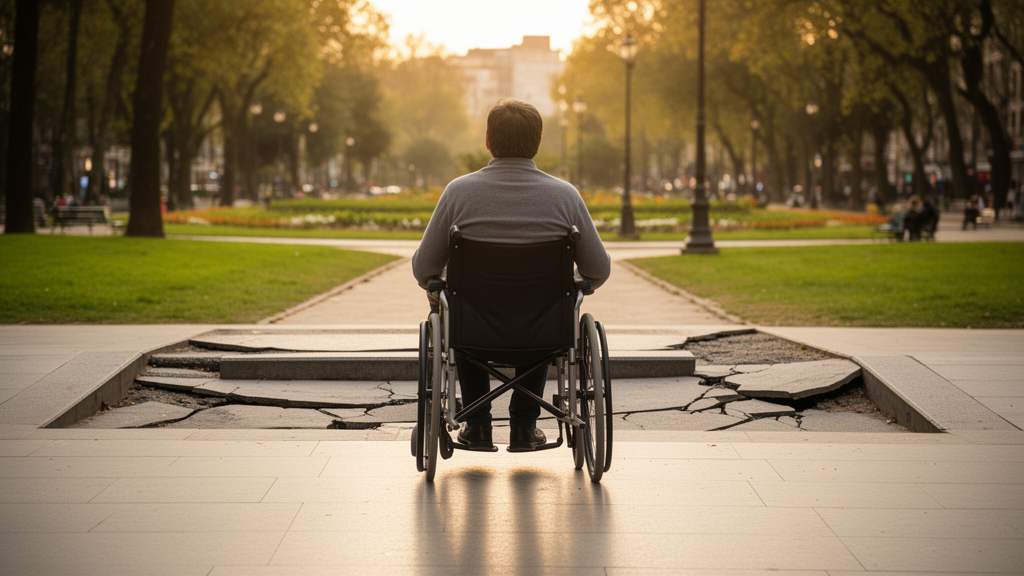
Chile has spent years building parks, plazas, cycle paths and sports facilities within walking distance of most homes, and a new national analysis suggests that effort has largely succeeded on paper. When researchers from Universidad Andrés Bello, Universidade Federal de São Paulo and ten other institutions mined the 2024 National Survey of Physical Activity and Sports Habits (ENAFyD), a probabilistic sample of 8,653 Chilean adults, they found something paradoxical: adults with disabilities reported that activity spaces existed near their homes at almost exactly the same rate as everyone else. Yet they used those spaces dramatically less. The gap, the study concludes, is not about whether the infrastructure exists. It is about whether that infrastructure is actually usable.
The numbers tell a stark story. Perceived availability of sports facilities or adequate spaces near the home was 92.1 percent among adults with disabilities and 91.4 percent among those without, a difference so small it vanished statistically (crude prevalence ratio 1.01; 95 percent CI 0.99 to 1.03; p = 0.478). But when the researchers asked who actually used those available spaces, the picture inverted. Only 29.9 percent of adults with disabilities who had spaces nearby reported using them, compared with 42.7 percent of adults without disabilities. That translates into a 22 percent higher prevalence of non-use among people with disabilities, a gap that persisted even after the researchers adjusted for sex, age group and socioeconomic status.
The study, published in Frontiers in Sports and Active Living, is the first to separate perceived availability from actual use along the full access chain in a national surveillance instrument, and it does so with unusual methodological care. The team classified disability into six mutually exclusive categories: sensory only, physical only, cognitive only, multiple types, other only, and none. They then used weighted Poisson regression with robust variance to estimate prevalence ratios, adjusting for confounders selected a priori through a directed acyclic graph rather than by statistical fishing. Because the public database provided survey weights but not stratum or cluster identifiers, the researchers approximated variance using a Kish design effect of 2.51, and they confirmed that their conclusions held when they recomputed key contrasts under design effects ranging from 2.0 to 3.0.
The weighted prevalence of disability in the sample was 9.3 percent, with sensory disability alone accounting for 57.4 percent of the group with disabilities, followed by physical only at 28.6 percent. Adults with disabilities were older (45.0 percent aged 60 or older, versus 19.7 percent of those without), more frequently women (55.8 percent versus 50.5 percent), and more frequently of low socioeconomic status (38.7 percent versus 31.0 percent). These demographic differences matter because they partially explain the crude inactivity gap: 40.5 percent of adults with disabilities were physically inactive compared with 27.0 percent of those without, a raw difference of roughly 13.5 percentage points that narrowed to a prevalence ratio of 1.22 after adjustment. The persistence of that association after controlling for demographics indicates a disability-specific disadvantage beyond age structure alone.
What makes the finding actionable is the barrier profile among non-users. Among the 634 adults with disabilities and 3,635 without who reported having available spaces but not using them, three barriers stood out as significantly more frequent in the disability group. Distance or difficulty of access was reported by 14.0 percent versus 7.7 percent (prevalence ratio 1.82; 95 percent CI 1.44 to 2.31). Lack of companionship was reported by 25.9 percent versus 16.8 percent (PR 1.54; 1.31 to 1.80). Presence of crime was reported by 26.4 percent versus 21.4 percent (PR 1.23; 1.06 to 1.44). Inadequate lighting was borderline (15.3 percent versus 12.2 percent; PR 1.25; p = 0.046). Notably, complaints about poor maintenance were actually less frequent among adults with disabilities (19.2 percent versus 23.5 percent; PR 0.82), which the authors interpret as evidence that the excess is not driven by a uniformly more negative perception of the environment but concentrates in barriers plausibly related to functional limitations: getting to the space and having support once there.
The heterogeneity across disability types adds another layer. Adults reporting multiple disability types showed the strongest association with non-use of available spaces (adjusted PR 1.47; 1.35 to 1.60), followed by cognitive only (1.29; 1.00 to 1.67), other only (1.20; 1.01 to 1.43), physical only (1.14; 1.05 to 1.24) and sensory only (1.09; 1.02 to 1.17). This ordering mirrors international evidence: among Spanish users of adapted sport programs, environmental barriers predominated in visual disability while intrinsic barriers predominated in physical and intellectual disability. The pattern is consistent with the global estimate that people with disabilities are 16 to 62 percent less likely to meet physical activity guidelines, a range that reflects precisely this heterogeneity across disability types and contexts.
The stratified analyses reveal a striking sex pattern. Disability appears to erase the male advantage in physical activity observed in the general population: men without disabilities were substantially more active than women without disabilities, but inactivity among adults with disabilities converged near 40 percent in both sexes. The interaction between disability and sex for inactivity was statistically significant (p = 0.009), with the crude prevalence ratio reaching 1.78 among men compared with 1.30 among women. Barrier profiles also diverged by group: lack of companionship weighed most heavily among adults aged 60 and over (30.5 percent versus 19.4 percent) and among men (27.7 percent versus 14.2 percent), while presence of crime was differential only among women (30.9 percent versus 24.3 percent). Distance or difficult access was elevated in nearly every stratum examined.
The policy implications are direct. Chile’s newly enacted National Policy on Physical Activity and Sport 2026-2037 acknowledges that 79.3 percent of persons with disabilities engage in no physical activity, citing the national disability survey, but delegates its quantified targets to forthcoming national and regional plans. The present findings suggest that building more infrastructure would not by itself close the gap, since perceived availability is already near universal in both groups. Instead, the actionable margins are accessibility audits and universal design retrofitting of existing spaces, safe route programs connecting homes to spaces, and accompanied or peer-supported physical activity schemes that directly target the three differential barriers identified. The authors also point to a comparatively low-cost complement: training physical education teachers, sport coaches and municipal staff in inclusive and adapted physical activity, so that existing spaces are staffed by professionals prepared to receive people with disabilities.
The study has limitations that the authors acknowledge candidly. Disability was self-reported through a brief dichotomous item battery without severity grading or use of the standardized Washington Group questions, which likely captures more severe cases; the 9.3 percent prevalence sits closer to the severe fraction of the III National Disability Study (ENDISC 2022), which estimates 17.6 percent of Chilean adults live with some degree of disability. The cognitive only group was small (n = 45), yielding wide confidence intervals. The residual
Subject of Research: Disability and use of physical activity spaces in Chilean adults
Article Title: Similar perceived availability but lower use of physical activity spaces among Chilean adults with disabilities
Article References: De Souza-Lima, J., Winckler, C., Olasagasti-Ibargoien, J., Yáñez-Sepúlveda, R., Godoy-Tapia, C., Parra-Saldías, M., Duclos-Bastías, D., Godoy-Cumillaf, A., Merellano-Navarro, E., Bruneau-Chávez, J., Reyes-Amigo, T., & Farías-Valenzuela, C. (2026). Similar perceived availability but lower use of physical activity spaces among Chilean adults with disabilities. Frontiers in Sports and Active Living, 8, Article 1969080. https://doi.org/10.3389/fspor.2026.1969080
Image Credits: AI Generated
DOI: 10.3389/fspor.2026.1969080
Keywords: physical activity, disability, Chile, built environment, accessibility, national survey, ENAFyD, public health, health equity, barriers, inclusive policy, Similar
Cite Scienmag News
Phoebe Ingram. (October 16, 2026). The Park Is There, but the Path Is Not: Disability Gap Lies in Use, Not Availability, of Chile’s Activity Spaces. Scienmag. https://scienmag.com/the-park-is-there-but-the-path-is-not-disability-gap-lies-in-use-not-availability-of-chiles-activity-spaces/
Phoebe Ingram. "The Park Is There, but the Path Is Not: Disability Gap Lies in Use, Not Availability, of Chile’s Activity Spaces." Scienmag, 16 October 2026, https://scienmag.com/the-park-is-there-but-the-path-is-not-disability-gap-lies-in-use-not-availability-of-chiles-activity-spaces/. Accessed 16 October 2026.
Phoebe Ingram. "The Park Is There, but the Path Is Not: Disability Gap Lies in Use, Not Availability, of Chile’s Activity Spaces." Scienmag. October 16, 2026. https://scienmag.com/the-park-is-there-but-the-path-is-not-disability-gap-lies-in-use-not-availability-of-chiles-activity-spaces/


