


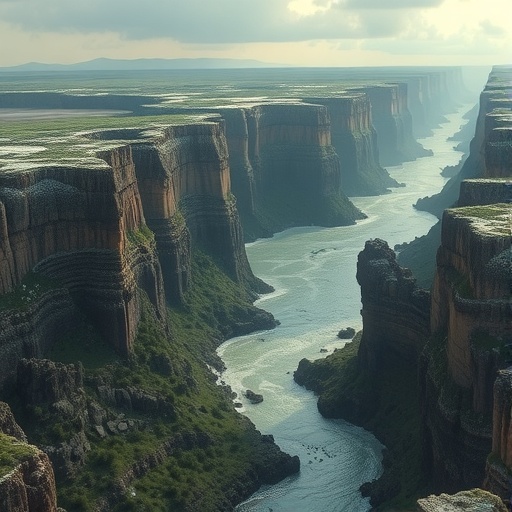
A flood remembered for centuries as the “St. Mary Magdalene’s Flood” was not a single catastrophe after all. A sweeping reconstruction of medieval records reveals that Europe endured a connected sequence of 16 major flooding events between 1341 and 1343, with the most destructive episodes concentrated in 1342. The findings transform one of Europe’s best-known medieval disasters from an isolated historical tragedy into an early example of cascading climate-related hazards—multiple extreme events striking different regions in rapid succession and repeatedly overwhelming societies that had little time to recover.
The study, led by researchers at TU Wien and involving universities across Europe, examined more than 1,000 historical references describing floods, deaths, crop failures, damaged infrastructure and disrupted trade. The team combined these records with modern hydrological knowledge to reconstruct when and where rivers overflowed across the continent. Instead of treating each medieval account as a separate anecdote, the researchers compared descriptions of rainfall, river levels, transportation failures and agricultural losses across regions. The result is a month-by-month picture of a flood sequence extending from 1341 through 1343, revealing a chain of events that moved through Europe like a “string of pearls.”
The scale of the human disaster was immense. Contemporary sources describe many thousands of deaths caused directly by drowning and indirectly by hunger and disease. Floodwaters destroyed homes, bridges, roads, mills and fields, while saturated soils made it difficult to plant or harvest crops. The damage did not end when the rivers receded. Repeated flooding stripped communities of food reserves, killed livestock and disrupted the movement of grain and other essential goods. Multiannual crop failures followed in some areas, creating conditions in which disease and famine could spread long after the most dramatic floodwaters had disappeared.
The economic consequences reached far beyond individual river valleys. Major trade routes were cut, and vital infrastructure collapsed under the force of water and debris. Among the structures damaged was Prague’s Stone Bridge, which crossed the Vltava River before the construction of the city’s later Charles Bridge. Such losses had effects that multiplied across the continent: when bridges and roads failed, food could not reach urban populations, merchants could not travel safely and emergency assistance could not be delivered. In a preindustrial economy dependent on local harvests and river transport, the destruction of a single crossing could destabilize entire regions.
The researchers reconstructed the flood sequence by assessing the reliability and geographic context of medieval documents. Historical evidence is rarely uniform: one chronicle may describe a river rising “higher than ever,” while another may record only the destruction of a village or bridge. To interpret these accounts, the team compared them with modern floods that occurred under similar geographical and meteorological conditions. River behavior, terrain, settlement patterns and known flood mechanisms provided a framework for translating scattered observations into a coherent hydrological history. This approach allowed the scientists to distinguish local disasters from episodes that were part of a broader continental pattern.
The resulting chronology shows that 1342 stands out as the year with the greatest number of extreme flood events in the past seven centuries. The following year, 1343, ranks close behind, while the broader sequence began in 1341. The events were not identical: some affected central Europe, others struck different watersheds, and their severity varied considerably. Yet their close timing suggests that they were not statistically independent accidents. When soils remain saturated, reservoirs and wetlands are full, river channels are already swollen and damaged infrastructure has not been repaired, a new storm can produce far greater destruction than it would under normal conditions.
The study also explores why so many floods occurred in such a compressed period. Around 1340 and 1341, an unusually high number of volcanic eruptions took place, including an eruption of Iceland’s Hekla volcano. Volcanic eruptions can inject sulfur-containing gases into the stratosphere, where they form sulfate aerosols that reflect incoming sunlight. This can temporarily cool the surface and alter atmospheric circulation. Cooling alone does not automatically cause widespread flooding, but changes in temperature gradients between the tropics and polar regions can influence the position and strength of large-scale weather systems, including the low-pressure systems that carry prolonged rainfall.
Other environmental factors may have amplified these effects. Arctic sea ice had already declined significantly from the middle of the 1330s, while solar activity remained relatively low during the 1330s and 1340s. The interaction among volcanic aerosols, ocean and sea-ice conditions, solar variability and atmospheric circulation could have favored persistent storm tracks over parts of Europe. Researchers caution that these factors cannot be treated as a single proven cause, but together they offer a plausible explanation for why extreme rainfall and flooding became unusually clustered. The medieval evidence therefore provides a rare natural experiment for studying how multiple climate influences can combine to create compound hazards.
The implications extend directly into the modern era. Flood-risk models often estimate the probability of individual events, but the historical reconstruction demonstrates why this approach can be incomplete. A river basin struck by one extreme flood may be more vulnerable to a second event because embankments have been weakened, sediment has shifted, farmland is waterlogged and communities have exhausted emergency supplies. Across a continent, several different river systems can also be affected by the same persistent atmospheric pattern. The lesson from 1341 to 1343 is clear: flood protection must be designed not only for the largest possible event, but also for sequences of major floods arriving before societies and ecosystems have recovered.
The St. Mary Magdalene’s Flood was therefore not simply a medieval curiosity or a single date in Europe’s disaster history. It was the most visible part of a prolonged, interconnected episode in which climate conditions, hydrological feedbacks and human vulnerability reinforced one another. By linking documentary evidence with modern science, the researchers show that extreme floods can arrive in clusters and that their combined impact may be far greater than the sum of individual events. As climate change increases the likelihood of intense rainfall in many regions, the medieval record offers a warning with contemporary urgency: the next disaster may not be one flood, but several arriving in succession.
News Publication Date: 12-Aug-2026
Web References: https://doi.org/10.1038/s41586-026-10888-8
References: Nature; DOI: 10.1038/s41586-026-10888-8
Cite Scienmag News
Violet Maxwell. (August 13, 2026). The Millennium’s Flood Wasn’t One Flood, Scientists Find. Scienmag. https://scienmag.com/the-millenniums-flood-wasnt-one-flood-scientists-find/
Violet Maxwell. "The Millennium’s Flood Wasn’t One Flood, Scientists Find." Scienmag, 13 August 2026, https://scienmag.com/the-millenniums-flood-wasnt-one-flood-scientists-find/. Accessed 3 September 2026.
Violet Maxwell. "The Millennium’s Flood Wasn’t One Flood, Scientists Find." Scienmag. August 13, 2026. https://scienmag.com/the-millenniums-flood-wasnt-one-flood-scientists-find/


