

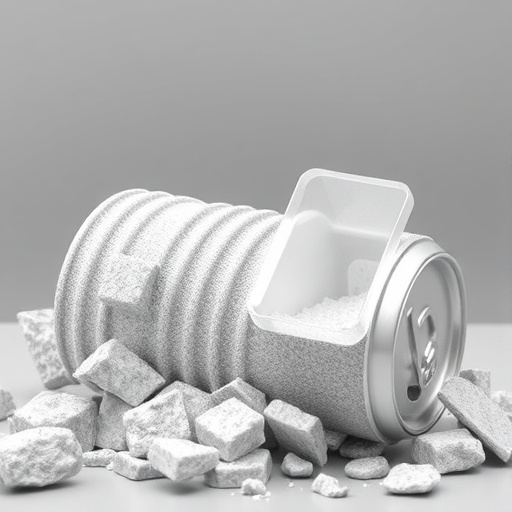
In the world of seemingly mundane objects subjected to extraordinary forces, the humble soda can reveals fascinating secrets that go far beyond satisfying visual spectacles. Researchers at The University of Manchester have uncovered an intricate and orderly pattern dictating how liquid-filled cans deform under compression, a discovery that challenges our traditional understanding of material buckling. While the common perception has long been that an empty can collapses abruptly and randomly, the behavior of a full can is remarkably different. Instead of an instantaneous crush, a liquid-filled can develops a sequence of circular corrugations, emerging one after another with mathematical precision.
This phenomenon was explored through a combination of meticulous laboratory experiments and advanced mathematical modeling techniques, typically reserved for analyzing natural pattern formations such as ripples on water surfaces or undulating wave structures. The researchers observed that the incompressibility of the liquid inside transforms how the can’s aluminum shell distributes applied stresses. This internal fluid resistance prevents sudden collapse and instead enables a progressive, stable buckling sequence. Each buckle forms in a predictable location, initiated by subtle physical imperfections that dictate the starting point of the ripple cascade before the material’s inherent properties take over.
Their detailed investigations revealed that as the can undergoes compression, the aluminum experiences alternating phases of softening and stiffening. This cyclical mechanical response underlies the ring-like corrugations, which propagate along the cylinder’s length with remarkable consistency even amid variations in internal pressure. Such robustness suggests that the observed buckling behavior is not simply a quirk of consumer packaging but a fundamental characteristic of fluid-filled cylindrical shells subjected to axial stress. Indeed, the findings implicate the same process in a diverse array of industrial and engineering contexts where liquid-filled metal cylinders are commonplace.
Central to the team’s discovery is the identification of the buckling sequence as an example of the rare mathematical phenomenon known as homoclinic snaking. This pattern describes the incremental and highly ordered emergence of localized states — in this case, the individual corrugation rings — rather than a random or chaotic assembly. Though theorized in mathematical physics, direct experimental evidence of homoclinic snaking in real-world materials under mechanical stress has been elusive. The soda can thus provided a surprisingly elegant platform to visualize and confirm this sophisticated mathematical behavior in tangible form.
From a practical standpoint, this insight holds considerable significance. Liquid-filled metal cylinders are ubiquitous in sectors ranging from industrial storage and transportation to energy generation and aerospace engineering. However, predicting their failure modes has historically been complicated by a lack of detailed understanding of how internal fluids interact with structural materials under load. The research breakthrough could enhance engineers’ ability to foresee early signs of mechanical instability long before catastrophic failure occurs, fostering improvements in safety protocols and design standards.
Moreover, the possibility exists to harness this sequential buckling phenomenon in manufacturing processes. As Dr. Finn Box, one of the lead investigators, suggests, the controlled induction of corrugations without reliance on external molds could revolutionize the production of containers that require both strength and controlled deformability. This could lead to lighter, more efficient packaging and novel design paradigms that strategically leverage the material’s mechanical responses rather than merely resisting them.
The uncovered underlying mathematics lend themselves to more comprehensive models describing the interplay between internal pressure, shell geometry, and material elasticity. These models allow for the simulation of a can’s buckling process with unprecedented accuracy, providing a predictive framework that could be adapted to various scales and materials. The researchers highlight that while minor geometric irregularities influence initial buckle formation, subsequent corrugations require no fine-tuning to maintain the sequential order, reinforcing the intrinsic nature of the snaking mechanism.
This research thus bridges the gap between abstract mathematical theory and tangible mechanical behavior, transforming a familiar everyday object into a window on complex physical processes. The fact that slight imperfections in the can can pinpoint the initial buckle but not disrupt the overall sequence highlights the balance between randomness and determinism in structural deformation. It also presents a compelling case for further investigations into fluid-structure interactions in cylindrical shells, promising to refine contemporary engineering simulations and design algorithms.
Beyond containers, there could be profound implications for the aerospace sector, where cylindrical tanks often store liquids under variable pressures and mechanical stress. Understanding buckling sequences could inform the design of fuel tanks and other critical components, enhancing resilience under operational and emergency conditions. Similarly, sectors such as construction and energy can benefit from predictive insights into the mechanical stability of metal cylinders used in storage or as structural elements, potentially preventing costly failures.
The discovery also invites contemplation of how evolutionary principles might inform engineered materials that mimic such pattern formation strategies. The interplay of fluid dynamics and material mechanics, governed by fundamental nonlinear dynamics, can inspire biomimetic designs and innovative technologies. This revelation that the humble soda can’s buckling entails deep physics and elegant mathematics may thus spur interdisciplinary collaboration between mathematicians, physicists, materials scientists, and engineers.
In sum, what begins as a captivating visual curiosity in viral hydraulic press videos unfolds into a profound exploration of nonlinear dynamics, material science, and applied mathematics. The University of Manchester team’s findings on sequential buckling in fluid-filled cylindrical shells illuminate a previously obscured mechanical phenomenon with broad relevance and potential for technological innovation. As researchers continue to decode the physics of complex materials under stress, even everyday objects like soda cans can inspire breakthroughs that ripple across industries and scientific disciplines.
Subject of Research: Mechanical buckling behavior of fluid-filled cylindrical metal shells under axial compression.
Article Title: Soda-forming: Sequential buckling in fluid-filled cylindrical shells
News Publication Date: 31-Mar-2026
Web References:
Communications Physics Article
Image Credits: Dr Finn Box
Keywords: Physics, Deformation, Compressibility, Mechanical properties, Mathematical analysis, Mathematical modeling, Material properties, Physical properties


