


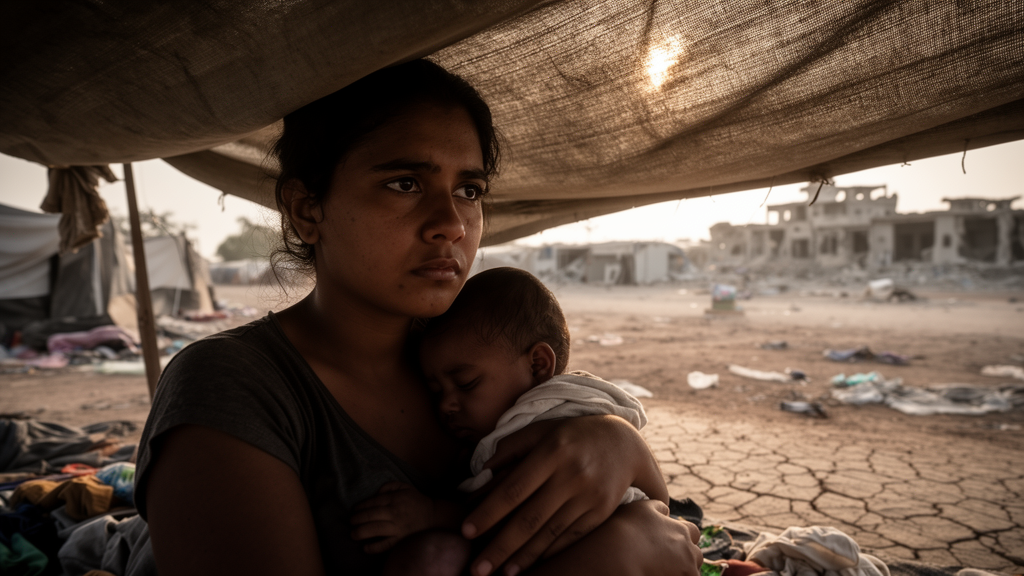
Every year, global health campaigns celebrate falling maternal death rates, yet a quieter emergency unfolds in the shadows of those statistics. In conflict-affected and low-resource settings, roughly one in four pregnant and postpartum women experiences depression, and one in five lives with an anxiety disorder. These psychological burdens, intensified by poverty, displacement, violence, and collapsing health systems, remain largely invisible in the policies and metrics that define maternal health success. A new Perspective published in Frontiers in Global Women’s Health by researchers at Hormuud University in Mogadishu, Somalia, argues that this neglect is not an accidental oversight but a structural failure, and it lays out a conceptual framework for placing maternal mental health at the very center of global women’s health agendas.
The authors, led by Ilyas Abdullahi Khalif, begin from a deceptively simple observation: surviving pregnancy is not the same as achieving maternal health. Over the past three decades, international efforts have concentrated overwhelmingly on reducing maternal mortality and expanding access to obstetric care, producing genuine and important gains. But this survival-focused agenda, the researchers contend, is too narrow. Contemporary maternal health scholarship increasingly emphasizes well-being, dignity, rights, and person-centred care as integral components of maternal health, while decades of global prioritization have privileged biomedical indicators over the social and political determinants that actually shape women’s lives. Within that gap, maternal depression, anxiety, trauma, and psychological distress have been systematically under-recognized, particularly where resources are scarcest.
The scale of the problem in conflict settings is stark. Among migrant women, one in four experience perinatal depression and one in five experience anxiety, while forced migrants carry a particularly heavy burden of post-traumatic stress disorder. Post-conflict settings report similarly elevated rates of anxiety, depression, and PTSD. The Perspective stresses that these risks cannot be explained by trauma exposure alone. Social isolation, discrimination, poor partner support, precarious housing, food insecurity, and disrupted access to prenatal and postnatal care all compound distress and can mediate the mental health effects of violence and displacement. Pregnancy and the postpartum period, already marked by major biological adjustment and heightened emotional demands, become periods of acute vulnerability when overlaid with trauma, family separation, and the erosion of the social support structures that ordinarily buffer stress.
Perhaps the most compelling dimension of the argument is intergenerational. Prenatal stress has been associated with measurable changes in fetal brain development and poorer infant cognitive and social-emotional outcomes. Perinatal distress can impair mother-infant bonding, breastfeeding, caregiving quality, and early child development, with consequences that ripple through family functioning and across generations. Evidence from conflict-affected settings, including Timor-Leste, indicates that maternal depressive symptoms and exposure to traumatic events are linked to poorer early childhood mental health, while children’s emotional and behavioral difficulties can in turn exacerbate maternal depression. The result is a potentially recursive cycle of adversity, in which the psychological wounds of war are transmitted from mother to child and back again. Maternal mental health, the authors argue, must therefore be understood not merely as an individual clinical concern but as a determinant of child well-being, family functioning, and health across generations.
Why has this burden remained so persistently neglected? The Perspective identifies three interconnected mechanisms. First, mortality-centred metrics dominate global policy: there are still no global indicators routinely used to track perinatal mental health status or progress, which reinforces policy invisibility even though psychological conditions contribute to both maternal morbidity and mortality. Second, health systems in many low- and middle-income settings organize maternal and mental health services in silos, with weak policy support, limited workforce capacity, absent clinical guidelines, and referral systems that fail to identify or follow women in distress. Third, humanitarian triage logic prioritizes food, shelter, infection control, and obstetric survival, leaving psychosocial care limited, delayed, or externalized to external actors. The authors describe this neglect as a structural weakness in global women’s health systems, a sign that health agendas respond more readily to visible threats to life than to the less visible conditions that shape women’s capacity to survive, function, parent, and recover.
To reframe the problem, the researchers propose a biopsychosocial, life-course model in which maternal mental health is treated as the psychological expression of conflict layered onto pre-existing structural inequality. In their framework, conflict operates as a structural determinant rather than a discrete shock: it erodes the political, economic, and health system conditions that shape everyday survival, while structural inequities distribute that harm unevenly across women already marginalized by poverty, low education, insecure housing, and weak service access. These disruptions become biologically and socially consequential through proximate determinants such as displacement, gender-based violence, food insecurity, restricted mobility, loss of income, and the breakdown of care infrastructures. In Gaza, for example, most pregnant women surveyed reported very low income, inadequate food quantity or diversity, limited antenatal care, and high stress, with transport costs a major barrier to reaching care. Maternal depression, anxiety, and trauma responses then act as mediating mechanisms through which conflict becomes embodied, ultimately producing intergenerational consequences that range from low birth weight and prematurity to later neurodevelopmental risk.
This reframing is not merely academic. The authors argue that psychological well-being is inseparable from maternal dignity, agency, and quality of care, and that a women’s health agenda ignoring mental health cannot fully address equity across pregnancy, childbirth, and the postpartum period. A gender-responsive orientation is central, because maternal health inequities are produced through power relations, constrained agency, violence, and exclusion from decision-making. Interventions that engage social relationships and gender dynamics can improve both mental health and care-seeking, as demonstrated by integrated and gender-synchronised models in low- and middle-income countries. Framing maternal mental health this way also aligns directly with the Sustainable Development Goals, particularly SDG 3 on health and well-being and SDG 5 on gender equality, offering a conceptual bridge between clinical care, social protection, and rights-based health-system design.
On the practical side, the Perspective offers concrete priorities. Mental health screening should be embedded into routine antenatal and postnatal contacts, but only where screening is linked to clinical assessment, referral, and follow-up, using brief validated tools that fit existing maternal and child health contacts without creating parallel services. Women who screen positive should move along a defined stepped-care pathway, beginning with psychosocial support and progressing to specialist assessment for severe or high-risk conditions. Experience from Sri Lanka suggests that two-stage screening, combining brief tools with clinical interview, can identify women needing support while reducing unnecessary pressure on specialist services. The realistic delivery model in low- and middle-income countries is task-shared, culturally adapted psychosocial care delivered by trained midwives, nurses, community health workers, or peers, supported by competency-based training, supervision, and clear escalation pathways. Where conflict disrupts facilities, community health workers, outreach teams, home visits, and peer-support groups can sustain continuity of care, complementing rather than replacing facility-based services.
The authors are candid about the obstacles. Sustainability remains threatened by intermittent funding, workforce turnover, and uneven resource distribution, while stigma, cultural mismatch, and low help-seeking continue to discourage disclosure and delay care. Humanitarian monitoring systems rarely capture screening, service access, referral completion, or provider training, and most existing indicators were developed outside low- and middle-income contexts. The researchers call for maternal mental health indicators to be incorporated into existing health information systems, tracking the proportion of eligible women screened, referrals completed, and follow-up attendance. Future research, they argue, should prioritize pragmatic trials, implementation and cost-effectiveness studies, longitudinal designs, and context-valid measures in conflict settings, where evidence remains sparse despite high and persistent risk.
The ultimate message is one of integration rather than addition. The way forward, the authors conclude, is not a parallel mental health agenda but integrated, gender-responsive, intersectional, and life-course approaches that embed maternal mental health within primary care, social policy, and broader systems of women’s health and rights. As conflicts multiply and displacement reaches historic levels, the invisible burdens carried by millions of mothers will no longer remain ignorable by default. What happens to a woman’s mind during pregnancy and after childbirth, the evidence increasingly shows, shapes the brains, health, and futures of the children she carries, and through them the recovery of entire societies. Recognizing that reality, the Mogadishu team argues, is the first step toward maternal health systems worthy of the name.
Subject of Research: Maternal mental health as a core priority in conflict-affected and low-resource settings
Article Title: Invisible burdens: reframing maternal mental health as a core priority in conflict-affected and low-resource settings
Article References: Abdullahi Khalif, I., Abdullahi Hubow, Y., Omar, A. M., Dahir, N. A., & Abdi, A. M. (2026). Invisible burdens: reframing maternal mental health as a core priority in conflict-affected and low-resource settings. Frontiers in Global Women's Health, 7, Article 1989039. https://doi.org/10.3389/fgwh.2026.1989039
Image Credits: AI Generated
DOI: 10.3389/fgwh.2026.1989039
Keywords: maternal mental health, perinatal depression, conflict settings, global health, women's health equity, humanitarian health, task-sharing, psychosocial support, health systems, gender inequality, PTSD, intergenerational outcomes
Cite Scienmag News
Glenn Wilkins. (October 16, 2026). The Invisible Crisis: Why Maternal Mental Health Demands a Central Place in Conflict Zones. Scienmag. https://scienmag.com/the-invisible-crisis-why-maternal-mental-health-demands-a-central-place-in-conflict-zones/
Glenn Wilkins. "The Invisible Crisis: Why Maternal Mental Health Demands a Central Place in Conflict Zones." Scienmag, 16 October 2026, https://scienmag.com/the-invisible-crisis-why-maternal-mental-health-demands-a-central-place-in-conflict-zones/. Accessed 16 October 2026.
Glenn Wilkins. "The Invisible Crisis: Why Maternal Mental Health Demands a Central Place in Conflict Zones." Scienmag. October 16, 2026. https://scienmag.com/the-invisible-crisis-why-maternal-mental-health-demands-a-central-place-in-conflict-zones/


