


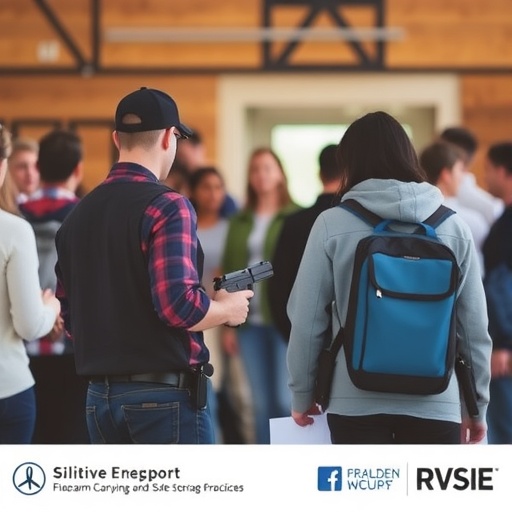
A groundbreaking study published in the renowned journal Injury Prevention reveals compelling evidence that social support from family, friends, and intimate partners plays a crucial role in shaping firearm-related behaviors in the United States. Conducted by researchers at Rutgers Health, this research sheds new light on the social dynamics influencing gun carrying and storage practices, highlighting how strong interpersonal connections may reduce unsafe firearm behaviors significantly.
Utilizing data from a nationally representative 2024 survey involving over 8,000 American adults, the researchers focused their analysis on the subset of 2,451 respondents who reported having access to firearms. Employing the Multidimensional Scale of Perceived Social Support (MSPSS), a validated psychological tool consisting of 12 carefully designed questions, the study quantitatively measured the degree of emotional and practical support individuals perceived from their social circles. This framework enabled an in-depth examination of how perceived social support correlates with specific firearm behaviors, such as the frequency of carrying guns and adherence to recommended safe storage practices.
The statistical analysis conducted indicates that enhanced social support is associated with a marked decrease in risk-laden firearm behaviors. Participants reporting higher MSPSS scores demonstrate an 8% reduction in the likelihood of frequent firearm carrying—a behavior closely linked to increased risks of accidental discharge or impulsive violence. Moreover, these individuals exhibit an 11% reduction in unsafe storage practices, specifically in storing firearms unlocked and loaded. Such findings suggest that social networks may exert a protective effect by fostering personal norms that discourage risky behavior.
Conversely, the presence of strong social support structures is positively correlated with safer firearm storage methods. The study finds a 14% increase in the odds of storing firearms locked up and an 8% increase in storing firearms separately from ammunition among those with better social integration. These practices have been consistently shown in injury prevention literature to reduce unintentional injuries, suicides, and unauthorized firearm access, highlighting the public health significance of the researchers’ findings.
Lead author Daniel Semenza, director of research at the New Jersey Gun Violence Research Center and associate professor at Rutgers University, points out that social connections serve as psychosocial buffers mitigating individuals’ perceived necessity to rely on firearms for personal safety. According to Semenza, the sense of security derived from nurturing relationships lessens the inclination to carry firearms frequently or adopt unsafe storage habits. This insight introduces a novel psychosocial pathway within firearm injury prevention research, a domain traditionally centered on legislation and individual psychological risk factors.
While the association between social support and general physical and mental health outcomes is well-documented, this study pioneers the investigation of how such support specifically influences firearm-related behaviors. The researchers emphasize that addressing social determinants within gun violence prevention frameworks can potentiate existing strategies. Incorporating approaches that strengthen community bonds and familial support may evolve into an effective intervention vector, reducing the rates of firearm-associated injuries and deaths.
The implications of this research call for a paradigm shift in public health initiatives aimed at firearm injury reduction. Instead of solely focusing on policy restrictions and individual behavior modification, the findings advocate for integrating social environment and network-based strategies. Encouraging supportive interpersonal relationships could function as a non-legislative yet impactful measure to cultivate safer firearm practices and diminish the reliance on firearms as a primary means of perceived protection.
This study represents a sophisticated use of epidemiological and sociological methodologies to dissect the complex interdependencies between social environments and firearm behaviors. By applying rigorous data/statistical analysis on nationally representative datasets, the researchers ensure robust and generalizable insights, essential for informing policy and cabinetry-level public health programming decisions.
Furthermore, the participation of academic experts spanning disciplines such as urban-global public health, sociology, anthropology, criminal justice, and behavioral psychology underpins the study’s multidisciplinary rigor. This collaborative approach enriches the research narrative, situating firearm safety within broader socio-behavioral and health contexts.
As firearm injuries continue to exact a tragic toll in the United States, this study underscores the urgency of embracing holistic, community-oriented solutions. Harnessing the protective power of social support networks not only addresses the immediate behavioral risk factors but also nurtures resilience and safety in vulnerable populations, potentially mitigating both intentional and accidental firearm harms.
In conclusion, the innovative findings presented by Rutgers Health’s research team reveal that social connections are critical determinants of firearm safety behaviors. This novel evidence suggests that public health interventions fostering strong, supportive relationships could become pivotal components in the nationwide effort to reduce firearm-related injuries and fatalities.
News Publication Date: 4-Nov-2025
Web References:
10.1136/ip-2025-045819
References: Injury Prevention (Journal)
Cite Scienmag News
Courtney Benton. (November 15, 2025). The Influence of Social Support on Firearm Carrying and Safe Storage Practices. Scienmag. https://scienmag.com/the-influence-of-social-support-on-firearm-carrying-and-safe-storage-practices/
Courtney Benton. "The Influence of Social Support on Firearm Carrying and Safe Storage Practices." Scienmag, 15 November 2025, https://scienmag.com/the-influence-of-social-support-on-firearm-carrying-and-safe-storage-practices/. Accessed 4 September 2026.
Courtney Benton. "The Influence of Social Support on Firearm Carrying and Safe Storage Practices." Scienmag. November 15, 2025. https://scienmag.com/the-influence-of-social-support-on-firearm-carrying-and-safe-storage-practices/


