


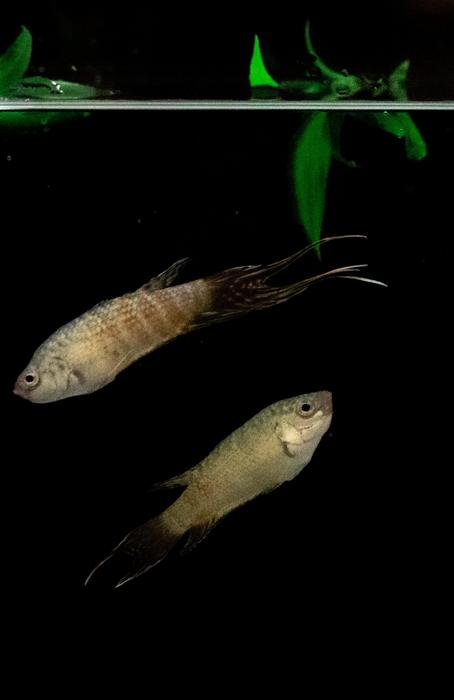
In Hungary, ethological research is most often identified with tests on dogs, but novel methodological advances could bring another species, the paradise fish, into the spotlight. Fish are easy to handle and produce numerous offspring, which could open up new possibilities for researchers in the fields of evolution and behavioural genetics. Researchers from ELTE Eötvös Loránd University have highlighted the importance of this old-new model animal in recent publications.

Credit: Photo: Eötvös Loránd University
In Hungary, ethological research is most often identified with tests on dogs, but novel methodological advances could bring another species, the paradise fish, into the spotlight. Fish are easy to handle and produce numerous offspring, which could open up new possibilities for researchers in the fields of evolution and behavioural genetics. Researchers from ELTE Eötvös Loránd University have highlighted the importance of this old-new model animal in recent publications.
Recent methodological advances in the field of molecular biology, such as the steep drop in sequencing costs or the proliferation of universally applicable genome editing techniques, have made it possible to carry out molecular-level studies on non-conventional animal models as well to understand the genetic background of the behaviour of a long-researched species..
As a part of such an effort,
researchers at ELTE have sequenced and characterised the reference genome of the Chinese paradise fish (Macropodus opercularis),
creating an important resource for future experiments. The genome, just 480Mb in size, is located on 23 chromosomes and contains more than 20,000 protein-coding genes. This compact genetic material could make the species an ideal subject for future targeted genome editing experiments.
The paper describing the results was published in the Springer-Nature journal Scientific Data, and in a parallel review published in the Journal of Experimental Zoology B, the researchers also outlined their vision of using the paradise fish
in studies of evolutionary development, and in research that aims to revealthe genetic basis of complex behaviours.
The ELTE Department of Ethology’s 30-year-old dog research project is one of the most “visible” of the many important and successful long-term research projects at ELTE. Before the mid-1990s, however, for almost two decades the “flagship animal” of the same Department was not the dog, and not even a mammal, but a species the paradise fish.
The use of this fish species in ethological experiments was also pioneered by Professor Vilmos Csányi.
When the Department was founded, he decided to conduct research using a species that had complex, repetitive and genetically encoded behaviours. The paradise fish fitted this bill, and for the following decades, with the help of his colleagues, he explored in detail the species’ behaviour. They constructed a species-specific ethogram, a catalogue of repetitive behaviours that individuals of the species exhibit alone or during their social interactions.
As promising as this early research was, by the mid-1990s the work had lost its pace. Due to the lack of appropriate genetic tools the mechanisms behind the specific behaviours could not be precisely defined.
Therefore, on the initiative of Prof. Ádám Miklósi, current Head of the Department of Ethology, in collaboration with the Fishgenetics Research Group (Department of Genetics) led by Máté Varga, with the support from the National Research, Development and Innovation Office’s (NRDIO) Thematic Excellence Programme, a new research programme has been initiated to “reinvent” the paradise fish as a model for behavioural genetics, with the help of cutting-edge genetic tools.
The work was accomplished in collaboration with Shawn Burgess’ group at the National Human Genome Research Institute (NHGRI) in the US, and Ildikó Szeverényi and László Orbán of the Fish Genomics Research Group at the Department of Applied Fish Biology of the Hungarian Agricultural and Life Sciences University (MATE), also played a key roles in the research.
Journal
Scientific Data
Article Title
The reference genome of Macropodus opercularis (the paradise fish)
Article Publication Date
25-May-2024
Cite Scienmag News
Juliet Wilcox. (June 5, 2024). The importance of the paradise fish in evolutionary and behavioural genetics research. Scienmag. https://scienmag.com/the-importance-of-the-paradise-fish-in-evolutionary-and-behavioural-genetics-research/
Juliet Wilcox. "The importance of the paradise fish in evolutionary and behavioural genetics research." Scienmag, 5 June 2024, https://scienmag.com/the-importance-of-the-paradise-fish-in-evolutionary-and-behavioural-genetics-research/. Accessed 4 September 2026.
Juliet Wilcox. "The importance of the paradise fish in evolutionary and behavioural genetics research." Scienmag. June 5, 2024. https://scienmag.com/the-importance-of-the-paradise-fish-in-evolutionary-and-behavioural-genetics-research/

