

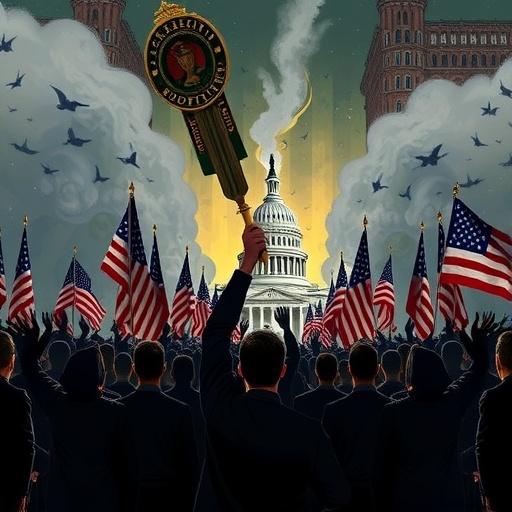
In recent years, the political landscape of the United States has been marked by deep divisions, fierce partisanship, and an increasing struggle for ideological dominance. Yet, amidst the glaring conflicts between the left and right, a subtle but equally impactful phenomenon has been quietly shaping democratic processes—democratic neutrality. A groundbreaking study, soon to be published in Nature Human Behaviour, authored by Hall, Leigh, and Solomon, sheds light on this overlooked but critical aspect of American democracy. Their research argues that democratic neutrality—often perceived as impartiality or disengagement from political partisanship—poses a formidable threat to the functioning and health of democracy in the United States.
At the heart of this study lies an intricate analysis of democratic neutrality, defined as a stance of political nonalignment or deliberate detachment from the polarized ideological spectrum. This phenomenon is not simply an absence of political opinion, but a complex social and cognitive posture where individuals and groups choose to remain neutral amidst a charged political environment. While neutrality in theory promises balance and fairness, Hall and colleagues illustrate through extensive data synthesis and experiments that in the American context, it paradoxically undermines democratic engagement and exacerbates systemic weaknesses.
The research points to multiple mechanisms by which democratic neutrality manifests and influences the political system. Key among these mechanisms is the alienation effect, where citizens who identify as politically neutral become less inclined to participate in civic duties such as voting, campaigning, or public debates. This withdrawal diminishes their influence on policymaking, effectively skewing political discourse toward more extreme and partisan voices. Consequently, neutrality inadvertently cedes ground to polarized actors, thereby distorting democratic representation and accountability.
A significant technical element of the study involves the use of longitudinal survey analyses combined with advanced statistical modeling. These methods track shifts in public attitudes over time, correlating trends in declared neutrality with voter turnout, political knowledge, and media consumption patterns. The authors employed hierarchical linear models to parse out nuanced relationships between neutrality and different sociodemographic groups, revealing that neutrality is not uniformly distributed but tends to concentrate among younger voters and certain socioeconomic strata, which has profound implications for political mobilization strategies.
Hall and colleagues further delve into the psychological underpinnings of neutrality, exploring identity theory and cognitive dissonance as explanatory frameworks. Their experiments suggest that neutrality often arises from a psychological conflict wherein individuals experience discomfort with the polarized options presented, leading to an avoidance strategy characterized by indifference and disengagement. This reveals neutrality not as a stable political identity but as a dynamic, cognitively motivated response to the hostile and fragmented political climate in the USA.
Another critical insight offered by this study relates to media ecosystems and their role in shaping political neutrality. The researchers show that in environments saturated with sensationalist coverage and echo chambers, citizens are more prone to adopt neutral postures as a form of protective distancing. Ironically, the attempt to remain unbiased in such media landscapes amplifies the polarizing narratives by depriving moderate voices of power and visibility. The study’s data strongly suggest that democratic neutrality is both a symptom and a catalyst of media-driven polarization cycles.
The policy implications of these findings are profound. Democratic neutrality, if left unaddressed, threatens the foundational principle of participatory governance by fostering political apathy and undermining the legitimacy of electoral outcomes. The researchers call for innovative civic education programs aimed at reducing political anxiety and encouraging informed, engaged citizenship that transcends simplistic binary choices. They advocate for institutional reforms to create inclusive deliberative forums that welcome diverse perspectives while discouraging disengagement through neutrality.
Technological tools also feature prominently in the authors’ recommendations. They argue that digital platforms must be incentivized or regulated to promote balanced content and facilitate dialogue rather than division. By leveraging algorithmic transparency and ethical design, social media can potentially mitigate the appeal of neutrality as a refuge from hyper-partisan environments, transforming it into an active engagement with democratic processes.
Importantly, the study distinguishes democratic neutrality from political apathy or cynicism, traditional concepts that have been widely studied in political science. While apathy denotes indifference born from disillusionment, neutrality is a more complex and often deliberate stance. This nuanced differentiation helps policymakers and scholars develop more targeted interventions, understanding that strategies effective against apathy may not suffice to address neutrality-driven disengagement.
The authors also highlight the geographic variability of neutrality within the US, employing spatial analysis techniques to map concentrations of neutral voters. These geographic patterns correlate strongly with regions experiencing economic decline or demographic shifts, suggesting that neutrality serves as a barometer of broader social stressors. Such spatial findings emphasize the interconnectedness of political behavior with economic and social realities, urging multidisciplinary approaches to democratic renewal.
From a systemic viewpoint, democratic neutrality threatens not just voter turnout but institutional trust. By distancing themselves from partisan commitments, neutral citizens often express skepticism toward governmental institutions and political actors, which can erode social capital and the collective capacity to solve complex societal problems. The study frames neutrality as a latent political crisis that demands urgent scholarly and practical attention.
Moreover, the research offers a compelling critique of the prevailing narrative that positions neutrality as an ideal or virtuous stance in politics. Instead, the authors assert that in polarized democracies like the US, neutrality is less a virtue and more a symptom of democratic dysfunctionality. This paradigm shift challenges activists, media professionals, and educators to rethink the roles and responsibilities of citizens in the democratic process.
The implications extend to electoral strategies and party politics as well. Political parties have traditionally viewed neutrality as a passive, non-threatening group on the sidelines, but Hall and colleagues demonstrate that this group’s growth can shift electoral dynamics dramatically. Increasing neutrality can depress overall turnout, changing electoral math in unpredictable ways and potentially favoring candidates with more extreme bases, who rely on highly motivated partisan supporters.
In synthesizing this research with existing political theory, the study enhances our understanding of democratic resilience and vulnerability. It complements models of political polarization by introducing a crucial third axis—neutrality—that complicates the simplistic dichotomies of left versus right. This triadic framework opens new avenues for scholarly inquiry and practical democratic innovation.
Hall, Leigh, and Solomon’s work ultimately calls on the American polity to confront the overlooked yet dangerous drift toward democratic neutrality with renewed vigor and creativity. Their meticulous empirical work and theoretical insights provide a foundation for revitalizing democratic engagement, safeguarding democratic norms, and fostering a more inclusive political culture that resists the paralyzing effects of neutrality.
As this research gains traction, it is poised to reshape conversations around democratic health, participation, and identity in the United States and beyond. The overlooked threat of democratic neutrality, once brought into the spotlight, may catalyze the next wave of democratic reform and political awakening in an era marked by unprecedented challenges and uncertainties.
Subject of Research: Democratic neutrality and its effects on political engagement and democratic health in the United States.
Article Title: The overlooked threat of democratic neutrality in the USA.
Article References:
Hall, M.E.K., Leigh, B.T. & Solomon, B.C. The overlooked threat of democratic neutrality in the USA. Nat Hum Behav (2026). https://doi.org/10.1038/s41562-026-02430-7
Image Credits: AI Generated


