


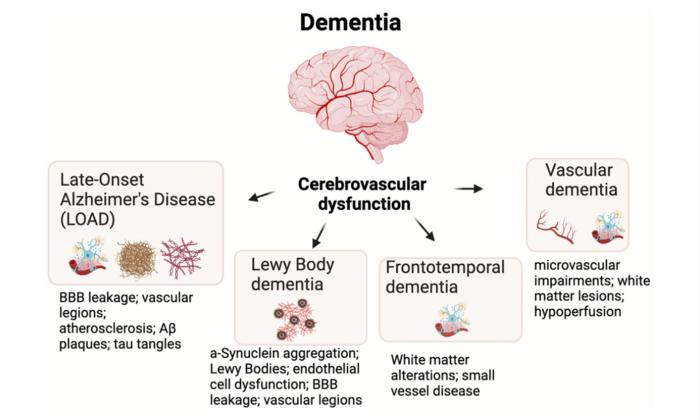
“[…] the associations between common non-invasive measures of cardiovascular health (e.g., blood pressure) and risk of dementia are not well-established.”

Credit: 2024 Wahl and Clayton.
“[…] the associations between common non-invasive measures of cardiovascular health (e.g., blood pressure) and risk of dementia are not well-established.”
BUFFALO, NY- June 12, 2024 – A new review paper was published in Aging (listed by MEDLINE/PubMed as “Aging (Albany NY)” and “Aging-US” by Web of Science) Volume 16, Issue 10, entitled, “Peripheral vascular dysfunction and the aging brain.”
Aging is the greatest non-modifiable risk factor for most diseases, including cardiovascular diseases (CVD), which remain the leading cause of mortality worldwide. In their new review, researchers Devin Wahl and Zachary S. Clayton from Colorado State University and the University of Colorado note that robust evidence indicates that CVD are a strong determinant for reduced brain health and all-cause dementia with advancing age.
“CVD are also closely linked with peripheral and cerebral vascular dysfunction, common contributors to the development and progression of all types of dementia, that are largely driven by excessive levels of oxidative stress (e.g., reactive oxygen species [ROS]).”
Emerging evidence suggests that several fundamental aging mechanisms (e.g., “hallmarks” of aging), including chronic low-grade inflammation, mitochondrial dysfunction, cellular senescence and deregulated nutrient sensing contribute to excessive ROS production and are common to both peripheral and cerebral vascular dysfunction. Therefore, targeting these mechanisms to reduce ROS-related oxidative stress and improve peripheral and/or cerebral vascular function may be a promising strategy to reduce dementia risk with aging. Investigating how certain lifestyle strategies (e.g., aerobic exercise and diet modulation) and/or select pharmacological agents (natural and synthetic) intersect with aging “hallmarks” to promote peripheral and/or cerebral vascular health represent a viable option for reducing dementia risk with aging.
“Therefore, the primary purpose of this review is to explore mechanistic links among peripheral vascular dysfunction, cerebral vascular dysfunction, and reduced brain health with aging. Such insight and assessments of non-invasive measures of peripheral and cerebral vascular health with aging might provide a new approach for assessing dementia risk in older adults.”
Read the full paper: DOI: https://doi.org/10.18632/aging.205877
Corresponding Authors: Devin Wahl, Zachary S. Clayton
Corresponding Emails: devin.wahl@colostate.edu, zachary.clayton@colorado.edu
Click here to sign up for free Altmetric alerts about this article.
About Aging:
Aging publishes research papers in all fields of aging research including but not limited, aging from yeast to mammals, cellular senescence, age-related diseases such as cancer and Alzheimer’s diseases and their prevention and treatment, anti-aging strategies and drug development and especially the role of signal transduction pathways such as mTOR in aging and potential approaches to modulate these signaling pathways to extend lifespan. The journal aims to promote treatment of age-related diseases by slowing down aging, validation of anti-aging drugs by treating age-related diseases, prevention of cancer by inhibiting aging. Cancer and COVID-19 are age-related diseases.
Aging is indexed by PubMed/Medline (abbreviated as “Aging (Albany NY)”), PubMed Central, Web of Science: Science Citation Index Expanded (abbreviated as “Aging‐US” and listed in the Cell Biology and Geriatrics & Gerontology categories), Scopus (abbreviated as “Aging” and listed in the Cell Biology and Aging categories), Biological Abstracts, BIOSIS Previews, EMBASE, META (Chan Zuckerberg Initiative) (2018-2022), and Dimensions (Digital Science).
Please visit our website at www.Aging-US.com and connect with us:
- X, formerly Twitter
- YouTube
- Spotify, and available wherever you listen to podcasts
Click here to subscribe to Aging publication updates.
For media inquiries, please contact media@impactjournals.com.
Aging (Aging-US) Journal Office
6666 E. Quaker Str., Suite 1B
Orchard Park, NY 14127
Phone: 1-800-922-0957, option 1
###
Journal
Aging-US
Method of Research
Literature review
Subject of Research
People
Article Title
Peripheral vascular dysfunction and the aging brain
Article Publication Date
22-May-2024
Cite Scienmag News
Beatrice Stafford. (June 12, 2024). The aging brain and peripheral vascular dysfunction. Scienmag. https://scienmag.com/the-aging-brain-and-peripheral-vascular-dysfunction/
Beatrice Stafford. "The aging brain and peripheral vascular dysfunction." Scienmag, 12 June 2024, https://scienmag.com/the-aging-brain-and-peripheral-vascular-dysfunction/. Accessed 4 September 2026.
Beatrice Stafford. "The aging brain and peripheral vascular dysfunction." Scienmag. June 12, 2024. https://scienmag.com/the-aging-brain-and-peripheral-vascular-dysfunction/

