


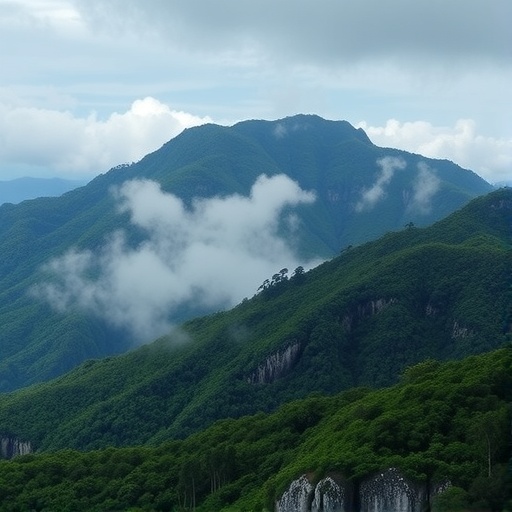
In forest ecosystems, carbon uptake is only half the story. A new study from southern Brazil shows that carbon partitioning depends not just on tree biomass, but on how forest structure, biodiversity patterns, and terrain interact across the full ecosystem—from living plants to litter and soil.
Researchers investigated an 8.3-hectare fragment of Araucaria forest in Curitibanos, Santa Catarina, a humid temperate Atlantic Forest type dominated by the iconic Brazilian pine, Araucaria angustifolia. The landscape is increasingly shaped by surrounding agriculture and forestry, making the fragment a test case for how threatened habitats store carbon.
The team surveyed nine permanent plots, measuring tree diameter, height, and species composition. They then estimated aboveground carbon, collected forest litter from the ground, and analyzed soil carbon down to 30 centimeters. This compartment-by-compartment approach reveals where carbon actually “stays” in real time.
Results varied substantially among plots. In most locations, soil held the largest share of total carbon, although vegetation stored more carbon than soil in several plots. On average, aboveground forest carbon was about 69 metric tons per hectare, while total soil carbon averaged roughly 73 metric tons per hectare. Litter contained less carbon but remains ecologically crucial because it is the fast-moving gateway to the long-term soil pool.
Forest structure mattered. Plots with greater basal area and higher aboveground carbon tended to accumulate more litter carbon, likely because larger, denser stands produce more organic residues that reach the forest floor.
Terrain modified this relationship. As slopes increased, the positive link between forest biomass and litter carbon weakened. The study suggests that gravity-driven runoff and transport can redistribute litter away from inclined ground, reducing local accumulation.
Biodiversity also shaped belowground storage. Higher species evenness—meaning a more balanced distribution of individuals among species—was associated with greater soil carbon stocks, implying that community structure can influence organic matter stabilization in the subsurface.
The researchers did not detect a direct relationship between litter carbon and soil carbon. Sampling occurred in winter, when colder temperatures slow decomposition and can delay the transfer of carbon from litter into soil; in addition, soil integrates longer timescales than the rapidly changing litter layer.
Finally, limitations were noted: the study covered a limited number of plots and relatively shallow, stony soils that constrained sampling depth. The authors call for broader seasonal, climatic, and topographic sampling to refine carbon-sink predictions.
These findings strengthen the case for climate-smart forest strategies that quantify carbon across multiple ecosystem compartments. Conservation plans that protect species evenness, support forest regeneration, and incorporate local terrain may improve both carbon accounting and mitigation effectiveness.
Subject of Research:
Carbon partitioning in Araucaria forest ecosystems
Article Title:
Carbon partitioning in a mixed ombrophilous forest fragment in southern Brazil
News Publication Date:
13-Jul-2026
Web References:
https://doi.org/10.48130/ebp-0026-0009
References:
Theodoroski GN, Cysneiros VC, Schmitt DE, Topanotti LR. 2026. Carbon partitioning in a mixed ombrophilous forest fragment in southern Brazil. Environmental and Biogeochemical Processes 2: e013. doi:10.48130/ebp-0026-0009
Image Credits:
Greyse Naira Theodoroski, Vinicius Costa Cysneiros, Djalma Eugenio Schmitt & Larissa Regina Topanotti
Keywords
carbon sinks, forest structure, species evenness, soil carbon, forest litter, terrain effects, Araucaria forest, carbon cycling
Cite Scienmag News
Margaret Porter. (July 27, 2026). Terrain diversity shapes carbon storage in Brazil’s Atlantic Forest. Scienmag. https://scienmag.com/terrain-diversity-shapes-carbon-storage-in-brazils-atlantic-forest/
Margaret Porter. "Terrain diversity shapes carbon storage in Brazil’s Atlantic Forest." Scienmag, 27 July 2026, https://scienmag.com/terrain-diversity-shapes-carbon-storage-in-brazils-atlantic-forest/. Accessed 4 September 2026.
Margaret Porter. "Terrain diversity shapes carbon storage in Brazil’s Atlantic Forest." Scienmag. July 27, 2026. https://scienmag.com/terrain-diversity-shapes-carbon-storage-in-brazils-atlantic-forest/


