


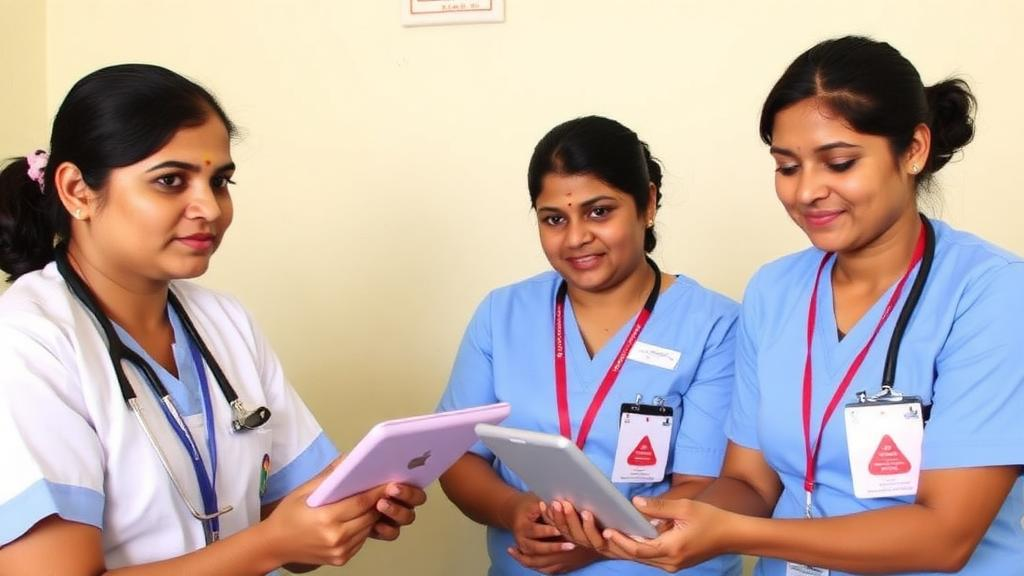
Cervical cancer remains one of the most preventable yet deadliest malignancies affecting women worldwide, and the front line of its defense often runs through the hands of a nurse. In India, where screening coverage has historically lagged behind global targets, a new study published in BMC Nursing suggests that a structured tele-mentoring model can meaningfully transform how nursing professionals understand, discuss, and promote cervical cancer prevention. The research, led by a team at ECHO India and evaluated with ethical approval from the International Institute of Health Management Research in Delhi, offers one of the most detailed looks yet at whether virtual training can shift both knowledge and behavior among nurses working in diverse clinical settings.
The program under evaluation was built on the Extension for Community Healthcare Outcomes, or ECHO, model, a tele-mentoring framework originally developed at the University of New Mexico. Rather than gathering trainees in a single physical location, ECHO connects regional hubs with dispersed learners through recurring virtual sessions, pairing subject matter experts with frontline professionals in a case-based, participatory format. For this initiative, seven hubs across India, including nursing councils and colleges in Andhra Pradesh, Sikkim, Mizoram, Goa, Jalandhar, and Delhi, each delivered seven virtual sessions, producing a total of 49 training sessions that reached 447 nursing professionals.
What distinguishes the new study is its mixed-methods architecture, which triangulated quantitative learning gains with qualitative narratives of change. The researchers deployed three complementary instruments. First, 191 participants completed pre- and post-training surveys designed to measure shifts in knowledge and attitudes toward cervical cancer prevention, screening, and early detection. Second, a far larger pool of post-session surveys, totaling 1,168 responses, captured participant perceptions immediately after each of the 49 sessions. Third, the team applied the Most Significant Change technique, a qualitative approach that collects in-depth stories from the hub members who delivered the training, allowing evaluators to surface unexpected outcomes that standardized questionnaires might miss.
The statistical results were unambiguous. Using the Wilcoxon signed-rank test, a non-parametric method suited to paired before-and-after measurements, the researchers found that the average knowledge score rose from 6.6 to 7.5 after the intervention, an improvement that was statistically significant at p less than 0.001. While the absolute gain may appear modest on a ten-point scale, the consistency of improvement across a heterogeneous cohort of nurses, many of whom work in resource-constrained environments, points to a reliable educational effect. Thematic analysis of the open-ended responses reinforced the quantitative picture, revealing recurring themes of renewed confidence and professional engagement.
Beyond test scores, the study documented striking shifts in behavioral intention, the cognitive precursor to actual screening uptake. Among respondents, 83.6 percent reported an increased willingness to undergo cervical cancer screening themselves, a finding with potential ripple effects, since health workers who participate in screening are more credible advocates for it. Even more broadly, 98 percent of participants expressed a commitment to promote screening and awareness among their peers and communities. In a country where nurses often serve as the most accessible health contacts for women in both outpatient and inpatient departments, such attitudinal conversion could translate into measurable public health gains.
The post-session surveys added a granular, session-by-session view of the training’s reception. Roughly 77 percent of respondents found the content relevant to their clinical roles, and 78 percent stated an intention to apply what they had learned in practice. These figures matter because relevance and applicability are the two attributes most strongly associated with knowledge transfer in adult education research. The feedback was not uniformly glowing, however. Participants flagged the need for improved session timing, better internet connectivity, and the inclusion of additional health topics, practical constraints that the authors acknowledge as design considerations for future iterations of the program.
The qualitative arm of the evaluation yielded some of the most intriguing findings. Through the Most Significant Change interviews, hub members recounted stories suggesting that some participants had already begun fostering more positive work environments and enhancing communication with patients and families. In the language of implementation science, this represents movement beyond individual knowledge acquisition toward organizational and interpersonal change, a harder and more valuable outcome to achieve. The technique, which asks stakeholders to identify and explain the most significant changes they have observed, is particularly well suited to capturing these emergent effects, and the authors report that the interviews also revealed sustained interest and motivation to continue the initiative.
The study’s ethical and methodological scaffolding deserves attention. The Institutional Review Board of IIHMR Delhi approved the research, and the post-session survey additionally received approval from the University of New Mexico Health Sciences Centre Human Research Review Committee for global use. Participation was voluntary, informed consent was obtained separately for each data collection tool, and the post-session questionnaire was fully anonymous, making it impossible to link feedback to individual participants. Qualitative interviewees received detailed participation information sheets and gave separate verbal consent for data collection and video recording, with all procedures conducted in adherence to the 1964 Helsinki Declaration and its later amendments.
Why does this matter on a global scale? Cervical cancer is driven overwhelmingly by persistent infection with high-risk strains of the human papillomavirus, and the World Health Organization has set an ambitious elimination strategy that hinges on vaccination, screening, and early treatment of precancerous lesions. Low-cost visual screening methods such as visual inspection with acetic acid are well suited to settings where cytology and HPV testing are scarce, but they depend critically on trained personnel who can perform the procedure, interpret findings, and counsel patients without alarm or ambiguity. Nurses who understand the disease trajectory, the screening pathway, and the communication skills needed to encourage uptake become force multipliers for every other component of the elimination agenda.
The authors conclude that the ECHO training has strengthened the knowledge and attitudes of nursing professionals in cervical cancer prevention, detection, and screening, and they position the findings as evidence of potential for scale-up and adaptation to other oncology-related topics. If the model proves replicable across additional cancer types and regions, it could offer a template for rapidly upskilling the nursing workforce at a fraction of the cost of conventional in-person training. In a field where the gap between scientific knowledge and frontline practice often determines survival outcomes, a virtual classroom that turns 447 nurses into informed advocates for screening may prove to be one of the more quietly consequential public health interventions of the decade.
Subject of Research: Evaluation of a tele-mentoring training program building nursing capacity for cervical cancer prevention and screening
Article Title: Building capacity for cervical cancer: a mixed-method evaluation of the training program for nursing professionals
Article References: Building capacity for cervical cancer: a mixed-method evaluation of the training program for nursing professionals. (n.d.). https://doi.org/10.1186/s12912-026-05508-9
Image Credits: AI Generated
DOI: 10.1186/s12912-026-05508-9
Keywords: cervical cancer, nursing education, ECHO tele-mentoring, capacity building, mixed methods, screening, HPV, India, program evaluation, public health, Most Significant Change, knowledge translation
Cite Scienmag News
Nathaniel Bowman. (October 14, 2026). Tele-Mentoring Program Boosts Nurses’ Cervical Cancer Knowledge in India. Scienmag. https://scienmag.com/tele-mentoring-program-boosts-nurses-cervical-cancer-knowledge-in-india/
Nathaniel Bowman. "Tele-Mentoring Program Boosts Nurses’ Cervical Cancer Knowledge in India." Scienmag, 14 October 2026, https://scienmag.com/tele-mentoring-program-boosts-nurses-cervical-cancer-knowledge-in-india/. Accessed 14 October 2026.
Nathaniel Bowman. "Tele-Mentoring Program Boosts Nurses’ Cervical Cancer Knowledge in India." Scienmag. October 14, 2026. https://scienmag.com/tele-mentoring-program-boosts-nurses-cervical-cancer-knowledge-in-india/


