

Sunday, October 25, 2026
Science
No Result
View All Result
  • Login
  • HOME
  • SCIENCE NEWS
  • CONTACT US
  • HOME
  • SCIENCE NEWS
  • CONTACT US
No Result
View All Result
Scienmag
No Result
View All Result
Home Science News Medicine

Tea Consumption Linked to Lower Vascular Disease Risk in Chinese Adults

October 25, 2026
in Medicine
Ophelia Keating
By Ophelia Keating Scienmag Editorial Profile - Health Services Research
Reading Time: 2 mins read
0
Tea Consumption Linked to Lower Vascular Disease Risk in Chinese Adults

Tea Consumption Linked to Lower Vascular Disease Risk in Chinese Adults

65
SHARES
587
VIEWS
Share on FacebookShare on Twitter
ADVERTISEMENT

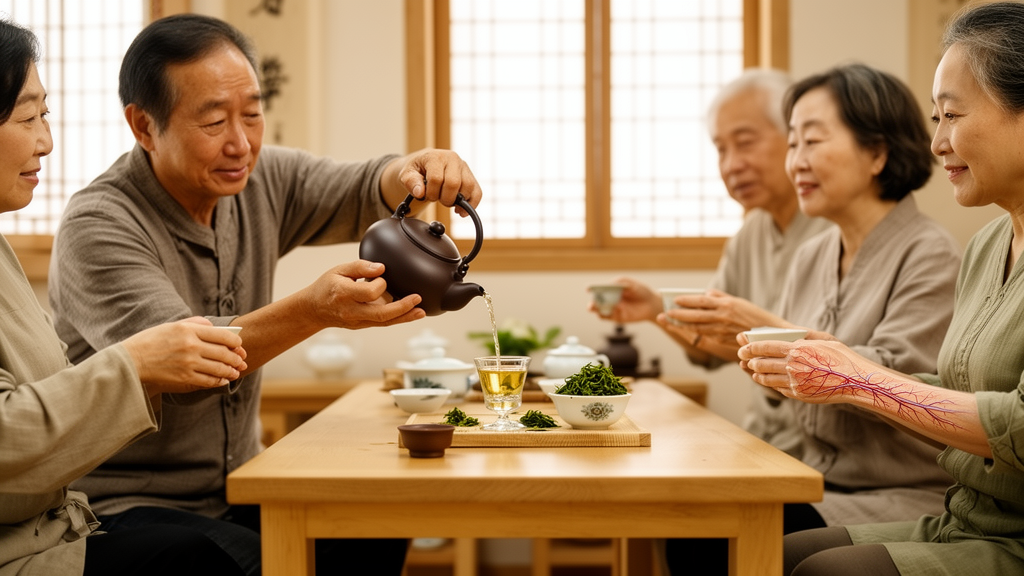
A large study of 485,934 adults in China found that regular tea consumption was associated with an 11% lower risk of cardiovascular and other vascular diseases than not drinking tea. The findings, published in the Journal of Internal Medicine, emerged from a median follow-up of 9.05 years during which participants experienced 14,863 cases of cardiovascular disease, cerebrovascular disease, pulmonary heart disease or peripheral artery disease. Researchers estimated that the lowest risk occurred among people consuming approximately six to eight cups of tea per day, although the analysis does not establish that drinking tea caused the reduction.

The researchers examined the relationship between habitual tea intake and the combined risk of major vascular outcomes. Across the cohort, tea drinkers had a lower estimated risk of these diseases than non-tea drinkers. The dose pattern was not presented as a simple, continuous decrease: instead, the analysis estimated the lowest risk at roughly six to eight cups daily, a level of consumption that was also more common among weekly tea drinkers. The release did not provide absolute event rates for tea drinkers and non-drinkers, so the clinical size of the association cannot be calculated from the reported figures.

Tea type and strength also varied in their associations with vascular disease. Black tea showed more consistent inverse associations with the outcomes than green tea. Moderate-strength tea was associated with the lowest estimated risk, suggesting that the relationship was not identical across preparations and brewing strengths. The researchers also found an elevated risk among people who consumed “burning hot” tea. The release did not quantify that increase, identify a safe drinking temperature, or determine whether temperature alone accounted for the association.

Joint analyses indicated that tea consumption was associated with vascular risk alongside smoking status and physical activity. The combination of habitual tea drinking, not currently smoking and high physical activity was associated with the lowest risk. This pattern does not mean that tea drinking compensated for smoking or that physical activity produced the same effect independently. Rather, the combined analysis identified a group in which several health-related behaviors coincided with a favorable vascular-risk profile.

The study offers detailed evidence that tea drinking is associated with lower vascular-disease risk in a large Chinese adult population, but the reported work remains observational in its interpretation. Its findings are based on associations between reported behavior and subsequent disease outcomes, and the supplied report does not describe a randomized intervention or demonstrate a preventive effect of tea. Tea type, consumption level, strength and temperature all appeared relevant to the analysis, with the lowest estimate around six to eight cups daily and at moderate strength. The results therefore support an association rather than a causal conclusion, and they do not establish that increasing tea intake will prevent cardiovascular disease in any individual.

Subject of Research: Associations between habitual tea consumption and vascular-disease risk in Chinese adults

Article Title: Can drinking tea help protect against cardiovascular disease?

Article References: Can drinking tea help protect against cardiovascular disease?. Original publication (Bibliographic details unavailable.)

Image Credits: AI Generated

DOI: Not provided

Keywords: tea consumption, cardiovascular disease, vascular disease, black tea, green tea, drinking temperature, smoking status, physical activity, Chinese adults, cohort study, drinking, help

Cite Scienmag News

Ophelia Keating. (October 25, 2026). Tea Consumption Linked to Lower Vascular Disease Risk in Chinese Adults. Scienmag. https://scienmag.com/tea-consumption-linked-to-lower-vascular-disease-risk-in-chinese-adults/

Ophelia Keating. "Tea Consumption Linked to Lower Vascular Disease Risk in Chinese Adults." Scienmag, 25 October 2026, https://scienmag.com/tea-consumption-linked-to-lower-vascular-disease-risk-in-chinese-adults/. Accessed 25 October 2026.

Ophelia Keating. "Tea Consumption Linked to Lower Vascular Disease Risk in Chinese Adults." Scienmag. October 25, 2026. https://scienmag.com/tea-consumption-linked-to-lower-vascular-disease-risk-in-chinese-adults/


Tags: black teacardiovascular diseaseChinese adultsChinese adults vascular disease studyCohort studydose-response relationship of tea intakedrinkingdrinking temperatureepidemiological study on tea and vascular diseasesgreen teahabitual tea intake cardiovascular riskhelpimpact of tea type and strength on vascular risklong-term effects of tea on vascular healthoptimal daily tea intake for heart healthPhysical activitysmoking statustea consumptionTea consumption and cardiovascular healthtea consumption and peripheral artery diseasetea consumption patterns in Chinatea drinking and cerebrovascular diseasetea drinking and pulmonary heart diseasevascular disease
Share26Tweet16
Previous Post

DAC-CPPO model reports stronger risk-adjusted portfolio allocation performance

Next Post

Vietnam study finds school abuse screening lacks reliable follow-up services

Related Posts

SGLT2 inhibitor oncology research expands as clinical proof remains uneven
Medicine

SGLT2 inhibitor oncology research expands as clinical proof remains uneven

October 25, 2026
Vietnam study finds school abuse screening lacks reliable follow-up services
Medicine

Vietnam study finds school abuse screening lacks reliable follow-up services

October 25, 2026
Malaysian Experts Issue Consensus on Detecting and Treating Diabetic Nerve Damage
Medicine

Malaysian Experts Issue Consensus on Detecting and Treating Diabetic Nerve Damage

October 25, 2026
Preclinical natural products target ferroptosis defenses in liver cancer
Medicine

Preclinical natural products target ferroptosis defenses in liver cancer

October 25, 2026
Elecsys HCV Duo shows high agreement in multicenter hepatitis C evaluation
Medicine

Elecsys HCV Duo shows high agreement in multicenter hepatitis C evaluation

October 25, 2026
Adult lung study finds no diffuse fibrosis in Alström syndrome
Medicine

Adult lung study finds no diffuse fibrosis in Alström syndrome

October 25, 2026
Next Post
Vietnam study finds school abuse screening lacks reliable follow-up services

Vietnam study finds school abuse screening lacks reliable follow-up services

  • Mothers who receive childcare support from maternal grandparents show more optimized

    Mothers who receive childcare support from maternal grandparents show more parental warmth, finds NTU Singapore study

    27656 shares
    Share 11059 Tweet 6912
  • University of Seville Breaks 120-Year-Old Mystery, Revises a Key Einstein Concept

    1061 shares
    Share 424 Tweet 265
  • Bee body mass, pathogens and local climate influence heat tolerance

    682 shares
    Share 273 Tweet 171
  • Researchers record first-ever images and data of a shark experiencing a boat strike

    546 shares
    Share 218 Tweet 137
  • Groundbreaking Clinical Trial Reveals Lubiprostone Enhances Kidney Function

    531 shares
    Share 212 Tweet 133
Science

Embark on a thrilling journey of discovery with Scienmag.com—your ultimate source for cutting-edge breakthroughs. Immerse yourself in a world where curiosity knows no limits and tomorrow’s possibilities become today’s reality!

RECENT NEWS

  • Chinese cannabis genomes reveal five regional genetic clusters
  • SGLT2 inhibitor oncology research expands as clinical proof remains uneven
  • Vietnam study finds school abuse screening lacks reliable follow-up services
  • Tea Consumption Linked to Lower Vascular Disease Risk in Chinese Adults

Categories

  • Agriculture
  • Anthropology
  • Archaeology
  • Athmospheric
  • Biology
  • Biotechnology
  • Blog
  • Bussines
  • Cancer
  • Chemistry
  • Climate
  • Earth Science
  • Editorial Policy
  • Marine
  • Mathematics
  • Medicine
  • Pediatry
  • Policy
  • Psychology & Psychiatry
  • Science Education
  • Science News
  • Social Science
  • Space
  • Technology and Engineering

Subscribe to Blog via Email

Enter your email address to subscribe to this blog and receive notifications of new posts by email.

Join 5,151 other subscribers

© 2025 Scienmag - Science Magazine

Welcome Back!

Login to your account below

Forgotten Password?

Retrieve your password

Please enter your username or email address to reset your password.

Log In
No Result
View All Result
  • HOME
  • SCIENCE NEWS
  • CONTACT US

© 2025 Scienmag - Science Magazine

Discover more from Science

Subscribe now to keep reading and get access to the full archive.

Continue reading