

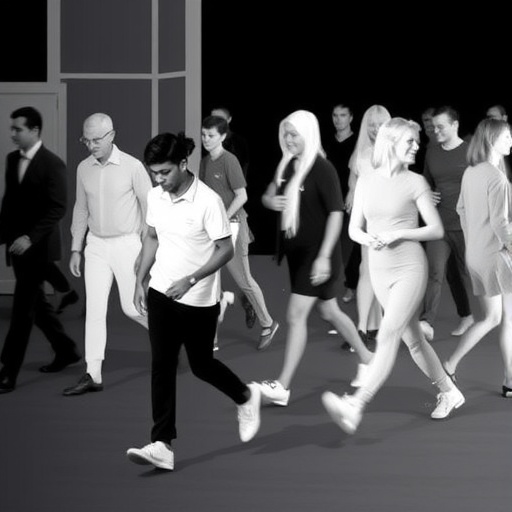
Recent research has revealed fascinating insights into the relationship between rhythmic movement, such as walking, and various cognitive factors. In a groundbreaking study by Parker, Dalla Bella, and Penhune, published in the Journal of Adult Development, the authors explore how the ability to walk to a beat is influenced by several variables including task complexity, age, individual differences in beat perception, and selective attention. This study is positioned at the intersection of psychology, neuroscience, and movement science, offering a rich tapestry of findings that may redefine our understanding of how rhythm interacts with human behavior.
The concept of walking in time with a beat is not merely an entertaining parlor trick; it is a complex interplay of neurological and cognitive functions. The researchers delved into the mechanisms behind this synchronization, analyzing how individuals process rhythmic cues while navigating their environments. As we engage in different tasks, our cognitive load becomes influenced by the complexity of those tasks. This complexity can either enhance or hinder our ability to maintain a rhythmic gait, which serves as a crucial insight for fields ranging from rehabilitation to athletic training.
Moreover, the research highlights age as a significant factor affecting beat perception and rhythmic coordination. Older adults exhibit a decline in both the sensitivity to and the ability to synchronize with musical beats. This finding opens up a dialogue about how age-related declines in cognitive functions can impact everyday activities like walking or dancing. It underscores the need for tailored interventions that could help older individuals maintain their mobility and rhythm-based physical activities, thus improving their quality of life.
An equally captivating aspect of this study is the examination of individual differences beyond age. Each person’s innate ability to perceive and react to rhythm can vary widely, influenced by factors such as musical training or neurological conditions. The authors employed various methodologies, measuring participants’ physical responses to rhythmic cues in controlled environments. Their findings suggest that those with heightened rhythmic awareness, often attributed to musical training, showed superior performance in walking tasks, even under increased cognitive load. This illuminates an important avenue for leveraging musical training as a means to enhance physical coordination across diverse populations.
Selective attention plays another crucial role in this dynamic. Differing levels of concentration can either obstruct or facilitate the synchronization process. In noisy environments or during complex multitasking, individuals may struggle more to keep their movements aligned with an external rhythm. This has significant implications for designing interventions for people with attention deficits or those engaged in multi-tasking scenarios. Recognizing the impact of environmental factors on rhythmic synchronization is a key takeaway that could guide future studies and practical applications.
While previous research has touched upon how rhythm can influence physical activity, Parker and colleagues effectively bridge the gap between cognitive science and physical movement in a multifaceted manner. Their research not only consolidates existing theories but also invites further exploration into how rhythmic activities can be harnessed to improve both cognitive functions and physical impairments. The realms of dance therapy, physical rehabilitation, and even educational practices could greatly benefit from integrating rhythm-based approaches.
In addition to practical applications, this study raises intriguing questions about the evolutionary implications of rhythm in human behavior. The ability to synchronize with a communal beat may have roots in social bonding and cultural expression, manifesting in communal dances or rhythmic music. As we dissect the individual capabilities of rhythm perception, one cannot help but ponder the deeper socio-cultural layers that inform our understanding of human movement and interaction.
Furthermore, the potential applications of these findings extend into the realm of technology and therapeutic interventions. For instance, virtual reality and gamified environments could be developed to aid individuals struggling with rhythm synchronization, combining elements of fun with cognitive therapy. By manipulating task complexity and environmental distractions, personalized experiences could be crafted to train individuals in improving their rhythmic abilities.
As we continue to uncover the impacts of rhythm on various facets of health and well-being, this research provides a foundational framework for future studies. In a rapidly aging global population, understanding how rhythm and movement are impacted by cognitive variables could contribute significantly to public health strategies. Furthermore, the integration of rhythmic training into physical therapy protocols represents an innovative step towards enhancing rehabilitative outcomes.
In conclusion, Parker and colleagues have illuminated a complex interplay between cognitive and physical performance that has far-reaching implications. Their research not only broadens our understanding of rhythm as a fundamental aspect of human behavior but also opens up avenues for practical applications designed to enhance both physical and cognitive health. As we delve deeper into this rich field of study, it is clear that rhythm does far more than simply keep time; it serves as a critical component of our interactions with ourselves, each other, and the world around us.
The insights from this research are also relevant beyond academic circles, hinting at the potential for community engagement through rhythmic activities. Encouraging community-based rhythm participation could foster social bonds while simultaneously improving individual cognitive and physical health. This may be especially useful in therapeutic contexts, where group activities can serve to enhance recovery and resilience in various populations.
Understanding the implications of such research can transform how we address physical activity in health care settings, dance schools, and even educational frameworks. By situating rhythm as a vital skill to be cultivated, we provide individuals with tools that can unlock their potential in numerous aspects of life. As science continues to decode the intricacies of our cognitive and physical experiences, studies such as these serve as a reminder of the richness of our inherited human capabilities.
Moreover, these findings also resonate within the broader context of developing smart cities and environments that facilitate movement. Integrating rhythmic cues into urban spaces may inspire more people to engage in active lifestyles. As we design public transportation systems, green spaces, and community centers, factoring in rhythm as an element that can enhance participation may lead to healthier, more connected communities.
Thus, while the study by Parker and colleagues begins by interrogating the basic mechanics of walking to a beat, it ultimately paves the way for a comprehensive understanding of rhythm’s role in human life. Through their meticulous research, we are reminded of the intricate relationships between our bodies, minds, and the rhythmic patterns that shape our daily activities and broader experiences.
Subject of Research: The relationship between rhythmic movement, cognitive factors, and walking synchronization.
Article Title: Walking to a Beat is Modulated by Task Complexity and Individual Differences in Age, Beat Perception, and Selective Attention.
Article References: Parker, A., Dalla Bella, S., Penhune, V.B. et al. Walking to a Beat is Modulated by Task Complexity and Individual Differences in Age, Beat Perception, and Selective Attention. J Adult Dev (2025). https://doi.org/10.1007/s10804-025-09545-7
Image Credits: AI Generated
DOI: https://doi.org/10.1007/s10804-025-09545-7
Keywords: rhythm, cognitive factors, walking, task complexity, age, beat perception, selective attention.


