

Wednesday, October 21, 2026
Science
No Result
View All Result
  • Login
  • HOME
  • SCIENCE NEWS
  • CONTACT US
  • HOME
  • SCIENCE NEWS
  • CONTACT US
No Result
View All Result
Scienmag
No Result
View All Result
Home Science News Medicine

Targeted spraying reduced indoor Aedes mosquitoes in Peruvian trial

October 21, 2026
in Medicine
Ophelia Keating
By Ophelia Keating Scienmag Editorial Profile - Health Services Research
Reading Time: 3 mins read
0
Targeted spraying reduced indoor Aedes mosquitoes in Peruvian trial

Targeted spraying reduced indoor Aedes mosquitoes in Peruvian trial

65
SHARES
587
VIEWS
Share on FacebookShare on Twitter
ADVERTISEMENT

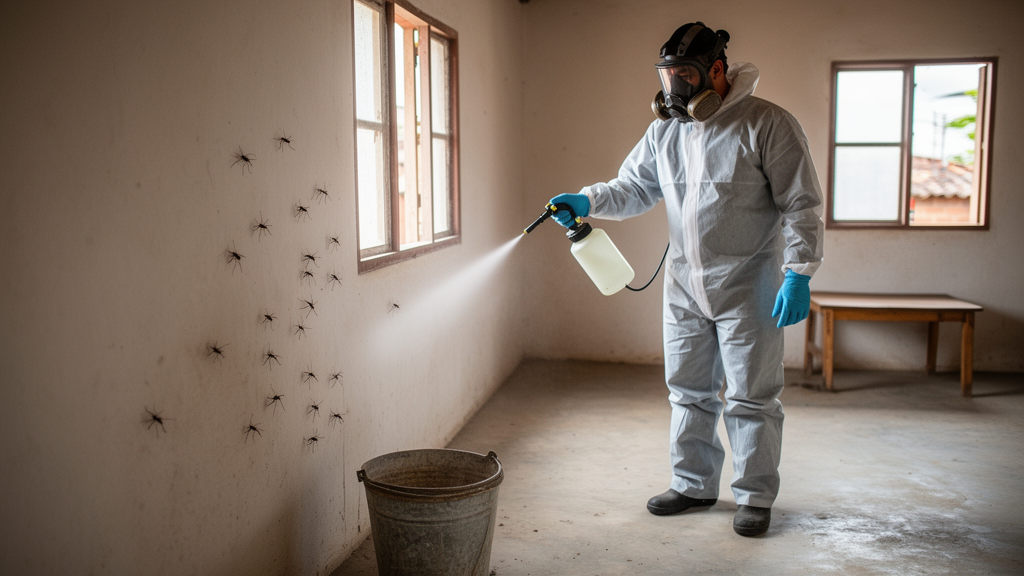
A cluster-randomized trial in Iquitos, Peru, found that targeted indoor residual spraying sharply reduced the density of Aedes aegypti, the primary vector of dengue and other Aedes-borne viruses. Fifteen days after treatment, sprayed houses had 96% fewer mosquitoes than comparison houses, while the estimated direct effect remained significant at 255 days, with a 40% reduction. The intervention also produced measurable indirect effects in untreated houses within the same intervention clusters, with efficacy estimated at 69% after 15 days and 7% after 255 days.

Researchers randomly assigned 30 urban clusters to either targeted indoor residual spraying, or TIRS, or to standard vector-control activities conducted by Peru’s Ministry of Health. TIRS used pirimiphos-methyl and focused on locations where A. aegypti were known to rest inside homes. The intervention covered 15 clusters containing 898 structures, and the comparison group included 15 clusters with 1,018 structures. By examining both sprayed houses and untreated houses in intervention clusters, the investigators could estimate direct effects in treated structures and indirect community-wide effects associated with the intervention.

The team assessed indoor mosquito density using Prokopack aspiration during the 45 days before spraying and at four subsequent time points extending to 255 days after the intervention. Generalized linear mixed models with a negative-binomial link estimated incidence rate ratios, and efficacy was calculated as one minus the incidence rate ratio. These measurements concern mosquito abundance, not human infections. The trial therefore provides entomological evidence about the effectiveness of TIRS but does not establish whether the intervention reduced dengue incidence, other viral infections or disease severity.

The largest direct effect appeared 15 days after spraying, when A. aegypti captures in treated houses were 96% lower than in the comparison group. The estimated reduction then weakened but remained significant at 255 days, when direct efficacy was 40%. In untreated houses located within TIRS clusters, estimated indirect efficacy reached 69% at 15 days. Although this estimate declined substantially over time, it remained statistically significant after eight months, reaching 7% at 255 days. Thus, the results indicate that TIRS was associated with reductions both in sprayed structures and in nearby untreated homes, with a much stronger and more persistent direct effect than indirect effect.

Household-level TIRS coverage was only 57%, yet statistically significant direct and indirect impacts were observed during the early post-intervention surveys, and indirect effects were still evident after eight months. The findings show that partial household coverage can coincide with meaningful reductions in indoor mosquito density. The trial’s scope also constrains interpretation: it was conducted in an urban setting in Iquitos, used one insecticide-based intervention and measured entomological outcomes rather than clinical disease. Within those limits, the results support the entomological value of TIRS in dengue-endemic urban settings and in tropical or subtropical military locations where the method is deployed, without demonstrating a corresponding reduction in human viral transmission.

Subject of Research: Entomological efficacy of targeted indoor residual spraying against Aedes aegypti in Iquitos, Peru

Article Title: Direct and indirect entomological efficacy of Targeted Indoor Residual Spraying against Aedes aegypti in Iquitos, Peru

Article References: Astete, H., Vasquez, G. M., López-Sifuentes, V. M., Zambrano, B., Reyna, B., Moore, R. C., Morrison, A. C., Vazquez-Prokopec, G. M., & Larson, R. T. (2026). Direct and indirect entomological efficacy of Targeted Indoor Residual Spraying against Aedes aegypti in Iquitos, Peru. PLOS Neglected Tropical Diseases, 20(10), e0014390. https://doi.org/10.1371/journal.pntd.0014390

Image Credits: AI Generated

DOI: 10.1371/journal.pntd.0014390

Keywords: Aedes aegypti, dengue, mosquito control, indoor residual spraying, pirimiphos-methyl, cluster-randomized trial, Peru, vector control, entomological efficacy, Direct, indirect, entomological

Cite Scienmag News

Ophelia Keating. (October 21, 2026). Targeted spraying reduced indoor Aedes mosquitoes in Peruvian trial. Scienmag. https://scienmag.com/targeted-spraying-reduced-indoor-aedes-mosquitoes-in-peruvian-trial/

Ophelia Keating. "Targeted spraying reduced indoor Aedes mosquitoes in Peruvian trial." Scienmag, 21 October 2026, https://scienmag.com/targeted-spraying-reduced-indoor-aedes-mosquitoes-in-peruvian-trial/. Accessed 21 October 2026.

Ophelia Keating. "Targeted spraying reduced indoor Aedes mosquitoes in Peruvian trial." Scienmag. October 21, 2026. https://scienmag.com/targeted-spraying-reduced-indoor-aedes-mosquitoes-in-peruvian-trial/


Tags: Aedes aegyptiAedes aegypti mosquito controlcluster randomized trialcommunity-wide mosquito reductiondenguedengue prevention strategiesdirectentomologicalentomological efficacyindirectindoor mosquito density measurementindoor residual sprayinglong-term efficacy of mosquito controlmosquito controlPerupirimiphos-methylpublic health impact of vector controlresidual effects of insecticide sprayingtargeted spraying in Latin Americatargeted vector control interventionurban mosquito control trialsvector controlvector-borne disease prevention
Share26Tweet16
Previous Post

Laboratory soil bacterium degrades phenanthrene and produces stable biosurfactant

Next Post

UK Biobank study finds modest link between adiposity increase and cardiovascular risk

Related Posts

UK Biobank study finds modest link between adiposity increase and cardiovascular risk
Medicine

UK Biobank study finds modest link between adiposity increase and cardiovascular risk

October 21, 2026
Blood Tests Fail to Flag Drug-Resistant Mycoplasma in Children
Medicine

Blood Tests Fail to Flag Drug-Resistant Mycoplasma in Children

October 21, 2026
Exercise fails to restore mitochondrial function in high-phosphate-fed male mice
Medicine

Exercise fails to restore mitochondrial function in high-phosphate-fed male mice

October 21, 2026
Three African natural products disrupt SARS-CoV-2 entry and replication in vitro
Medicine

Three African natural products disrupt SARS-CoV-2 entry and replication in vitro

October 21, 2026
Global meta-analysis links violence with HIV outcomes in female sex workers
Medicine

Global meta-analysis links violence with HIV outcomes in female sex workers

October 21, 2026
COVID-19 intensive care patients had more contaminated and polymicrobial blood cultures
Medicine

COVID-19 intensive care patients had more contaminated and polymicrobial blood cultures

October 21, 2026
Next Post
UK Biobank study finds modest link between adiposity increase and cardiovascular risk

UK Biobank study finds modest link between adiposity increase and cardiovascular risk

  • Mothers who receive childcare support from maternal grandparents show more optimized

    Mothers who receive childcare support from maternal grandparents show more parental warmth, finds NTU Singapore study

    27656 shares
    Share 11059 Tweet 6912
  • University of Seville Breaks 120-Year-Old Mystery, Revises a Key Einstein Concept

    1061 shares
    Share 424 Tweet 265
  • Bee body mass, pathogens and local climate influence heat tolerance

    682 shares
    Share 273 Tweet 171
  • Researchers record first-ever images and data of a shark experiencing a boat strike

    546 shares
    Share 218 Tweet 137
  • Groundbreaking Clinical Trial Reveals Lubiprostone Enhances Kidney Function

    531 shares
    Share 212 Tweet 133
Science

Embark on a thrilling journey of discovery with Scienmag.com—your ultimate source for cutting-edge breakthroughs. Immerse yourself in a world where curiosity knows no limits and tomorrow’s possibilities become today’s reality!

RECENT NEWS

  • Targeted spraying reduced indoor Aedes mosquitoes in Peruvian trial
  • Laboratory soil bacterium degrades phenanthrene and produces stable biosurfactant
  • Blood Tests Fail to Flag Drug-Resistant Mycoplasma in Children
  • Blood glucose linked to aggressive features in papillary thyroid cancer

Categories

  • Agriculture
  • Anthropology
  • Archaeology
  • Athmospheric
  • Biology
  • Biotechnology
  • Blog
  • Bussines
  • Cancer
  • Chemistry
  • Climate
  • Earth Science
  • Editorial Policy
  • Marine
  • Mathematics
  • Medicine
  • Pediatry
  • Policy
  • Psychology & Psychiatry
  • Science Education
  • Science News
  • Social Science
  • Space
  • Technology and Engineering

Subscribe to Blog via Email

Enter your email address to subscribe to this blog and receive notifications of new posts by email.

Join 5,151 other subscribers

© 2025 Scienmag - Science Magazine

Welcome Back!

Login to your account below

Forgotten Password?

Retrieve your password

Please enter your username or email address to reset your password.

Log In
No Result
View All Result
  • HOME
  • SCIENCE NEWS
  • CONTACT US

© 2025 Scienmag - Science Magazine

Discover more from Science

Subscribe now to keep reading and get access to the full archive.

Continue reading