


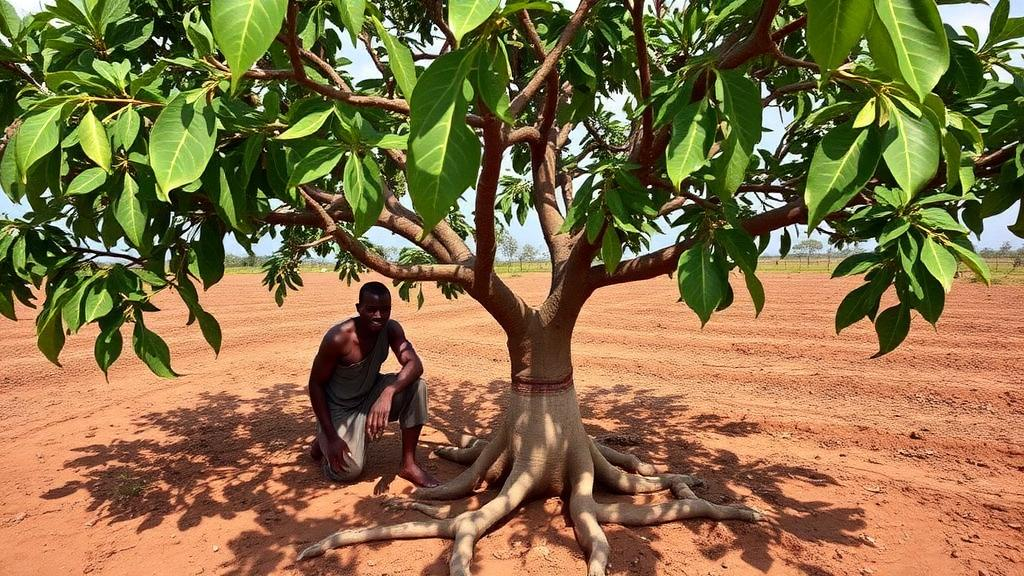
The baobab is one of the most recognisable trees on Earth, a swollen, centuries-old giant that dominates the savannas of sub-Saharan Africa. In central Tanzania, it is more than a landmark: it is a source of food, medicine, shade and cultural identity. Yet a new study from the Dodoma region suggests that the very communities who depend on Adansonia digitata are watching its numbers slip away, and that the barriers to protecting it are as much economic and practical as they are ecological. The research, published in Discover Conservation, surveyed more than 500 households across three districts and offers one of the most detailed pictures yet of how rural Tanzanians perceive, use and safeguard this keystone dryland species.
A team of researchers from the University of Dodoma, led by Rosemary Peter Mramba, conducted a cross-sectional household survey between March and May 2025 in the Mpwapwa, Bahi and Chemba districts. Using a multi-stage random sampling design, they interviewed 515 households, distributed roughly equally across the districts, drawing respondents from village registers with a random number generator. The questionnaires, translated into Swahili and pre-tested in non-sampled villages, captured socio-demographic details, the number of baobab trees on each household’s land, awareness of the tree’s ecosystem services, conservation practices and perceived threats. The team then applied chi-square tests, negative binomial regression and binary logistic regression to untangle which factors shaped awareness and abundance.
The results reveal a population that knows its baobabs intimately. Roughly 94 percent of respondents reported baobab trees on their land, with counts ranging from a single tree to as many as 60. Awareness of the tree’s land-related benefits was strikingly high: 85.2 percent of respondents recognised its role in reducing soil erosion, 81.2 percent valued its contribution to soil fertility, and 70.5 percent cited its function as a windbreak. The researchers attribute this pattern to the primacy of farming in the region. In semi-arid landscapes where erosion and declining fertility directly threaten harvests, the services a tree delivers to the soil are the ones farmers notice first, and those benefits are well supported by science, with studies showing higher moisture and improved fertility beneath baobab canopies.
Not everyone saw the tree the same way, however. District of residence emerged as the main determinant of awareness across most services. Respondents in Chemba were 55 percent less likely, and those in Mpwapwa 32 percent less likely, to identify baobab’s role in carbon sequestration compared with residents of Bahi. Chemba respondents were also 76 percent less likely to recognise the tree’s erosion-control function. Education and age produced more surprising patterns: people with informal, non-school education were more than twice as likely as college-educated respondents to recognise baobab’s pollination services, an odds ratio of 2.34, plausibly because they spend more time in direct contact with crops and the ecological interactions around them. Younger respondents were consistently more aware of pollination and water retention benefits, with each additional year of age slightly reducing the odds of recognition.
Perhaps the study’s most consequential finding concerns what determines how many baobabs a household actually maintains. Household land size was the strongest driver of tree abundance, with the apparent effects of age and district largely explained by their correlation with land ownership. Older household heads tend to hold larger, often inherited plots, and larger plots support more trees. Chemba, with the biggest landholdings, had the most baobabs; Bahi, with the smallest, had the fewest. Farmers explained the logic plainly: baobab canopies shade out crops beneath them, so on small farms where food production takes priority, the tree loses out regardless of how much people value it. Conservation strategies, the authors argue, must therefore grapple with land tenure, encouraging planting on field boundaries, community woodlots on public land, or incentives for smallholders to retain trees.
When it came to threats, respondents pointed overwhelmingly at two culprits. Climate change was named the primary danger by 53 percent of participants, while 36.3 percent singled out the clearance of land for agriculture. Smaller shares flagged over-harvesting of bark for ropes, mats and medicine, and firewood collection. The geography of concern varied: in Bahi, 62.9 percent saw climate change as the chief threat, whereas in Chemba, 45.8 percent identified agricultural expansion as the leading problem, and Chemba residents were also the most worried about bark exploitation. The findings echo continent-wide research showing that even long-lived giants are vulnerable to shifting rainfall, drought cycles and rising temperatures, and that habitat fragmentation and livestock grazing of seedlings undermine regeneration across sub-Saharan drylands.
What protects the baobab today is largely not formal conservation but belief. Traditional taboos, cited by 63.6 percent of respondents as the main protective force, prohibit cutting the trees because they are regarded as traditional symbols, an informal safeguard that is especially strong in Bahi. Most respondents said baobabs simply grow on their own without human intervention, and 64.3 percent believed local populations are declining. Yet when offered seedlings, 61.2 percent said they would be willing to plant them. The reluctance of the remaining 38.8 percent is telling: 53.7 percent said baobabs take too long to mature, 28.9 percent said they require too much land, and others worried about shading crops or the low market value of the fruit pulp.
That reluctance points to one of the study’s most promising recommendations: grafting. Under natural regeneration, a baobab may take around 20 years to produce its first fruit, a timescale that spans an entire farming generation and explains why few households invest in planting. Grafting techniques developed in East and West Africa can compress that timeline to roughly three years, transforming the economics of baobab restoration. Faster fruiting means quicker returns, and quicker returns mean that planting a tree stops being a gift to grandchildren and becomes a livelihood decision with near-term payoffs. Combined with extension advice on tree spacing, pruning and shade-tolerant crop varieties, the authors argue, grafting could convert passive tolerance into active stewardship.
The study is candid about its limits. Self-reported survey data are vulnerable to recall and social desirability bias, the cross-sectional design captures only a single moment in time, and the absence of direct ecological measurements, such as tree age, health and regeneration rates, means that perceived population trends could not be objectively verified. Results from three Dodoma districts may not generalise to other baobab habitats. The authors call for longitudinal studies paired with field-based ecological assessments to test whether community perceptions match biological reality, and to track how climate pressures reshape regeneration over decades rather than seasons.
Even with those caveats, the message is clear and timely. Dodoma’s semi-arid climate has already seen rainfall decline by up to 20 percent in recent decades, with more frequent droughts squeezing both farms and the trees that shelter them. The researchers conclude that conservation strategies should weave local knowledge and cultural practice into formal policy: formalising taboos that discourage cutting and debarking, integrating baobab ecology into environmental education, using both household and communal land, and supplying grafted seedlings to eager planters. The tree of life has survived millennia of drought through sheer botanical stubbornness. Whether it survives the next century may depend less on the tree itself than on whether the people who revere it are given practical reasons, and practical means, to put it back in the ground.
Subject of Research: Community awareness, conservation practices and perceived threats affecting baobab tree populations in semi-arid Dodoma, Tanzania
Article Title: Community awareness of baobab (Adansonia digitata) ecosystem services, conservation practices, and perceived threats in Dodoma, Tanzania
Article References: Mramba, R. P., Athumani, P. C., Mbise, F. P., Ngongolo, K., & Mmbaga, N. E. (2026). Community awareness of baobab (Adansonia digitata) ecosystem services, conservation practices, and perceived threats in Dodoma, Tanzania. Discover Conservation, 3(1), Article 8. https://doi.org/10.1007/s44353-026-00079-x
Image Credits: AI Generated
DOI: 10.1007/s44353-026-00079-x
Keywords: baobab, Adansonia digitata, ecosystem services, Dodoma, Tanzania, conservation, climate change, agroforestry, traditional beliefs, grafting, soil fertility, semi-arid drylands
Cite Scienmag News
Sloane Callahan. (October 1, 2026). Tanzania’s Tree of Life: Farmers Know Its Value but Hesitate to Plant It. Scienmag. https://scienmag.com/tanzanias-tree-of-life-farmers-know-its-value-but-hesitate-to-plant-it/
Sloane Callahan. "Tanzania’s Tree of Life: Farmers Know Its Value but Hesitate to Plant It." Scienmag, 1 October 2026, https://scienmag.com/tanzanias-tree-of-life-farmers-know-its-value-but-hesitate-to-plant-it/. Accessed 5 October 2026.
Sloane Callahan. "Tanzania’s Tree of Life: Farmers Know Its Value but Hesitate to Plant It." Scienmag. October 1, 2026. https://scienmag.com/tanzanias-tree-of-life-farmers-know-its-value-but-hesitate-to-plant-it/


