

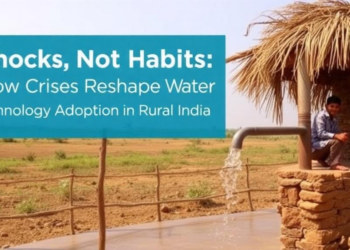
Shocks, Not Habits: How Crises Reshape Water Technology Adoption in Rural India
A study of 54 rural Indian communities shows that external shocks such as policy shifts and natural hazards significantly alter ...
A study of 54 rural Indian communities shows that external shocks such as policy shifts and natural hazards significantly alter ...

Researchers have compiled and field-validated the most complete harmonized dataset of dams and reservoirs in West Africa, revealing systematic gaps ...
A global analysis of 1.7 million runoff events across 4,838 catchments finds that the transformation of rain and snowmelt into ...
A new PLOS Water opinion piece argues that adolescents, the largest youth generation in history, are the missing middle of ...
Researchers have mapped a scalable framework for storing surplus river water in Berlin's deep confined aquifers, finding that over sixty ...
A 75-year analysis of India's Chandra Basin reveals significant warming and a precipitation phase shift from snow to rain, threatening ...
Researchers coupled an improved artificial bee colony algorithm with EPANET simulations to simultaneously identify the location, timing, and concentration of ...
A new meta-analysis of 29 studies finds that precipitation significantly drives runoff in northern Pakistan's glacier-fed mountains, while temperature effects ...
A 123-year analysis of rainfall, rivers, groundwater and community experience shows that Cherrapunji, one of the wettest places on Earth, ...
A district-level analysis of 471 Indian districts using satellite-derived MNDWI and NDVI indices shows that temperature anomalies significantly reduce both ...

Embark on a thrilling journey of discovery with Scienmag.com—your ultimate source for cutting-edge breakthroughs. Immerse yourself in a world where curiosity knows no limits and tomorrow’s possibilities become today’s reality!