

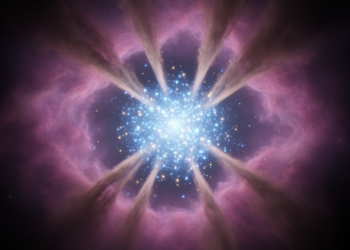
Cosmic Escape Hatch: Young Starbursts Leak Ionizing Light Before Winds Slam It Shut
New Hubble observations of six nearby compact starbursts reveal that ionizing photons escape most readily within the first three million ...
New Hubble observations of six nearby compact starbursts reveal that ionizing photons escape most readily within the first three million ...

A new study of nonminimally coupled quintessence shows that observational data favor parameter regions in which the universe avoids a ...
An international physics team has for the first time recreated high-energy cosmic ray collisions with atmospheric oxygen inside CERN's Large ...
New simulations from the University of Copenhagen show that neutrino flavor conversion can determine whether massive stars explode as supernovae ...
New JWST observations reveal that galaxies were already producing and expelling heavy elements such as carbon and oxygen into intergalactic ...
The MEGATRON collaboration's new simulations of the first stars and galaxies provide a physical bridge between James Webb Space Telescope ...
A Hubble survey of 29 massive stars in extremely metal-poor dwarf galaxies reveals unexpectedly weak stellar winds that could explain ...
Three-dimensional radiation-hydrodynamics simulations with the CO5BOLD and Athena++ codes are revealing how giant convective cells, shock waves and pulsations drive ...
A combined FAST and Very Large Array survey of Andromeda has catalogued 118 hydrogen superbubbles whose supernova-driven energy injection matches ...
A new review charts the computational techniques that decode the spectra of supernovae and kilonovae, the cosmic explosions that forge ...

Embark on a thrilling journey of discovery with Scienmag.com—your ultimate source for cutting-edge breakthroughs. Immerse yourself in a world where curiosity knows no limits and tomorrow’s possibilities become today’s reality!