

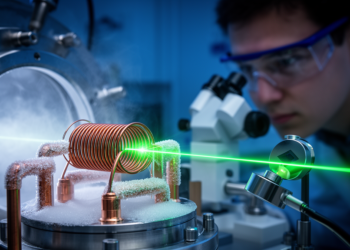
Picosecond Pulses Push Superconductors to Their True Current Limit
By driving superconductors with two-picosecond electrical pulses faster than vortices can move, researchers have directly measured the intrinsic depairing current ...
By driving superconductors with two-picosecond electrical pulses faster than vortices can move, researchers have directly measured the intrinsic depairing current ...

Researchers at Okayama University used uniaxial strain to separate two competing superconducting states in the kagome metal CsV3Sb5, enhancing superconductivity ...
Physicists at the University of Illinois Urbana-Champaign report the first direct evidence that Cooper pairs in uranium ditelluride organize into ...
Two back-to-back Science papers map nearly 9,000 two-dimensional materials and identify more than 1,600 candidates for building new quantum simulators ...
Physicists have recreated the elusive anomalous metal — a 'failed superconductor' that resists current despite behaving like a superconductor — ...
Spectroscopic measurements on superconducting bilayer nickelate thin films show that coherent dz2-pz-dz2 interlayer hybridization, together with suppressed spin order, is ...
Researchers from leading institutions, including the University of British Columbia (UBC), the University of Washington, and Johns Hopkins University, have ...

Embark on a thrilling journey of discovery with Scienmag.com—your ultimate source for cutting-edge breakthroughs. Immerse yourself in a world where curiosity knows no limits and tomorrow’s possibilities become today’s reality!