

One Dial at a Time: New Method Pinpoints What Spoils Ionospheric Maps Over China
A single-parameter directional perturbation study of more than 250 GNSS stations across China has quantified how observation noise, elevation mask ...
A single-parameter directional perturbation study of more than 250 GNSS stations across China has quantified how observation noise, elevation mask ...
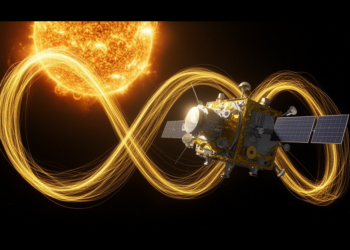
ESA's Solar Orbiter has flown through a giant S-shaped magnetic switchback in the solar wind and used the chemical fingerprints ...

A neural network trained on ten years of all-sky images from Svalbard shows that clouds, not solar activity, govern when ...
A statistical analysis of eight years of GOES soft X-ray data finds a single power-law exponent of about three linking ...
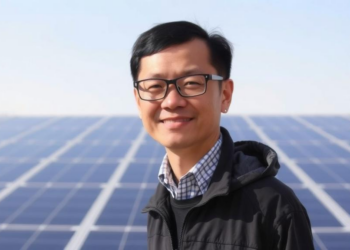
Auburn University assistant professor Chen Shi has received a 2026 Kamide Lecture Award from the Asia Oceania Geosciences Society for ...

An international research team has shown that a famous 1841 account of space weather delaying a train in Exeter, England, ...

Kyushu University researchers used high-power lasers to recreate magnetic reconnection in the laboratory and found that its energy-release rate is ...
A new two-stage theoretical model proposes that solar flares begin with a slow global magnetic instability that triggers a multi-scale ...
George Mason University's Edward Oughton will lead a $499,837 NSF-funded collaboration to build an AI-enabled, uncertainty-aware framework linking space weather ...
A Huazhong Agricultural University team has developed IncResUnet, a deep learning model that detects ionospheric plasma bubbles far more reliably ...


Embark on a thrilling journey of discovery with Scienmag.com—your ultimate source for cutting-edge breakthroughs. Immerse yourself in a world where curiosity knows no limits and tomorrow’s possibilities become today’s reality!