

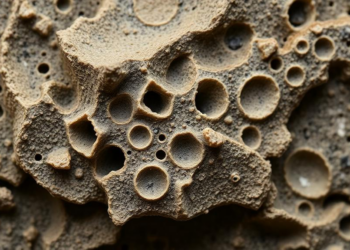
Tiny Ocean Fossils in Argentina Reveal How Life and Climate Rebounded After the Dinosaur-Killing Asteroid
A continuous Argentine sediment record shows that after the K–Pg extinction, opportunistic foraminifera dominated the ocean before a 1.5 °C ...
A continuous Argentine sediment record shows that after the K–Pg extinction, opportunistic foraminifera dominated the ocean before a 1.5 °C ...

A new study links Kerala's rising pre-monsoon rainfall to North Indian Ocean warming and shows that the state's March-to-May rains ...
A new deep-learning dataset called PhyEddy-Net fuses satellite altimetry, vorticity, and sea surface temperature data to detect 36.7 million ocean ...
A systematic evaluation of Med-CORDEX regional climate models shows they reliably improve Mediterranean sea surface temperature patterns and marine heatwave ...
A new quasi-global ensemble ocean reanalysis, LORA-QG, matches established global products in accuracy while uniquely providing uncertainty estimates and full ...
New ocean model experiments show that declining chlorophyll a in the equatorial Atlantic warms the eastern basin, weakens upwelling, and ...
A study of more than 900 French rain gauges shows that flexible three-parameter distributions with evolving shape parameters are essential ...
New alkenone and foraminifera records reveal that late Holocene cooling in the mid-latitude North Atlantic was zonally asymmetric and driven ...
A new stochastic modelling study shows that replacing Gaussian noise with jump-rich, conditionally switched non-Gaussian noise better captures the westerly ...
Satellite observations and reanalysis data reveal that meridional wind shifts coherently modulate temperature, salinity, sea level, and interocean water exchange ...

Embark on a thrilling journey of discovery with Scienmag.com—your ultimate source for cutting-edge breakthroughs. Immerse yourself in a world where curiosity knows no limits and tomorrow’s possibilities become today’s reality!